By Marc Bunn | C.A.S.
A note regarding timing of updates: Due to the sheer size of the EADD II project and the requisite hours needed to gather, aggregate, analyze and draft reports, there is a lengthy delay between activities and reporting. The following is a summary report on progress achieved in 2017. More stories and statistics will be detailed in subsequent updates.
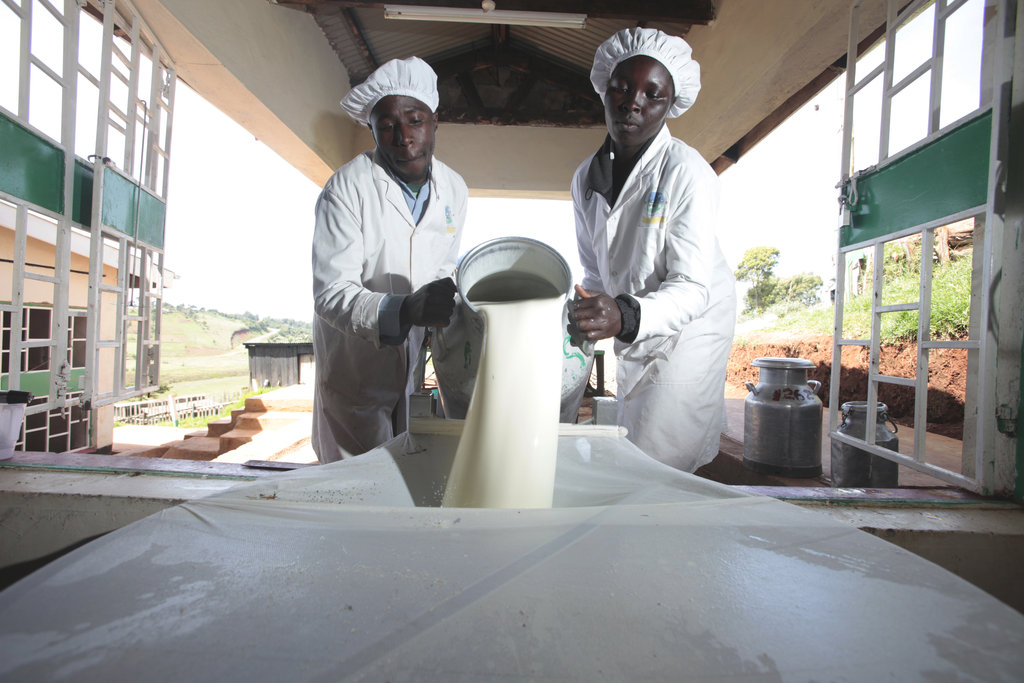
2017 was a definitive year for the project. The team evolved from focusing exclusively on the hub approach as the nucleus of the project, to venturing into the dairy market, particularly in Tanzania and Uganda. This was a natural transition in response to weak linkages between the producer organizations and the dairy market. It involved looking at the existing dairy markets in the countries and identifying areas where the project could leverage expertise to benefit farmers, both through the dairy hubs and milk processors. East Africa Dairy Development II works with three processors in Tanzania at different capacities, to help create markets and demand for the milk produced by the dairy farmers.
No longer active in Kenya, the project is in the final phases of exiting Uganda by October 2018, and exiting Tanzania by October 2019. Significant work strengthens the established foundations and ensures sustainability of farmer representation in the dairy value chain. We achieve this by creating new farmer apex bodies where needed, and by strengthening those already in operation. The project will continue to support existing bodies in Kenya and Uganda - Kenya Dairy Farmers Federation and the Uganda Crane Creameries Cooperative Union; while in Tanzania, registration of a dairy cooperative union is ongoing.
Targets indicate a positive trend. Both Tanzania and Uganda report an increase in farmer numbers when compared to previous years. Active farmers who supply and access services increased from 74,823 in 2016 to 107,736 in 2017 - with 60,081 in Kenya, 28,223 in Uganda, and 18,432 in Tanzania. At the close of the project, Kenya had surpassed its target of 58,000 farmers to reaching over 60,000 farmers. Farmers also received a boost in dairy household income with farmers in Uganda getting an increase of 29 percent and those in Tanzania getting an increase of 44 percent compared to 2016 figures.
It was also a good year for the producer organizations in Uganda and Tanzania, which recorded a rise in revenue. Uganda for instance increased its revenue from $3.98 million in 2016 to $6.9 million in 2017, while Tanzania increased from $500,000 to $900,000. However, revenue in Kenya decreased from $10.4 million to $7.6 million, due to prolonged, severe drought during the first half of the year.
The project continued leveraging the social capital development approach in farmer outreach and capacity building and in the transfer of skills for farmers through dairy interest groups. Our social capital development fuels remarkable transformations among dairy farmers and includes an increased adoption rate for productivity enhancing technologies, strengthened social cohesion and peer-to-peer learning. In addition, stakeholders such as government-led projects and micro finance institutions show increasing interest in using existing social capital development structures to expedite desired results. Stakeholders also increased technical and financial support for hubs and dairy interest groups, indicating project transformation and growth. Likewise, farmers were able to mobilize capital through savings and credit schemes with greater capacity than previous years, and reported a savings portfolio of $512,000. The savings and credit schemes act as community safety nets through which financial resources are availed to men and women in dairy interest groups.
Phase II continues to promulgate gender equity for women involved in the dairy value chain. A 2017 assessment on Women Empowerment in Agriculture, executed in Tanzania, indicates a significant increase in the rate of women who engage in decision making at the household level. The report shows that women are now more involved in decisions on feeding, disease prevention and treatment, breeding and household milk sales. By deliberately involving men as gender change agents, men further promote gender inclusivity in the sector. Kenya saw a notable increase in the gender index as it rose from 22.9 to 46.4.
A key success of the project is the birth of new projects anchored on the East Africa Dairy Development approach. For example, Heifer International received funding from the Swedish Embassy in Kenya to implement the Kenya Market Led Dairy Supply Chain Project. The four year, $2.7 million project developed a partnership with New Kenya Cooperative Creameries and Tetra Laval/Tetra pack, with the two private companies contributing $2.8 million. The project builds on East Africa Dairy Development experiences such as working with dairy cooperatives and linking them to sustainable markets.
In 2017, we learned key lessons to consider in preparing project phase out at the end of 2018 for Uganda, and 2019 for Tanzania. This includes building more public-private partnerships to leverage resources, competencies and the delivery of sustainable interventions, and to strengthen farmer organizations. This effectively promotes healthy competition in the sector and stable milk prices to improve farmer incomes and community transformation.
By Heifer Staff | Writer/Editor
By Heifer Staff Writers | n/a
Project reports on GlobalGiving are posted directly to globalgiving.org by Project Leaders as they are completed, generally every 3-4 months. To protect the integrity of these documents, GlobalGiving does not alter them; therefore you may find some language or formatting issues.
If you donate to this project or have donated to this project, you can receive an email when this project posts a report. You can also subscribe for reports without donating.