By Aidah Nanyonjo | EADD Staff
UGANDA: How improved breeds have transformed my dairy farming: The story of Katwere, the Artificial Insemination ambassador
What started off as a journey with one cross breed, 15 years ago, has transformed Jowali Katwere into one of the successful dairy farmers in the Mukono Cluster.
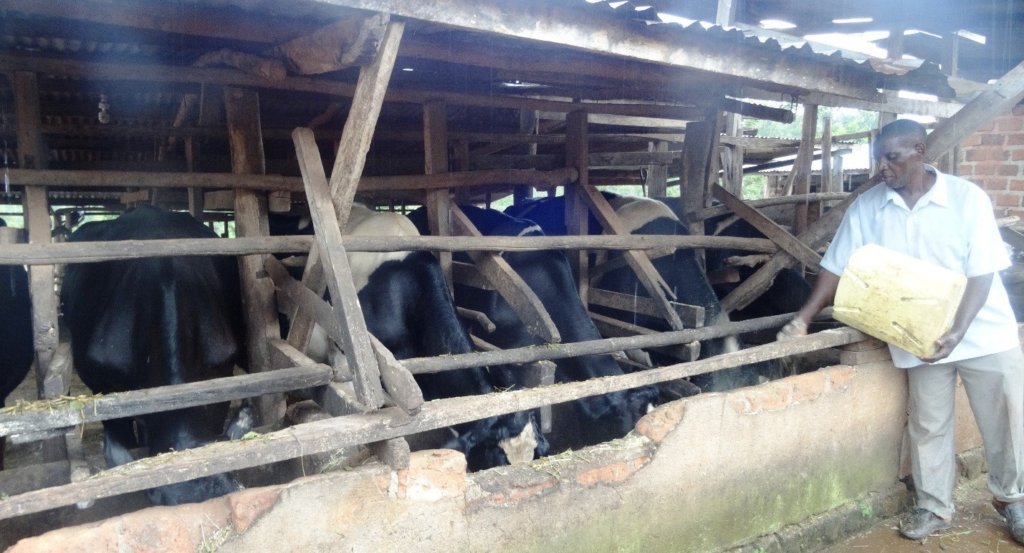
Today, 48-year-old Katwere, a resident of Kawulu village in Buikwe Town Council, boasts of over 20 heads of improved dairy cattle. He attributes his success to Artificial Insemination (AI).
Before adopting AI, Katwere used to hire a bull from a farmer four kilometres away from his (Katwere’s) home. Sometimes, by the time the bull reached Katwere’s home, the cow would already be off heat. That would mean waiting for another month for it to get back on heat.
When the Heifer International-supported East Africa Dairy Development (EADD) project started operating in the area, Katwere was one of the first dairy farmers to benefit from its trainings and exchange visits. Katwere says, “Though, life was not so bad, I have learnt a lot from EADD through Buikwe Dairy Cooperative Limited. I participated in several trainings and exchange visits in and out of Uganda on better dairy farming methods. The knowledge and skills have enabled me to improve tremendously by adopting best practices such as artificial insemination.” Using AI has contributed to high quality breeds. The new improved breeds coupled with good feeding have increased milk production at Katwere’s farm: “Before EADD, a cow would give me about eight litres a day. With the use of artificial insemination, the new breeds produce about 18 litres a day. I milk 85 litres (50 in the morning and 35 in the evening) a day from the six cows.
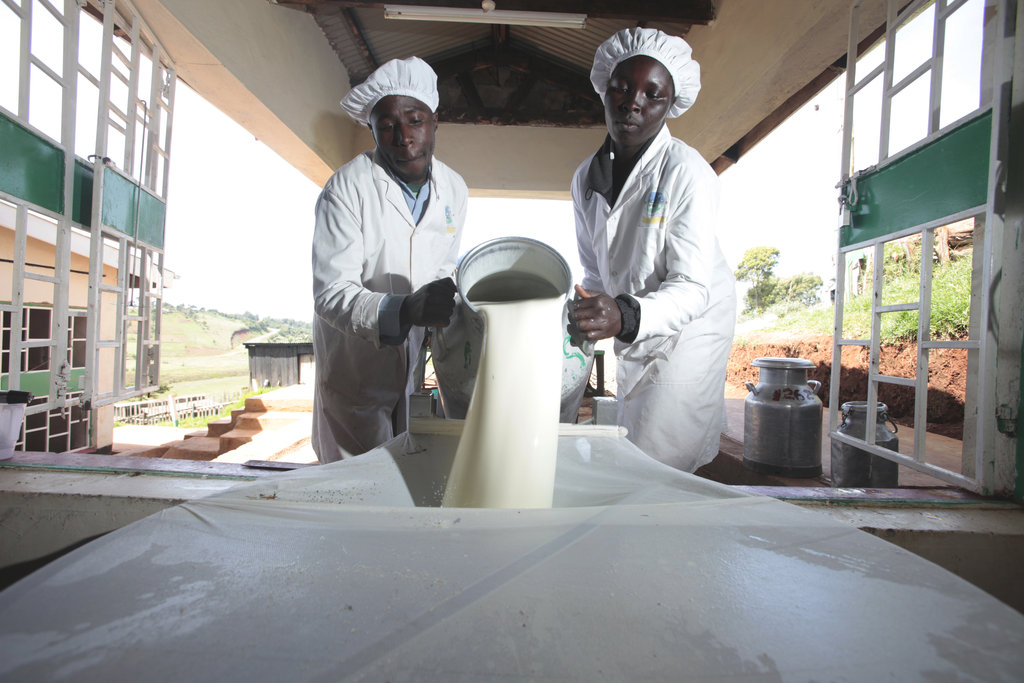
Katwere sells his milk to Buikwe Dairy Farmers’ Cooperative Limited, which is about two kilometres away from his farm. Fortunately for Katwere, the Cooperative collects and transports milk from the farmers. So, he does not incur transport costs. A litre goes for 700 Uganda shillings.
“We no longer get stuck with our milk because of lack of market. The Cooperative buys it from us and supplies it to boarding schools and milk processing companies in Kampala,” Katwere explains.
He adds, “Keeping improved dairy cattle is more profitable. I sell a calf at 1.5 million Uganda shillings yet a mature local breed costs 900,000 Uganda shillings.”
Katwere hopes to continue using artificial insemination to ensure that a single cow gives him at least 25 litres a day. He also wants to import a milking machine from Nairobi to reduce on labour challenges.
Katwere looks at dairy farming as a family business, where everyone at home is involved: “We are all accountable to the welfare of the cattle. With this, I am sure that even when I am away, the cattle will be taken care of.”
All Katwere’s children have completed school. He stays with his wife, grandson and a farm help. The family also drinks part of the milk produced by their cows which has improved their health.
From the dairy earnings, Katwere has bought several pieces of land where he plants pasture for the cattle. He planted Central summer, Lablab and Ruccina. He also feeds his cattle on silage and Hay. Ever since he started feeding the cattle on dry pastures, they rarely fall sick.
Katwere has become an ambassador for rearing improved breeds through embracing AI. Through advising his village mates, all his neighbours have changed to keeping improved dairy cattle.
By Chelsey Louzeiro | Resource Development Operations Coordinator
By Marc Bunn | C.A.S.
Project reports on GlobalGiving are posted directly to globalgiving.org by Project Leaders as they are completed, generally every 3-4 months. To protect the integrity of these documents, GlobalGiving does not alter them; therefore you may find some language or formatting issues.
If you donate to this project or have donated to this project, you can receive an email when this project posts a report. You can also subscribe for reports without donating.