By Heifer Staff | Writer/Editor
EADD - Lessons Learned
Strong leadership and good governance are essential for Hub proftability and sustainability
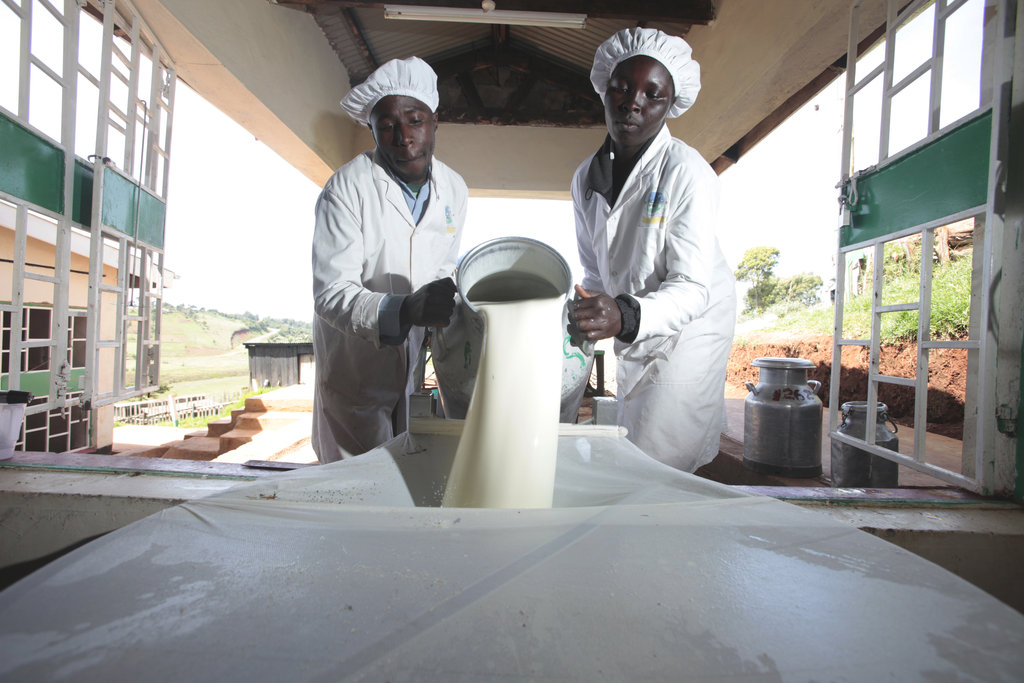
Strong leadership and good governance are vital for continued Hub proftability, expansion and vision. EADD supports Hub management through training in fnancial management, business planning, business organization, good governance and reporting. The management training is provided at all levels: from dairy farmers to board members, making it an area of ongoing responsibility. Capacity building has increased monthly milk intake in Tarakwo Dairy. Previously the Dairy collected 250 liters of milk per day today, there has been a quantum leap and this fgure stands at 10,000 liters per day during the dry season, and goes as high as 20,000 liters during the wet season
Competitive and stable milk prices promote farmer loyalty
POs have managed to give farmers attractive and prompt payments, and farmers in turn sell only to the POs. The contract pay basis by the processors as per the PO milk volumes has facilitated prompt payment like in Sirikwa Dairy. The stable and competitive milk prices have helped to build trust and loyalty between the farmers and POs thus encouraging the farmer to invest more in dairy as a business. A high volume supply of quality milk is very valuable to larger scale dairy processors. Successful Hubs like Tarakwo, Sirikwa, Lessos and Lelchego have used this to leverage competitive milk supplier contracts and attractive prices with processors such as Brookside Dairies.
Strong public-private partnership will sustain the dairy value chain
The private sector has partnered with the county government departments of livestock, in providing veterinary and extension services to farmers in the project areas. This partnership has been useful in building a sustainable extension structure which requires time and investment. This helps to grow both the PO and farmer at diferent levels and contributes to the sustainability of the dairy value chain
Recruitment of qualifed staf with adequate technical knowledge is essential for proftability
The quality of the organization’s fnancial systems, policies, procedures and the staf knowledge of the system contribute greatly to a good working environment that will ultimately contribute to increased proftability. Related to this is sound fnancial management. Further, recruitment of qualifed staf with adequate knowledge of the job also reduces board-management confict.
Investing in fodder preservation and water conservation can mitigate seasonality effects
During the project period, there were increased spells of prolonged dry weather which afected milk production, and necessitated investments in the water conservation and fodder management. Farmers who have invested in water harvesting and feed conservation practices confrmed reduced seasonality in milk productivity and ability to continue earning good income through all seasons. Training from EADD has helped them to remain proftable by sustaining milk production through continuous feeding during dry seasons, thus tackling climate change head-on.
Social capital development mobilizes farmers while creating socio-economic systems
Social capital is contributing towards stronger dairy enterprise sustainability through improved leadership, ownership and capacity building. It is key in the organization of farmers to access services and promotes linkage between farmers and POs. Thanks to mobilization eforts, group membership increased three-fold from 24% at baseline to 72% in 2016. Social capital development brings togetherness, harmony, cohesion and peaceful coexistence among members of a community, and reinforces their values, mobilizing them to take action in securing their own development.
Farmer perceptions and attitudes towards dairy as an enterprise enhance their success and proftability
The successful dairy farmers are those who treat dairy as an enterprise and who invest invest in all critical factors of production i.e. better feeds, feeding practices, disease control and cow comfort to ensure that they generate good incomes. Together with this is livestock disease management, which is important in preventing diseases such as Foot and Mouth, East Coast Fever and Mastitis; ensuring better herd production, safety and quality of raw milk
Involvement of women and youth is key to the dairy industry’s success
Through gender sensitization and mainstreaming, women and youth are participating more meaningfully in the dairy industry at both household and PO levels.
Project reports on GlobalGiving are posted directly to globalgiving.org by Project Leaders as they are completed, generally every 3-4 months. To protect the integrity of these documents, GlobalGiving does not alter them; therefore you may find some language or formatting issues.
If you donate to this project or have donated to this project, you can receive an email when this project posts a report. You can also subscribe for reports without donating.