By Chelsey Louzeiro | Resource Development Operations Coordinator
Heifer International CEO Pierre Ferrari visits EADD Tanzania
Increasing demand and consumption of milk and other dairy products is key to achieving EADD II objective of doubling income of smallholder dairy farmers in East Africa, and specifically those of 35,000 smallholder farmers in Tanzania. Pierre Ferrari, President and CEO of Heifer International is leading efforts towards innovatively building the demand side of the dairy value chain in Tanzania even as the project continues to work with farmers in increasing milk production.
The CEO together with Dr. Mahendra Lohani, Senior Vice President of Programsat Heifer International, Rakesh Kapoor, EADD Regional Director and other senior EADD and Heifer leadership recently visited the project in Tanzania to deliberate on Heifer’s contribution towards improving the dairy value chain in the country. For about eight days from March 20th 2016, the team led by the CEO visited three farmers (two in Rungwe district and one in Mbozi), Mbozi Maziwa Limited, Ndoledzi Pre-primary Cooperative as well as held sessions to discuss sustainable solutions to increase uptake of milk in Tanzania.
Hilda Mulungu (51), a farmer living in Mbozi was one of the three farmers visited by the team. A cheerful and smiling Hilda warmly welcomed them into her home and happily narrated her story, how dairy farming has transformed her life.
Hilda is a member of the VWAWA Dairy Cooperative, one of the 17 member groups forming the MVIWAMBO (Mtandao wa Vikundi Vya Wafugaji Mbozi) Producer Organization. She started dairy farming, when she received a heifer on credit from her neighbor. Initially she ignored cross bred livestock believing they were easily prone to ailment therefore only kept local cattle. Through seminar classes given by the chairman of the Vwawa Dairy Cooperative, she got motivated and started dairy farming of cross bred animals in 1998. Depending mainly on crop cultivation, and with the coffee prices dropping drastically, Hilda decided to start dairy farming to increase her family income.
Currently Hilda has two acres of pasture plot and four cattle: one bull, one calf and two cows which are being milked with an average of 34 liters per day for both cows. She sells 30 litres of the milk per day. Three of her children are now teachers by profession, two are university students and two are in secondary school - all this being made possible by selling the milk she got from her dairy farming. Mrs. Mulungu has also managed to buy a motorbike which she uses for transport.
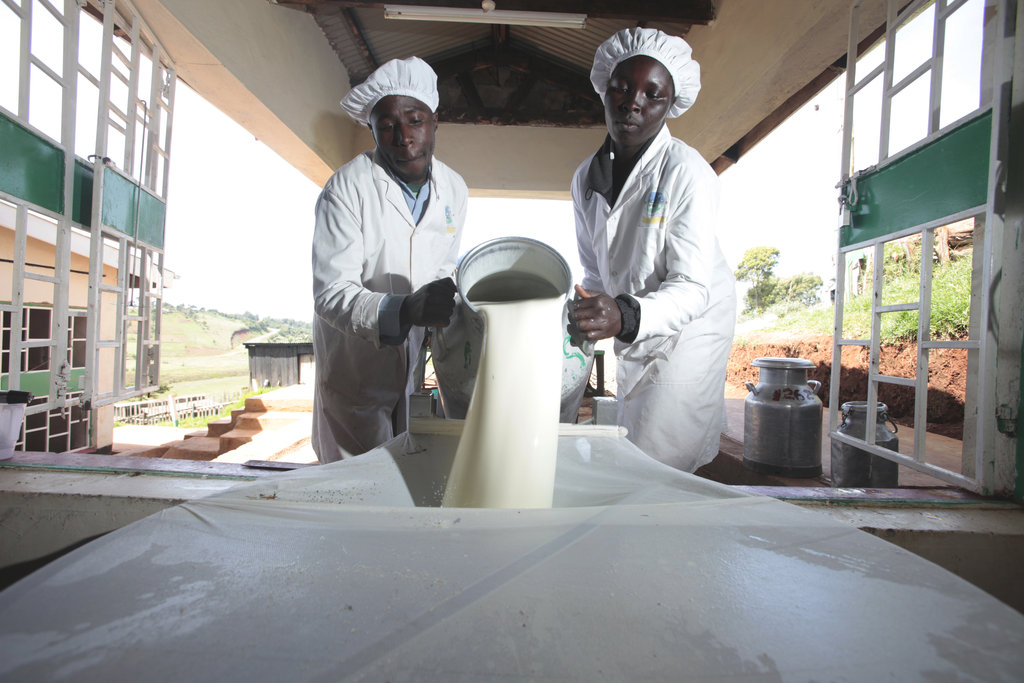
From Hilda’s farm, the team visited the milk processing factory – Mbozi Maziwa Limited, which is owned by MVIWAMBO. The team sought clarity on who funds the cooperative, where they source raw milk from and what their market for the milk is. It was explained that the factory is financed by the farmers (members) through deductions from the milk they sell and with some contribution from the Local Government Authority. The factory whose capacity is 3000 litres per day can be extended to 8,000 litres. With support from EADD Tanzania and the Mbozi Farmers Livelihood initiative project a Heifer Tanzania project the production and productivity is expected to double within the next three years.
The factory’s targeted market for the processed milk is the Tunduma boarder, Vwawa town, Mlowo town, institutions in the hub catchment and outside the hub catchment and Mbeya city. The Mbozi Maziwa will highly depend on the cooperative structure for the milk bulking and service delivery to farmers.
At the Ndolezi Pre-primary cooperative, the CEO inaugurated the official launch of the cooperative, where he handed over the legal cooperative documents; complimenting them for taking the first steps towards doing dairy farming as a business and urging them to look into milk markets and work towards seeing the cooperative grow.
Speaking to the EADD / Heifer staff later on in a staff meeting, the CEO encouraged the team to push hard on demand for milk and endure to make the milk business a living income for the farmers. He urged the staff to be more helpful to the farmers, “let us be a demand driven organization and stop being a supply driven organization. Train your mind to think about demand, think like a business farmer. Be people who have a real heart for the farmers” He said. The CEO emphasized to the project team to get hands on in getting project activities done, because any success will come not from waiting for people to do things, but by being proactive and getting things done.
Project reports on GlobalGiving are posted directly to globalgiving.org by Project Leaders as they are completed, generally every 3-4 months. To protect the integrity of these documents, GlobalGiving does not alter them; therefore you may find some language or formatting issues.
If you donate to this project or have donated to this project, you can receive an email when this project posts a report. You can also subscribe for reports without donating.