By Simon Bradley | SOS Communications and Marketing Officer
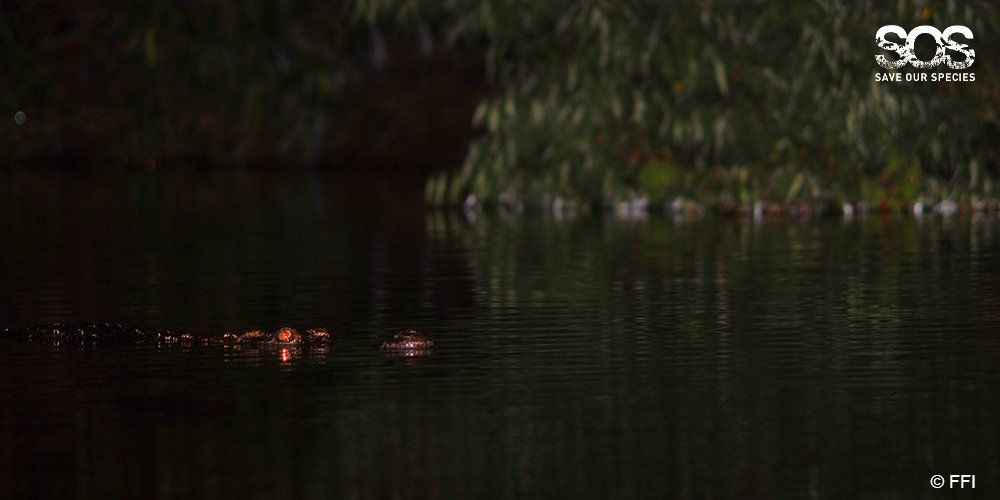
Twenty-five years ago the Critically Endangered Siamese Crocodile (Crocodylus siamensis) was reported as virtually ‘Extinct in the Wild’.
Rediscovered in Cambodia in 2000, survival prospects seemed dim for this iconic and culturally important species. But the future is looking brighter, according to SOS grantee Jackson.
The recent approval by the Cambodian government’s Forestry Administration of the Reintroduction and Reinforcement Action Plan for Siamese Crocodiles builds on successes in captive breeding and release as well as in developing alternative livelihoods with local residents.
These are fruits of 16 years’ community engagement since Fauna and Flora International’s (FFI) conservation efforts began in the Cardamom Mountains, Cambodia. Launched in 2001, the Cambodian Crocodile Conservation Programme (CCCP) is an initiative co-founded by FFI, the Royal Government of Cambodia and local communities.
Coordinating that work Jackson works with communities, crocodile farms, government authorities and the Phnom Tamao Wildlife Rescue Center (PTWRC) – the base for CCCP’s captive-breeding programme. This is a critical activity to rebuild wild populations of Siamese Crocodiles. Annual surveys since its rediscovery had found very few nests and hence reproduction and recruitment of juveniles in the wild was too low for populations to recover.
SOS funding allowed the first pilot release of 18 Siamese crocodiles into one of several pre-selected release sites in 2013, followed by a second release in 2014.“In 2014 we released 20 individuals. In 2016 we released seven crocodiles into a new release site, and in 2017 we released another six into the site of our previous two releases”, iterates Jackson.
Importantly, as of 2016 all of the key crocodile sanctuary sites – where juveniles are released - are in nationally protected areas, monitored by community wardens. Community wardens are local community members who patrol the sanctuaries keeping an eye out for threats and crocodile presence. Wardens regularly see signs of crocodile presence and even individuals around the release sites - indicating a good survival rate.
Jackson’s biggest lesson learned? “The value of investing in developing staff capacity in animal husbandry and breeding care”, he says. To kickstart that process the team brought in a full-time international staff member to help with improving the programme through training and expertise. The team expanded breeding facilities at PTWRC and two more males were sourced by partnering with local crocodile farms.
At the same time the programme continues to work with communities to protect the crocodile sanctuaries and release sites supported by a three year Darwin Initiative grant awarded recently. This will be used to improve their livelihoods in a way that sustainably benefits the crocodiles.
Currently the fate of the species rests - in part at least - on three males and four females in the breeding programme.But the signs from the wild are good. “There still have been no reported incidences of poaching or capture in any of our sanctuary areas and monitoring has shown breeding in two locations in the past two years” says Jackson.
And while much more remains to be done, the future for Siamese Crocodiles and species conservation is just that bit brighter with this news.
This story concerns just one of more than 250 threatened species supported by more than 100 projects in the SOS portfolio. Each one completed offers a wealth of practical lessons and insights into conservation action across numerous taxonomic groups and challenges. Explore the SOS interactive map and sign up for the SOS newsletter to keep up to date on further news from our grantees.
Links:
By Simon Bradley | SOS Communications and Marketing Officer
By Simon Bradley | SOS Communications and Marketing Officer
Project reports on GlobalGiving are posted directly to globalgiving.org by Project Leaders as they are completed, generally every 3-4 months. To protect the integrity of these documents, GlobalGiving does not alter them; therefore you may find some language or formatting issues.
If you donate to this project or have donated to this project, you can receive an email when this project posts a report. You can also subscribe for reports without donating.