By Tong He | Project Leader
Final Report
Narrative
Narrative Report
Please provide a detailed description of activities undertaken with funds and any progress made toward the goals of this Grant to date, including unexpected delays or challenges.
“”15614000
1
2021121“”2022
20239-2023916804000
1
202292020233282023316202365
2202292830
320221115
420234
520235
65040200050
71680
8807284312588401
91016160010101010204000
1020229202386173
1202292220
2202292830
3202351931
42023526311016
520236292110026
620238284040
11202389
12202211CEPA
13202310
2023“7.31”
Online translation:
Laoniuwan Village is located in Shahe Town, Changping District, Beijing, adjacent to Haidian District. It is named "Laoniuwan" because it is located at a big bend of Nansha River. The village is built along the river and covers an area of 1,561 acres. Laoniuwan Village currently has a population of more than 4,000 people. The permanent population is mostly the elderly, and the floating population is mostly young people working nearby.
Laoniuwan Village currently has a temporary sewage treatment facility, but it cannot meet the existing sewage treatment needs, causing sewage to overflow into the Nansha River. Rainwater and sewage in the village are not diverted, causing the capacity of the sewage pipes in the village's temporary sewage treatment facilities to exceed the standard and overflowing. The overflowing sewage causes direct domestic sewage pollution to the local soil and Nansha River, and the polluted area is filled with stench. The village also has the phenomenon of tail water being discharged through rainwater outlets.
On December 1, 2021, Foton Cummins jointly launched the "Sponge Community" project with Fuqun and Laoniuwan Village in Beijing, aiming to solve the problems of sewage overflow, waterlogging, and surface pollutant discharge caused by rainwater in the city. Into the river, sewage overflow pollutes the Nansha River, resulting in serious water pollution of the Nansha River. Promote the construction of sponge communities, so that rainwater can be discharged into the river through infiltration, retention, and purification, reducing pollution to the river, alleviating community waterlogging during the flood season, and at the same time Enhance the environmental awareness of community residents and improve the community environment. The first phase of the project in 2022 will mainly solve source pollution through rain gardens, reduce the amount of sewage entering the sewage pipes, solve the problems of sewage overflow and water logging in Laoniuwan Village, and the direct discharge of polluted rainwater into the river. problems while promoting the improvement of the village environment. A small rain garden was built using one-third of the open space in the southern part of the playground in Laoniuwan Village, and two small sedimentation purification tanks were built. This phase of work effectively solved the problem of water logging in the rain garden area and successfully proved the feasibility of further expansion of the rain garden project. In light of the recent frequent urban flooding disasters in China, Laoniuwan Village has the potential to become a model for decentralized stormwater management and be promoted to other communities in severe flooding areas across the country to alleviate urban flooding.
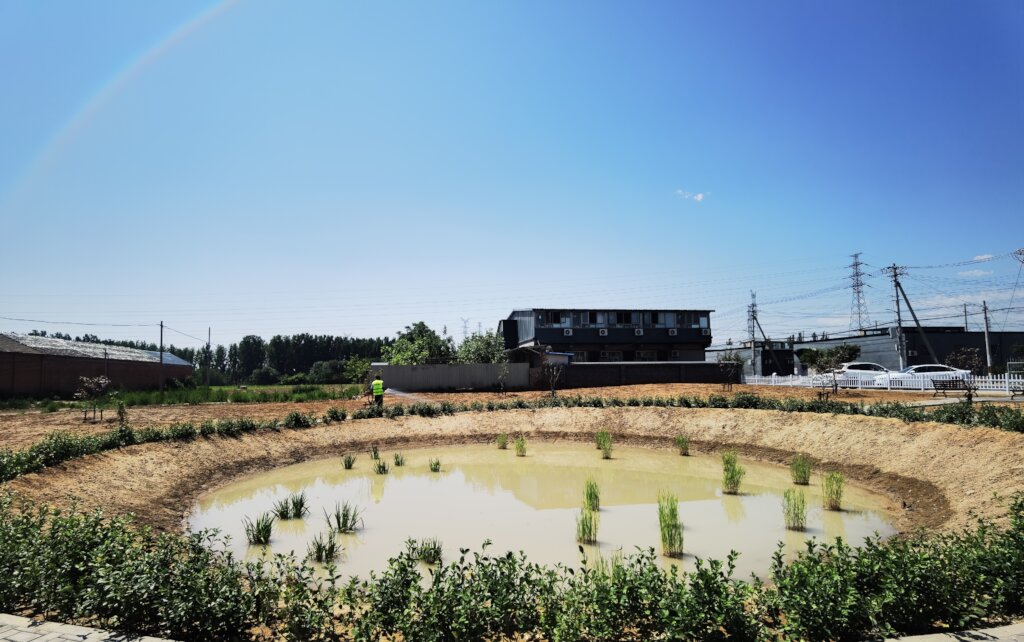
From September 2023 to September 2023, in the second phase of the project, based on the first phase of work, a 1,680-square-meter sedimentation purification tank was built, a biological purification system was built, and the climate adaptability and climate adaptability of the rain garden were enhanced. purification capacity; connected three purification sedimentation tanks into a whole, transformed the entire site into a 4,000 square meter rain garden, and improved garden supporting facilities such as roads, vegetation, street lights, etc., and built a rainwater collection and purification It is a public space that integrates environmental education, residents’ recreation and entertainment. The main specific tasks carried out include:
1. Multi-party communication meeting
On September 20, 2022, and March 28, 2023, Fuqun organized Futian Cummins volunteers, Laoniuwan Village Committee, etc. to hold communication meetings to discuss the needs of Laoniuwan Village and project needs. On March 16, 2023, and June 5, 2023, Fuqun went to Beijing Foton Cummins Engine Co., Ltd. to report the sponge community project results and next work plan to Foton Cummins management, and inspected the rain garden together to introduce the project results. , Foton Cummins leaders put forward constructive opinions on the implementation of the project.
2. Sponge community unveiling ceremony and planting activities. On September 28, 2022, the unveiling ceremony of Sponge Community was held in Laoniuwan Village. The general manager of Futian Cummins, the secretary of Laoniuwan Village, Beijing Fuqun and corporate volunteers attended the ceremony and expressed their affirmation and support for the sponge community project. After the unveiling ceremony, 30 Foton Cummins employees carried out planting and watering activities, set up garden display signs, and cleaned up garden waste.
3. Water cycle experts, wetland experts and community construction experts provide suggestions for the sponge community project in Laoniuwan Village. On November 15, 2022, Fuqun invited Associate Professor Jia Yifei of Beijing Forestry University and Teacher Han, an expert in the field of wetlands, to Laoniuwan Village and along the Nansha River for inspection. Fuqun also invited experts to hold a symposium with Laoniuwan Village. At the meeting, the implementation plan and specific operations of the rain garden were discussed.
4. Determine the rain garden construction party and design the construction plan. In April 2023, after multiple parties and rounds of communication, the second phase renovation plan for the rain garden was determined, including specific plans for the construction of sedimentation purification tanks, road systems, and vegetation systems.
5. Submit the project report and plan to Shahe Town, Changping District. In May 2023, Fuqun submitted a project report and plan to Shahe Town, Changping District. The mayor of Shahe Town recommended the sponge community project to everyone as a typical case of joint construction by enterprises, social organizations and communities.
6. Clean up the construction waste at the rain garden implementation site and cover it with soil. 5,040 cubic meters of construction waste were cleared. After the construction waste was removed, 2,000 square meters of high-quality soil with a thickness of about 50 centimeters was backfilled, which fully guaranteed the subsequent construction of the rain garden.
7. Ground shaping and building the framework of the rain garden. A 1,680-square-meter sedimentation and purification tank was excavated, and the ground shape was adjusted according to the three sedimentation and purification tanks to guide the accumulated water to gather into the sedimentation tank. Through pipeline laying, the three sedimentation and purification tanks are connected to form a complete wetland ecosystem.
8. Improve the ground facilities of the rain garden. After the construction of the rain garden system was completed, the project also obtained supporting support from the village. With the joint efforts of the village, a total of 80 meters of guardrails were installed in the rain garden, 7 benches, 2 chessboard tables, 8 fitness equipment, and garbage were installed. 4 barrels, 312 square meters of road construction, and 588 meters of curbs were installed; 40 solar floor lamps, several safety warning signs, and 1 sponge community introduction sign were installed, which further improved the facilities of the rain garden and met the basic needs of the villagers. .
9. Carry out rain garden vegetation design and construction. With effective design, reasonable plant configuration and proper maintenance, rain gardens can not only improve the environment of the community and provide food and habitat for birds, insects and other animals, but also achieve good landscape effects and become a place for leisure and entertainment for community residents. place. Volunteers from Futian Cummins also participated in the design and improvement of the plan, and participated in plant planting activities in the rain garden. A total of 10 crabapples, 16 crabapples, 1,600 boxwoods, 10 North China lilacs, 10 cattails, 10 gladioli, 10 reeds, 20 golden leaf elm, alfalfa and other herbaceous plants were planted in 4,000 square meters.
10. Volunteers participate in the construction and maintenance of rain gardens. A total of 6 volunteer service activities were organized from September 2022 to August 2023, with a total of 173 Foton Cummins employee volunteers participating. Activities include:
(1) On September 22, 2022, 20 volunteers from Futian Cummins carried out garbage cleaning work in the rain garden, cleaning up the garbage in and around the rain garden in preparation for the unveiling ceremony of the sponge community.
(2) On September 28, 2022, the unveiling ceremony of the Sponge Community was held in Laoniuwan Village. The general manager of Futian Cummins, the secretary of Laoniuwan Village, and the chairman of Beijing Fuqun Social Service Center attended the ceremony. After the unveiling ceremony, 30 Foton Cummins employees carried out planting and watering activities, set up garden display signs, and cleaned up garden waste.
(3) On May 19, 2023, 31 volunteers from Futian Cummins, organized by Fuqun, worked with gardening workers to plant hedges around the sedimentation purification tank. The volunteers installed the structures in groups and planted more than a thousand large-leaved boxwood trees near the sedimentation purification tank at prescribed intervals. On the one hand, these shrubs can play a role in soil and water conservation and prevent the pool slope from collapsing; on the other hand, they can Block the safety hazards caused by pedestrians getting too close to the pool.
(4) On May 26, 2023, 31 volunteers from Futian Cummins, organized by Fuqun, and gardening workers planted small trees in the rain garden to increase the landscape effect and soil and water conservation capacity of the rain garden, and planted Xifu crabapples. 10 plants and 16 Begonia plants.
(5) On June 29, 2023, Fuqun designed a questionnaire and organized 21 Foton Cummins volunteers to distribute it in Laoniuwan community. It designed 100 sponge community water-saving promotional cultural and creative handbags and distributed them together. The survey collected 26 valid questionnaires and formed a questionnaire survey report. Surveys show that users of rain gardens include not only residents of Laoniuwan Village, but also residents of surrounding villages and employees of companies such as Futian Cummins who rent in Laoniuwan Village; people are highly satisfied with rain gardens and have high expectations for landscape construction. and sedimentation tank sedimentation safety are of greater concern.
(6) On August 28, 2023, 40 Foton Cummins volunteers carried out garbage clean-up work in the village area of Laoniuwan Village. 40 volunteers were divided into four groups to carry out garbage collection activities in different areas. They carefully classified and put out the garbage to ensure that the garbage was disposed of in the correct way.
11. Organize a student team from Beijing Forestry University to carry out volunteer services in Laoniuwan Village. From the end of August to the beginning of September 2023, with the support of Fuqun Docking and the Youth League Committee of Beijing Forestry University, the student practice team of Beijing Forestry University went to Laoniuwan Village to carry out practical research work, surveyed the rain garden and drew a floor plan, and discussed the construction of rain garden vegetation. Give suggestion.
12. Share sponge community results at the 14th Conference of the Parties to the United Nations Convention on Ramsar. In November 2022, at the CEPA Wetland Education and Protection Sub-forum of the 14th Conference of the Parties to the United Nations Convention on Ramsar, Fu Qun shared the practical results and experience of sponge community construction in Laoniuwan Village.
13. Introduce the results of the sponge community project to government leaders in Beijing and Shiyan. In October 2023, Fuqun was invited by the Beijing Youth League Committee to introduce the sponge community project and results to leaders from Shiyan City, Beijing Youth League Committee leaders and Beijing social organizations. Sponge Community Project gave thumbs up and recognition.
Through the above activities, the second phase of the rain garden renovation was successfully completed; the waterlogging problem where the rain garden was located was completely solved; the rainwater and sewage absorption capacity of Laoniuwan Village was further improved, successfully withstanding the 2023 "7.31 Beijing Heavy Rain"; Laoniuwan Village Garbage along the Nansha River has been cleaned up, and the environment has been protected and beautified; the environmental awareness of employees and local communities has been enhanced.
1.Would you say that your grant project was successful?
Yes
2. Why or why not?
Online translation:
Because the implementation of the project has brought great changes to the community, it has completely solved the waterlogging problem in the community and enhanced the community's climate adaptability; an abandoned plot full of construction waste has been built into a beautiful rain garden. The rain garden has excellent rainwater absorption and purification capabilities, and can alleviate the pollution of adjacent rivers caused by rainwater overflow. It has also carried out many volunteer service activities, optimized the community environment, and enhanced the environmental awareness of employees and the community.
3. What is your project’s biggest accomplishment?
400016.8831
Online translation:
The project promoted the construction of a sponge community with the participation of Laoniuwan Village, Futian Cummins, university experts and other parties, and built a 4,000-square-meter rain garden with beautiful environment and strong functionality. It also built a rain garden that integrates water diversion, water storage, and purification. of small wetlands. It is estimated based on the rainfall area and the average annual precipitation in the area that approximately 168,831 tons of rainwater flows through the wetland every year and is purified to a certain extent, which greatly reduces the impact of rainwater on the sewer system and pollution caused by sewage overflow. In order to solve the problem The Nansha River pollution problem was explored as a successful case. This case was also shared at the United Nations Convention on Ramsar.
During this process, Fuqun is responsible for controlling the progress of the project; experts are responsible for providing technical guidance, visiting the project site and providing on-site guidance; the village committee assists in organizing villagers and holding meetings to discuss mechanisms and systems; villagers participate in garden construction; volunteers carry out Garden planting, garden and adjacent water environment maintenance activities; finally jointly designed and completed the garden construction. This model can be replicated in other villages to further solve river pollution caused by rainwater overflow in the Nansha River basin or other basins.
4. What are the lessons learned from this project?
l
l
l
l
Online translation:
Mobilizing community participation as fully as possible during the design and implementation of community projects can strengthen the community's sense of ownership of the project and regard the project as their own.
Projects that mobilize communities to participate in project implementation can also avoid many unnecessary disputes. For example, if it is an external construction team, it is easy to complain about noise problems during construction, but if it is an in-village construction team, it will reach an internal settlement. In addition, the quotations provided by the community are slightly more favorable than those of engineering companies on the market, which helps to save project expenses.
It is necessary to organize multi-party discussions. Moreover, restraint should be maintained during discussions, and participants should be guided to think and discuss rather than think and make decisions for the participants. On the one hand, this is full respect for the participants; on the other hand, it also helps to strengthen the participants’ sense of responsibility and gain, and it also helps to allow the participants to express some of their thoughts and concerns.
The beneficiaries of volunteer activities are not only the community, but also volunteers. Volunteering is also a great educational and team-building opportunity for volunteers. When organizing volunteer activities, the experience and gains of volunteers should also be fully considered.
Financial Report
Financial Reports
Financial Report comments
Impact - Project Outcomes & Metrics
l 1/31561500333000
l 30%
l 16.8831
l 4000200011.440[1]1022.72[2][3]
l 240012096
l 4000200050168080807284312588403
l 40004000
l 173692
l
[1],,,,,.[J].,2023,43(03):319-328.
[2], , , , . . , 2017, 37(7): 2455-2462.
[3] HJ 1173—2021——[S]2021
Online translation:
The water accumulation problem in at least 1/3 of the community (the village area is 1,561 acres, one third of which is about 500 acres, or 333,000 square meters) has been solved;
Reduces the flow of rainwater into sewage pipes by 30% during rainfall, reducing the burden on the existing drainage system and reducing or eradicating soil and river pollution caused by overflow caused by undivided rainwater and sewage;
The average annual rainwater purification volume is approximately 168,831 tons;
The green area is 4,000 square meters, with more than 2,000 plants planted. It is expected to sequester approximately 11.440 tons of carbon[1] and conserve 1,022.72 tons of water resources[2][3];
2,400 cubic meters (approximately 12,096 tons) of construction waste were cleared.
A 4,000-square-meter rain garden with both environmental education and recreational functions was built. The rain garden backfilled a total of 2,000 square meters of high-quality soil with a thickness of about 50 centimeters, excavated a 1,680 square meter sedimentation purification tank, demolished 80 meters of the original cement low wall, installed 80 meters of metal guardrails, and installed 7 benches and 2 chessboard tables. , 8 fitness equipment, 4 trash cans, 312 square meters of roads were built, 588 meters of curbs were paved, 40 solar floor lights were installed, and 3 safety warning signs were installed.
The impact of the project has improved the living environment of more than 4,000 residents; created an increase of at least 4,000 square meters of public space;
At least 173 volunteers participated in the activity, and the volunteer time was at least 692 hours;
It provides a model for how to manage urban waterlogging disasters in decentralized communities, and can be continuously extended to other areas with serious waterlogging across the country.
Number of Cummins
Employees who Helped Number of Hours Cummins
173692
173 Foton Cummins volunteers participated and contributed 692 hours of volunteer service time
Employees Volunteered
Can this project continue without further funding from GlobalGiving in partnership
with Cummins?
Yes
Actions that ensure the project is sustainable
l
l
l
Online translation:
Communicated with the village committee and confirmed that the village committee will continue to carry out maintenance activities in the future.
Most of the vegetation selected for garden construction is vigorous, stress-resistant, and adapted to Beijing’s climate. After these vegetations form mature communities under early maintenance, they have the resistance stability and repair power stability of the community, and can self-renew and repair.
In the future, rain gardens can continue to provide rainwater absorption and purification functions with low maintenance.
Grant report metrics for proposal project type = environment
Please select one of the following which best describes the purpose of your project:
If "Other" please describe
Employees who HelpedNumber of Hours Cummins
How many kiloliters of water did your project conserve or make fit for use, if applicable?
168831KL
How many trees or seedlings did you plant, if applicable?
2000
How many metric tons of waste did you collect, if applicable?
12096 tons
How many metric tons of the collected waste were recycled or diverted from landfills, if applicable?
How many metric tons of Greenhouse Gas did your project reduce, if applicable?
11.44 tons
How many people were educated, if applicable?
216 person-times
What successes and key accomplishments has your project achieved that were not captured through previous metrics?
l 1.36/ (2014865)27.01
l
Online translation:
Rain gardens significantly reduce the load and expense of sewage treatment systems. The sewage treatment fee standard in Beijing is 1.36 yuan/ton for residents (Jingfa Gai [2014] No. 865). If the rainwater consumed every year is treated chemically, it will cost 270,100 yuan. Rainwater can also effectively recharge groundwater through the precipitation and purification of rain gardens.
In addition to the ecological function and rainwater absorption function, the rain garden constructed also provides the community with a place that can be used for science education, activities, and leisure.
Storytelling - Photos and Videos
Inspiring storiesPhotos / Videos
Project reports on GlobalGiving are posted directly to globalgiving.org by Project Leaders as they are completed, generally every 3-4 months. To protect the integrity of these documents, GlobalGiving does not alter them; therefore you may find some language or formatting issues.
If you donate to this project or have donated to this project, you can receive an email when this project posts a report. You can also subscribe for reports without donating.



Support this important cause by creating a personalized fundraising page.
Start a Fundraiser









