By Martha Sunda | Executive Director, Childline Kenya
"When a Child is Born, A Parent is Born too!"
What happens when we support the caregiver before a family reaches crisis?
For many families, the pressures of displacement, conflict, financial hardship, trauma and harmful social practices can make parenting extraordinarily difficult. When caregivers become overwhelmed, children can experience the consequences through neglect, violence, anxiety, school dropout and exploitation.
This is the gap CareConnect Circles is designed to address.
Childline Kenya co-created CareConnect with 400 caregivers from refugee-hosting communities in Nairobi and conflict-affected communities in West Pokot. Rather than simply taking a conventional parenting manual and putting it online, we listened to caregivers about what actually affects their families, their languages, cultures, daily pressures and the challenges they face in raising children.
That learning fundamentally shaped the model.
From training to continuous support
CareConnect brings together peer support, digital learning, professional support and referral services.
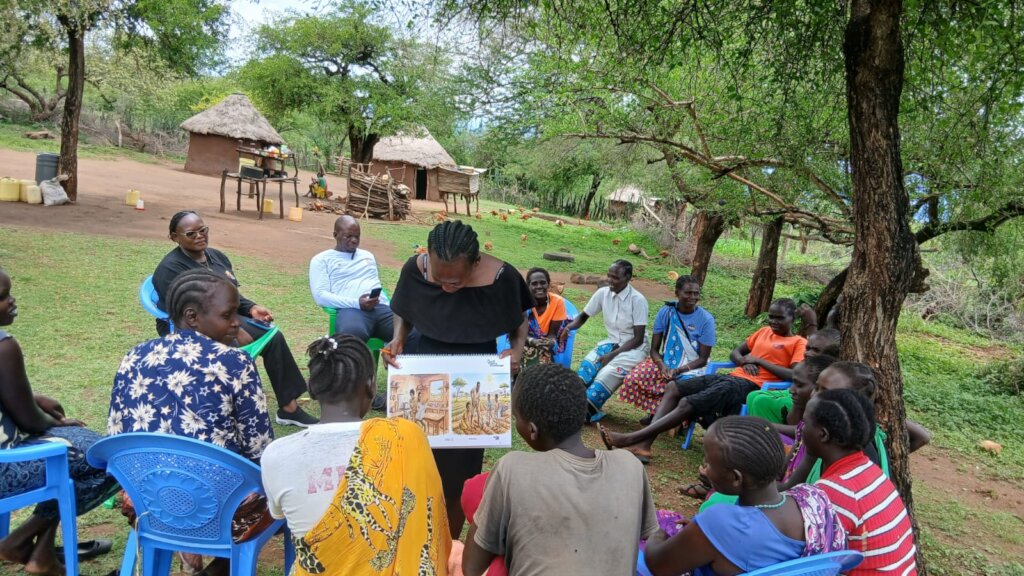
Through peer-led Care Circles, caregivers meet in safe spaces to learn positive parenting approaches, share experiences and support one another. Between sessions, an AI-enabled parenting assistant available through WhatsApp and SMS provides practical lessons, reminders, answers to common parenting questions and links caregivers to relevant services.
Importantly, CareConnect was designed with digital exclusion in mind. Caregivers do not need a smartphone or continuous internet access to participate. SMS, audio content and peer facilitators help include those with basic phones, limited connectivity or low digital literacy.
When a caregiver needs more than digital or peer support, the model connects them to professional psychosocial and child-protection services. This builds on Childline Kenya's experience operating the National Child Helpline 116, ensuring that prevention and early support can connect with established child-protection referral pathways.
What we are learning
One of our most important lessons has been that technology alone does not create lasting change.
Caregivers engage when the content is practical, relevant to their lives and reinforced by trusted human relationships. The Care Circles therefore remain at the heart of the model. The technology extends the relationship between sessions—it does not replace it.
We are also learning that scaling requires localisation. Content that works for one community cannot simply be transferred unchanged to another. CareConnect is consequently being developed as an adaptive model, with caregivers, child-protection specialists, psychologists, parenting experts, government partners and technical teams contributing to continuous review and improvement.
Our monitoring to date, including participant feedback, assessments and testimonies, points to encouraging changes in caregiver confidence, communication with children, stress management and help-seeking. At the same time, we recognise that caregiver wellbeing is influenced by many factors. As CareConnect grows, we will strengthen the evidence through longitudinal monitoring, comparison approaches where feasible and independent external evaluation.
Keeping the human connection as we scale
Our ambition is not to create a chatbot that parents talk to instead of people.
It is to build a support system in which a caregiver can learn with other caregivers, access practical guidance at any time, and reach professional help when the situation requires it.
This is particularly important for fathers, whose participation is deliberately built into the model through male peer facilitators, father-friendly session times, positive fatherhood content, community champions and safe spaces to discuss parenting challenges.
Where we go next
With continued support, Childline Kenya will take CareConnect forward through three complementary pathways:
Scale Deep – strengthen the model in existing communities through expanded peer circles, greater language and accessibility options, stronger psychosocial support and improved referral pathways.
Scale Out – reach additional counties, refugee-hosting communities and underserved populations through trained peer facilitators, partnerships and expanded digital access.
Scale Up – work with government, telecommunications providers and development partners to integrate CareConnect into broader parenting and child-protection systems, creating a pathway towards long-term sustainability.
Our experience with the State Department for Children Services and the National Child Helpline 116 provides an important foundation for this journey. We are not building a parallel child-protection system; we are seeking to strengthen prevention and early support while connecting families to existing services when they need them.
The change we are pursuing
CareConnect starts with a simple belief:
Caregivers should not have to navigate the challenges of parenting alone.
When a caregiver has someone to learn from, somewhere to turn, practical tools to use and a pathway to professional help, a difficult family situation can be addressed before it becomes a child-protection crisis.
That is the future CareConnect is helping us build, stronger caregivers, safer families and better opportunities for children to grow, learn and thrive.
By Martha Sunda | Executive Director, Childline Kenya
By Martha Sunda | Executive Director, Childline Kenya
Project reports on GlobalGiving are posted directly to globalgiving.org by Project Leaders as they are completed, generally every 3-4 months. To protect the integrity of these documents, GlobalGiving does not alter them; therefore you may find some language or formatting issues.
If you donate to this project or have donated to this project, you can receive an email when this project posts a report. You can also subscribe for reports without donating.


Support this important cause by creating a personalized fundraising page.
Start a Fundraiser