By Sophie Muir | Chair of Trustees
Dear friends and supporters,
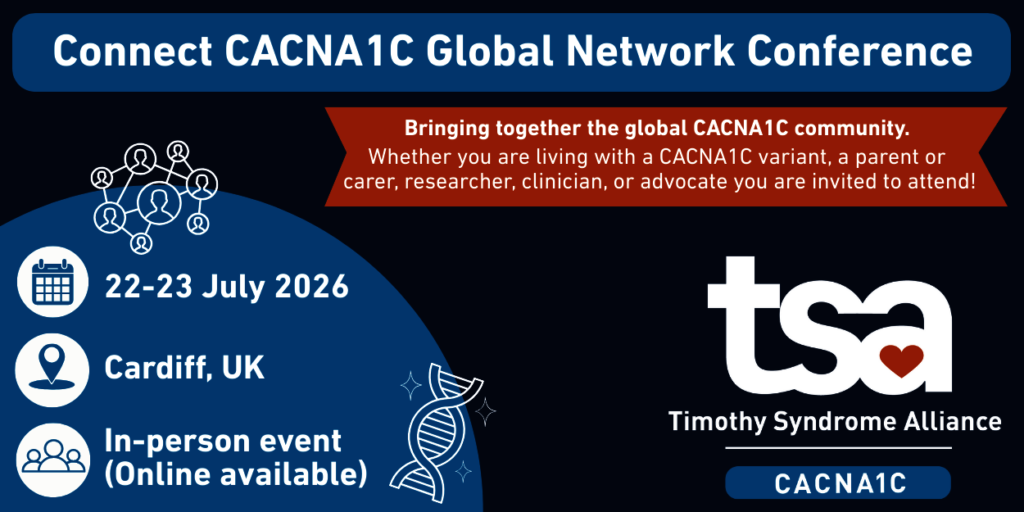
In our last report we told you we were hoping to share the first findings from the CACNA1C Community Registry at our Connect CACNA1C Global Network Conference in July. We're delighted to tell you that we did, and this report is about what that meant for our community.
Twenty families travelled to Cardiff University in Wales from ten countries, alongside forty-one professionals and researchers from seven countries. For many of our families it was the first time they'd ever met another family living with a CACNA1C variant in person, and more than half told us that before finding TSA they had felt completely alone with this diagnosis. Bringing everyone together in one place, with interpretation and childcare so that every family could genuinely take part, was one of the proudest things we've done.
Thanks to you, the registry made it possible. Dr Jack Underwood, Chair of our Scientific Advisory Board, presented the first analysis of the registry data to the conference, and it is now the largest study ever undertaken of the rarer, less studied CACNA1C variants. Among participants whose data passed quality control, initial analysis suggests that neurological, developmental or psychiatric features were present in 60%, cardiac symptoms in 46.2%, and gastrointestinal issues in 49.2%. Our families have been describing this pattern to one another for years, and now it is visible in the data, set out clearly enough for researchers and clinicians to work from. One parent wrote afterwards, simply, "Someone is doing research on my variant!" The full analysis is being prepared for publication and there is much more still to come.
We were also thrilled by what the conference did for the research community. Ninety-seven per cent of the professionals who attended told us the event exceeded their expectations, three quarters left with new or potential collaborations, and more than three quarters said that meeting our families had changed how they understand what living with a CACNA1C-Related Disorder is really like. One researcher wrote that they had thought of TSA as a pillar of the community, and now expected us to become an active force shaping the research itself.
Cardiff also saw the launch of the CACNA1C Collection, our biobank held in partnership with Cardiff University Biobank, and nine families donated a blood sample over the two days. Each sample was separated into its constituent parts, around six plasma, four PBMC and eight whole blood aliquots per donor, giving us a collection of roughly 162 samples. Every one is linked to that person's registry record and genetic data through their CRID, the free personal research identifier we described last time, which each participant creates and controls themselves. It means a sample stored in our Biobank can be connected to a full picture of that person's health and to the exact variant they carry, without their name ever needing to travel with it.
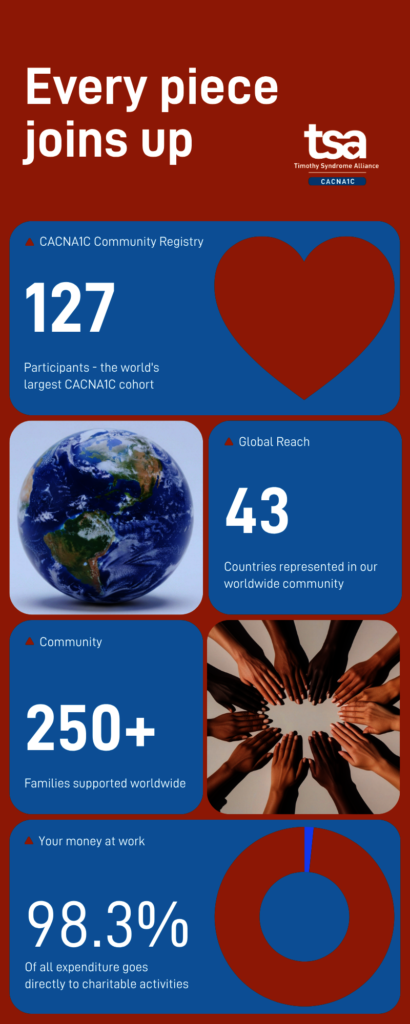
The registry has now grown to 140 participants, up from 127 when we last wrote. If you or your family are affected by CACNA1C and you're already enrolled, your annual survey update is the perfect moment to add your CRID to your record. Those yearly updates matter enormously in their own right. Each one adds another layer to the picture, and together they are how the registry builds a natural history of CACNA1C over time. If you haven't joined yet, now would be an excellent time. The registry is open to individuals of any age with a CACNA1C variant, to families completing a record on behalf of a loved one, and to families who wish to contribute in memory of someone they have lost.
There are currently no dedicated funding streams anywhere for rare disease patient registries, and for a condition as rare as ours that makes community support essential rather than optional. The registry receives grant support from the Waterloo Foundation, and the rest of its running costs depend on contributions like yours. Every donation here keeps the registry open, secure and accessible to families anywhere in the world.
We're sharing our full conference feedback report with you alongside this update, and we hope you'll take a moment to read it. The findings are there in the words of the families and researchers who were in the room.
It is because of your generosity that any of this is possible, and that we can keep working towards a world where shared knowledge and understanding lead to a cure for everyone with a rare CACNA1C genetic variant.
Thank you for being with us on this journey.
Warm regards,
Sophie and Team TSA
By Sophie Muir | Chair of Trustees
By Sophie Muir | Chair of Trustees
Project reports on GlobalGiving are posted directly to globalgiving.org by Project Leaders as they are completed, generally every 3-4 months. To protect the integrity of these documents, GlobalGiving does not alter them; therefore you may find some language or formatting issues.
If you donate to this project or have donated to this project, you can receive an email when this project posts a report. You can also subscribe for reports without donating.



Support this important cause by creating a personalized fundraising page.
Start a Fundraiser