By Smadar Shiffman | Project Leader, Volunteer
Dear Supporters and Friends,
We are happy to report that the status of the Road to Recovery in Israel was enhanced this quarter in two ways. First, our volunteers are now covered by the National Insurance Institute of Israel during their volunteer activity. Second, donations to our organization by Israeli donors are now recognized as tax deductible by Israeli tax authorities. These changes are likely to make us more attractive to new volunteers and donors.
In February volunteers met in Herzliya to discuss ways to promote the organization and to improve the efficiency of its operations. Action items from the meeting included the establishment of two new committees, one for supporting administrative operations, and another for providing mobile applications for ride coordination. We are excited about the help that will result from the work of the new committees.
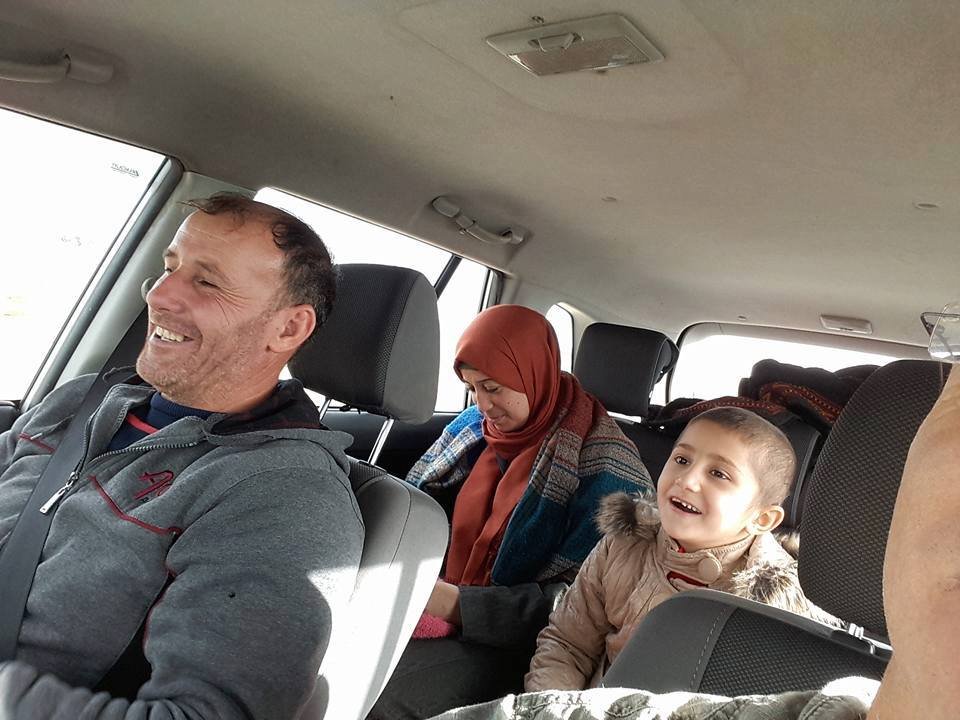
The following accounts illustrate how conversations between our volunteers and patients and coordinators shed light on the daily challenges that Palestinians face. Nadav, a volunteer who frequently drives patients, shared his experience from a recent trip. “As soon as the patient S entered the car, it was clear that the trip would not be a quiet one. Only five years old, but clearly a born leader and full of curiosity. S ran the trip, despite the fact that there were three adults in the car with her, her parents and myself, driving from the Reihan border crossing to the children’s department at Tel-Hashomer hospital. S had undergone three chemotherapy treatments, her blood count and other health-related parameters were poor. But this trip was unexpected. The night before S’s fever rose over 102 F several times, indicating instability in the little child. But S was unaware of the rules of chemistry, and made us laugh while we drove.
- What is this bird called? How do you say tree in Hebrew?
And then she showed us she can count to 10 in Arabic, Hebrew, and English. Then she imitated Dr. Sara, the physician that cared for her at Tel Hashomer. The father, E, a charming and pleasant man, told me that S loved Dr. Sara very much. Following several years of treatment at Tel-Hashomer they had become very close.
Later on S held a lively conversation on the phone with imaginary friends, as if she was cramping her young and challenged-by-disease life into a concentrated capsule of joyous living. I laughed a lot on this trip. I dropped the family off at Tel Hashomer, and drove off to work feeling good. Later in the afternoon E called to ask for a ride back to the border crossing and said they decided to keep S in the hospital for three days for additional monitoring. S probably turned the department up-side-down while there…Thank you S for the lesson about livelihood, and about the insight that illness is not always a reason to stop living or laughing.”
Naim, a Road to Recovery Palestinian coordinator, continues to host tours for volunteers and their friends along the Israel-West Bank separation barrier near the village Jayyous. A volunteer who participated in the tour shared her impression (translated from Hebrew).
“Our convoy had just passed the Sha’ar Eliahu border crossing, on our way to Naim’s home in Jayyous. Jayyous is in Area C of the West Bank, where Palestinian land is controlled by the Israeli military. In this area many Palestinians are separated from their land by road blocks, and need permits to travel to their land for cultivating it. The hills around us were suffused with delicate early-winter light. In the fields seeds were beginning to sprout. A merchant on the roadside was selling lemons and oranges. Near Jayyous we saw what Naim called ‘orphan orchards’—orchards that were not cultivate because the owners had difficulty reaching them. The hills were covered with old olive groves, in stark contrast to nearby fields where olive trees were uprooted to make room for two separation walls and a road block. A salvaged olive tree grew within a barbed wire. But the some land owners were able to grow crop despite the surrounding hardship. Recently farmers planted za’atar in these formerly olive tree plots, and the new seedlings quickly grew green-gray leaves. We saw greenhouses with tomatoes and green beans. A few lone squash plants that were not picked in the summer were clinging to a near-by fence.
Guests were regulars in Naim’s home. Chairs quickly went up around huge tables that offered the best of the local Palestinian kitchen, prepared by Samar, Naim’s wife. Naim told us about his family history and the hardships his family underwent in recent years. Naim described the fear that was daily routine under the occupation. Although he and his family were greatly hurt by the occupation, he was still hopeful that co-existence was possible. I noticed tears in the eyes of some participants when they heard his story. We ended the tour hoping we would meet again soon. As we left the village, children waved at us, surprised to see so many Israeli guests. We looked westward, toward the setting sun, so near and so far from the Tel Aviv skyline.”
Thanks to your support, in the months of December 2016 - February 2017 we were able to fund 28 minibus trips between Gaza and hospitals in Jerusalem. We are excited to see new people joining our donor family as they become aware of our work and its role in promoting conversation between Israelis and Palestinians at a personal level.
Grateful as always,
Yuval Roth and The Road to Recovery US volunteer team
By Smadar Shiffman | Project Leader, Volunteer
By Smadar Shiffman | Project Leader, Volunteer
Project reports on GlobalGiving are posted directly to globalgiving.org by Project Leaders as they are completed, generally every 3-4 months. To protect the integrity of these documents, GlobalGiving does not alter them; therefore you may find some language or formatting issues.
If you donate to this project or have donated to this project, you can receive an email when this project posts a report. You can also subscribe for reports without donating.