By Doreen Appiah-Num | Partnership and fundraising coordinator
In January 2018, the Government of Ghana through the Ministry of Education introduced the Senior High School double-track system. The system is to afford the government with the capacity to deal with a large number of placed candidates who would hitherto not have had the opportunity to access Free Senior High School because of lack of classroom spaces.
The double track system, which commenced with the 2018/2019 academic year, is a fallout of the free SHS policy by the government which is in its second year of operation.
The double track system, we are told, is to last between five and seven years to allow the government ample time to address the accommodation challenges in the various Senior High Schools after which the 400 out of the 698 schools which are currently running the double intake system would revert to the trimester school calendar of the SHS.
The double track system and School Farms programme
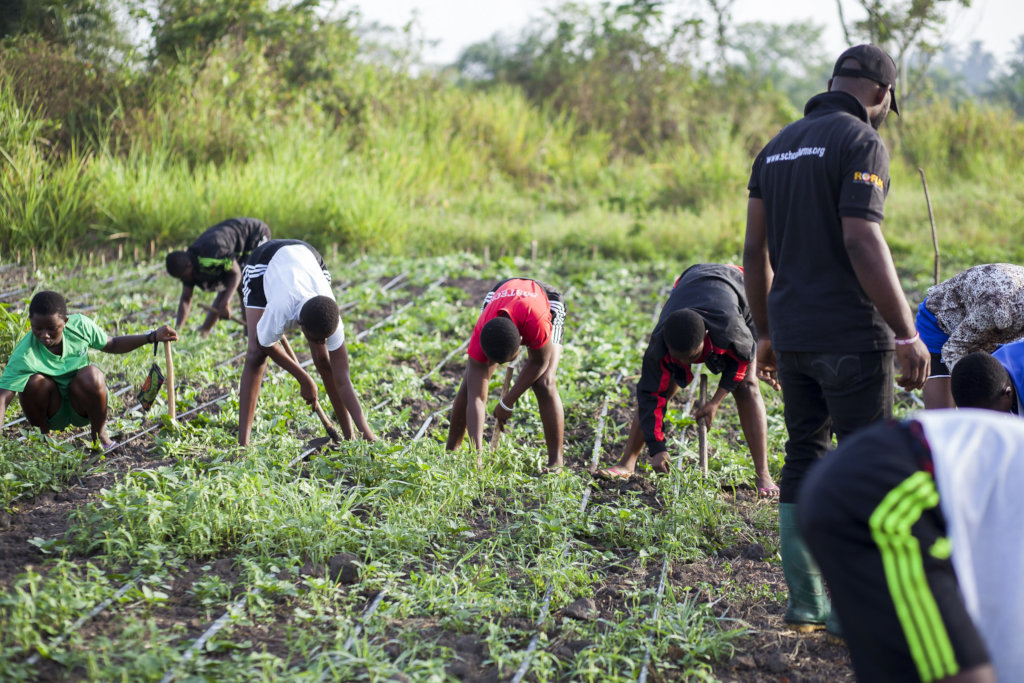
The double track has affected the implementation of the School Farms project, in that, schools do not have enough time to allow students to engage in practical agriculture. Ideally, the school farms provide a space for experiential learning for agriculture entrepreneurial skills through our Agriculture Skills Development Program for young people.
Each track undergoes two semesters instead of the regular trimester in an academic year. Normal classroom contact hours have been increased from six hours per day to eight hours under the double track system. Because of the increase in the instructional hours from six hours to eight hours per day, teaching hours have also been increased from 1080 hours per week to 1134 hours per week in the double track system. This has been coupled with a long 41 days’ vacation period.
In view of the recent changes in the educational system, students may have limited time in school with longer contact hours within this short period. This means that students may not have enough time to work on the farm as well as likely not being on campus long enough to successfully complete full cultivation. Due to the increased contact hours, it has become difficult for schools to apportion times which students can dedicate to work on the farms.
The way forward
To overcome this challenge, the team has decided on creating an out-of-school model, at the community level, where students who are not in school during holidays can learn from home. This model would last until the end of the year 2024 when the double track system is anticipated to end.
Because of the two shifts, for each track or group of students, there is the need to divide the allocated land into two to allow each track experience the entire land preparation, nursery and monitoring plant growth before vacation. This would give students the opportunity to learn at various stages of production and measure growth from different stages. This would be made possible by the integration of the school farms practical into the time tables of school curricula.
Project reports on GlobalGiving are posted directly to globalgiving.org by Project Leaders as they are completed, generally every 3-4 months. To protect the integrity of these documents, GlobalGiving does not alter them; therefore you may find some language or formatting issues.
If you donate to this project or have donated to this project, you can receive an email when this project posts a report. You can also subscribe for reports without donating.