By Sara Servin | Sustainable and Equitable Food Systems Intern
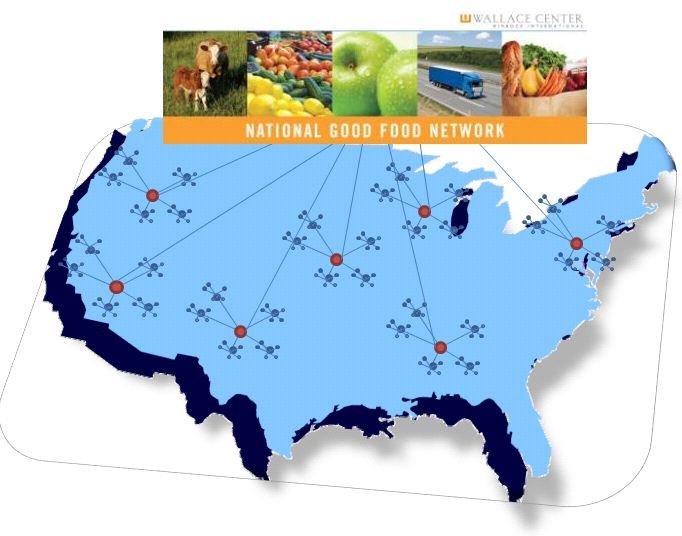
The Wallace Center has long been a leader in supporting local and regional food systems across the United States – from thought leadership and technical assistance to building a stronger network of food hub practitioners and supporters through the National Good Food Network (NGFN). Increasingly, we have been seeing a growing number of good food jobs being created across the country. With this increase, we continue our support of the good food businesses that are helping entrepreneurs, producers, activists, educators, nonprofits, and many others to thrive in this growing sector. One of the ways we support this sector is through our webinars. Our most recent webinars have gone beyond the evidence that good food businesses develop stronger local economies and offer innovative ideas and tools for businesses to deepen their social, economic, and environmental impacts even further.
The NGFN webinars not only provide resources for food businesses to thrive, but they also highlight hot-button topics, and connect viewers and attendees to experts in these areas. Over the past several months, our webinars have examined topics such as healthcare funding and the ways in which healthy, local food can be infiltrated into nonprofit hospitals, cosmetically imperfect produce - what it is and how it is currently being utilized - and a one page cost benefit analysis tool - an easy to use, straightforward tool for budgeting and realizing financial decisions. This month, we’ll also be addressing the state of food hubs in the United States, analyzing an extensive Michigan State University study on food hubs. If you have previously attended one of our NGFN webinars or would like to participate in one of our upcoming webinars, consider showing your support or making a pledge today! Check out our recently aired and upcoming webinars below.
Our Recently Aired Webinars:
August 20, 2015: One Page Cost Benefit Analysis Tool
“Pencil it out” is shorthand for making good farm investment and purchasing decisions. This session provides a straightforward financial tool for making informed decisions and budgeting for the future.
Making decisions that make good financial sense is difficult. But difficult decisions become a whole lot easier when you have the right tool to walk you through the financial implications of your decision. This session simplifies the concepts of Partial Budget Analysis so that you can “use the parts you’re comfortable with.” The idea is to grow your financial skill set at a pace that makes sense for you, to provide a pathway to improve your abilities rather than terrorize you with details, ratios, and secret formulas intelligible only to accountants.
Learn how this powerfully simple tool can help your business today... and trainers and technical assistance providers who work with farmers or other businesses, learn how you can add this to your toolbox you can provide to your students or clients.
View the recordings, slides, presenter bios and more – visit this webinar’s full web page.
September 24, 2015: Leveraging Healthcare Funding to Build Healthier Communities
The Affordable Care Act updated legal requirements for nonprofit hospitals, mandating them to invest significantly more money in communities to address health disparities, promote population health, and emphasize preventive care services.
Healthy, fair, green and affordable local food certainly fits the bill!
This webinar will teach you about the legal provisions requiring nonprofit hospitals to invest in their communities. With that as a starting point, you will learn how your Good Food business or Good Food support organization might tap into this large stream of funding. The panelists will explain the specific steps in the process where food organizations can interact with the nonprofit hospitals to work together to improve food systems, address food insecurity and promote “food for health.”
Several examples of communities who have worked in partnership with their local hospitals will illustrate how this partnership works in practice.
View the recordings, slides, presenter bios and more – visit this webinar’s full web page.
October 22, 2015: Beyond Beauty – The Opportunities and Challenges of Cosmetically Imperfect Produce
JoAnne Berkenkamp at Tomorrow’s Table and The Real Food Challenge have been exploring the market - from farmer to processor to college foodservice - of produce that is healthful and delicious, if a little imperfect. Looking at "imperfects" from the farmer's perspective, this first phase of their research explores realities on the farm and in the marketplace for fruit and veggies that go beyond beauty.
Join us to hear their sometimes surprising insights through a deep dive into this topic.
The webinar begins with a statement of the issue, including some details like why there are imperfections in produce, rates of imperfections, as well as a sense for what growers in Minnesota do with this produce right now. Then we turn to how we can more fully utilize the imperfect produce, including some blue sky thinking… and some possible unintended consequences. The webinar concludes with ideas for bringing such product to market efficiently and policy recommendations.
View the recordings, slides, presenter bios and more – visit this webinar’s full web page.
Our Upcoming Webinars:
November 19, 2015: National Food Hub Survey 2015, 3:30pm-4:45pmEST
What is the state of the food hub across the country?
Join us to learn the latest we know from an in-depth survey that a significant number of US food hubs contributed to. Designed, run and analyzed by Michigan State University's Center for Regional Food Systems in cooperation with the NGFN Food Hub Collaboration, this is truly the definitive word on food hubs in the US.
December 17, 2015: USDA's New Cooperative Approach to Farmer Food Safety Certification, 3:30-4:45pmEST
GroupGAP is a new service (available Spring 2016) from USDA to audit farmers to Good Agricultural Practices (GAP). Small farmers are feeling the pressure to get third-party certified as more buyers are requiring GAP certification, and as the Food Safety Modernization Act (FSMA) puts them under new regulatory oversight.
In GroupGAP, a food hub, support organization, or central business entity collaborates with producers to establish site-specific best practices for complying with a food safety standard. The group develops and implements a quality management system (QMS) built to an international standard that can be measured, analyzed, reviewed, and continually improved.
Come hear the experience of a few of the trailblazers - Groups who have already received GroupGAP certification. Why did they seek this certification? How much did it cost? Will they keep up their certification next year? What supports are available? What makes group a good candidate for GroupGAP? What happens if one farmer does not pass an audit?
Answers to these questions and more!
Links:
Project reports on GlobalGiving are posted directly to globalgiving.org by Project Leaders as they are completed, generally every 3-4 months. To protect the integrity of these documents, GlobalGiving does not alter them; therefore you may find some language or formatting issues.
If you donate to this project or have donated to this project, you can receive an email when this project posts a report. You can also subscribe for reports without donating.