By Sara Servin | Intern
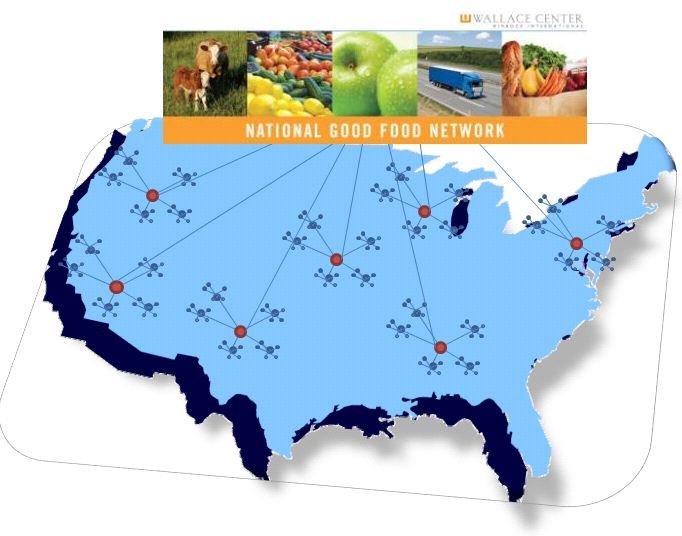
The Wallace Center has long been a leader in the field of sustainable food systems in the United States. NGFN specicifically works to strengthen local and regional food systems and build stronger, more resilient economies across the United States through food hubs. With this in mind, the summer months have shared a specifc theme among the National Good Food Network webinars: Economic development. Small, socially and environmentally-minded businesses often lack the initial resources and mentorship to drive their mission forward towards success, and our webinars aim to address this resource gap.
Our webinars offer models, guidance, and a platform for food businesses, nonprofits, farmers, activists and consumers to ask questions from experienced leaders and innovators across a wide spectrum of food systems work. Most recently, our webinar panelists have included experts in food saftey, local distribution and community economics. If you have previously attended one of our NGFN webinars or would like to participate in one of our upcoming webinars, consider showing your support or making a pledge today! Check out our recently aired and upcoming webinars below.
Our Recently Aired Webinars:
June 18, 2015: Pollinating Food Enterprises: Creative New Models for Starting, Supporting, and Financing Local Food Business
View the recording, slides, presenter bios and more - visit this webinar's full web page.
A “pollinator” is a self-financing enterprise committed to boosting local business. Michael Shuman, author of The Local Economy Solution (Chelsea Green, 2015), argues that these enterprises are the keystone of sustainable economic development.
The current mainstream means to community economic development is to attract large corporate chains to build and stay. Shuman argues that this paradigm is fundamentally misguided, because it overlooks the power and efficiency of locally owned small business. A growing body of evidence underscores that locally owned business can deliver far more economic-development impact—jobs, income, wealth, taxes—than global corporations at a lower cost. In fact, Shuman shows that local economic development might be possible at zero long-term cost, if planners were to take full advantage of an expanding range of business “pollinators.”
Pollinators carry out all of the basic functions of economic development that are taken on by typical, taxpayer-funded programs, including planning, entrepreneurship training, business partnerships, local purchasing, and local investing. Shuman’s new book shows that pollinators accomplish these functions with far greater efficacy and at a substantially lower cost. The book illustrates the clout of pollinators through 28 case studies, many of which focus on development of local food businesses.
In this webinar, Shuman delves deep into this transformational idea on sustainable economic development through food (and other) businesses, sharing some of the best models of food-related pollinators. Linda Best, founder of FarmWorks, a local-food investment fund in Nova Scotia, will present an in-depth case study of one of these models.
July 23, 2015: Systemic Change: How Formalizing Processes Increases Efficiency
View the recording, slides, presenter bios and more - visit this webinar's full web page.
All businesses have systems. At some point in its development, it makes excellent business sense to document those systems - as the number of employees grow, the sophistication of the business grows, or even as key employees start to think of moving on.
Although there is no "magic bullet" for making your business efficient and reducing risk, formalizing and documenting the jobs and operations the business performs has been shown time and again to have those effects. From faster training of new hires, to decreasing costly errors, to increasing overall quality (ensuring happy customers!) taking a systems approach to your business positively effects your bottom line. Moreover, employees have a sense of confidence, each knowing their jobs, and the workings of the business they need to attend to.
This webinar will introduce how one might incorporate systems to bring your food business to the next level of sophistication, and efficiency. Following an introduction to systems, systems thinking, and its application to business, we will hear two very different case studies to get you thinking of the wide variety of applications. One case study explores achieving third-party food safety certification, the other dives deeply into systematizing employee training.
Our Upcoming Webinars
August 20, 2015: One Page Cost Benefit Anaylsis Tool
“Pencil it out” is shorthand for making good farm investment and purchasing decisions. This session provides a straightforward financial tool for making informed decisions and budgeting for the future.
Making decisions that make good financial sense is difficult. But difficult decisions become a whole lot easier when you have the right tool to walk you through the financial implications of your decision. This session simplifies the concepts of Partial Budget Analysis so that you can “use the parts you’re comfortable with.” The idea is to grow your financial skill set at a pace that makes sense for you, to provide a pathway to improve your abilities rather than terrorize you with details, ratios, and secret formulas intelligible only to accountants.
Join us to learn how this powerfully simple tool can help your business today... and trainers and technical assistance providers who work with farmers or other businesses, learn how you can add this to your toolbox you can provide to your students or clients.
October 15, 2015: National Food Hub Survey 2015:
What is the state of the food hub across the country?
Join us to learn the latest we know from an in-depth survey that a significant number of US food hubs contributed to. Designed, run and analyzed by Michigan State University's Center for Regional Food Systems in cooperation with the NGFN Food Hub Collaboration, this is truly the definitive word on food hubs in the US.
Project reports on GlobalGiving are posted directly to globalgiving.org by Project Leaders as they are completed, generally every 3-4 months. To protect the integrity of these documents, GlobalGiving does not alter them; therefore you may find some language or formatting issues.
If you donate to this project or have donated to this project, you can receive an email when this project posts a report. You can also subscribe for reports without donating.