![ACT Children at Chitradurga]()
ACT Children at Chitradurga
Introduction
As part of ACT’s commitment to holistic and experiential education, educational trips were organized in December 2025 to provide students with meaningful exposure beyond the classroom. These journeys were carefully designed to deepen students’ understanding of history, culture, architecture, and nature, while also fostering independence, curiosity, and shared learning.
ACT places great importance on educational travel as a powerful tool for learning and personal growth. Reflecting this commitment, the Founder Trustee personally joined the trips, enriching the students’ experience through her guidance and presence. As an experienced traveller who has visited these locations several times with earlier batches, her involvement provided valuable context, insights, and inspiration, making the learning experience more engaging and meaningful for the students.
Student-Led Learning and Planning
A significant new step introduced during these trips was encouraging students to actively participate in planning their itineraries based on their interests and areas of curiosity. This approach empowered students to take ownership of their learning and develop decision-making and planning skills.
What was especially noteworthy was the students’ choice of less-traveled and rare sites, reflecting their genuine interest in meaningful exploration rather than conventional tourism. A remarkable example of this was the inclusion of the Pillow Lava formations during the Chitradurga trip, a unique geological site that is not commonly visited. This choice highlighted the students’ curiosity and willingness to explore unconventional learning spaces.
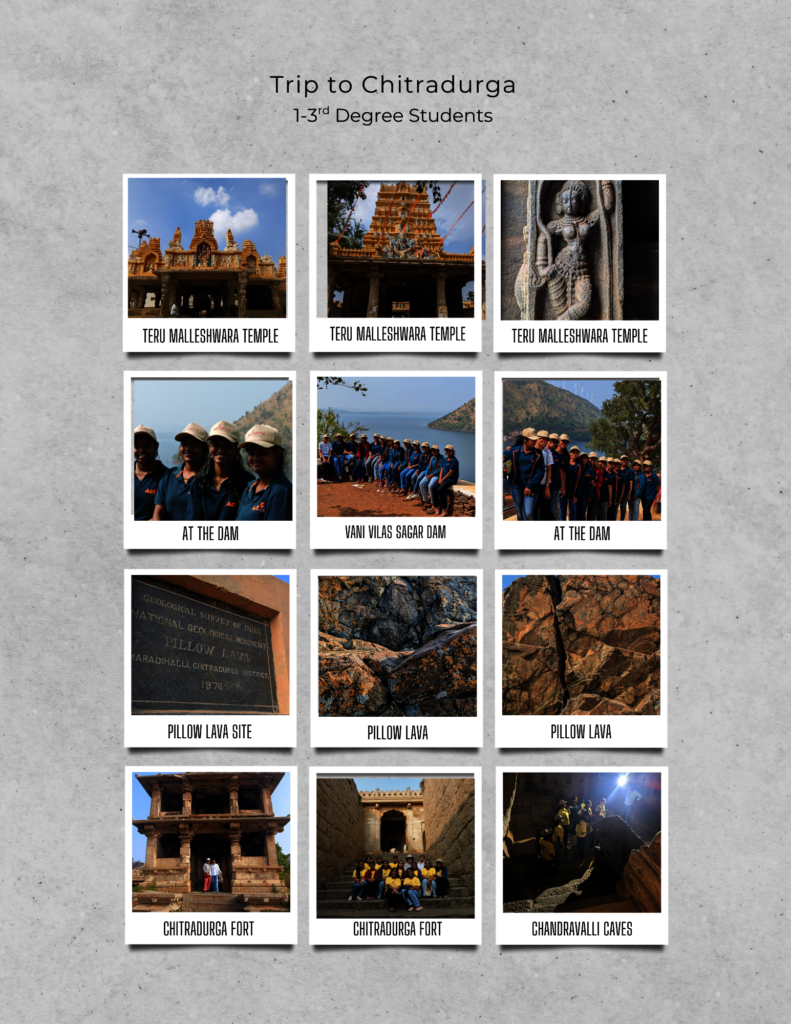
Chitradurga: From Forts to Forgotten Geological Wonders 26 & 27 December 2025
A two-day educational trip to Chitradurga was organized for girl students from 1st year to 3rd year degree, accompanied by two ACT team members and the Founder Trustee. The objective of the trip was to provide students with exposure to historical heritage, cultural traditions, and natural geological features, while encouraging learning through observation and experience.
The group reached Chitradurga safely on the first day.
The students visited Teru Malleshwara Temple, where they learned about its religious and cultural significance and spent time in a calm and reflective environment.
This was followed by a visit to Vani Vilas Sagar Dam, where students observed the structure and understood its role in water conservation and irrigation.
Later, the group visited the Pillow Lava formations, a rare geological site chosen as part of the student-planned itinerary. Students observed the unique rock formations and learned about natural geological processes, making this visit one of the most enriching and memorable experiences of the trip.
On the second day, students visited the historic Chitradurga Fort, where they learned about its architectural strength, historical background, and the stories of courage associated with it.
The trip concluded with a visit to Chandravalli Cave, an ancient archaeological site that offered insights into early human settlements and the historical significance of the region.
Mysore: A Journey Through Art, Architecture, and Royal Legacy 30 & 31 December 2025
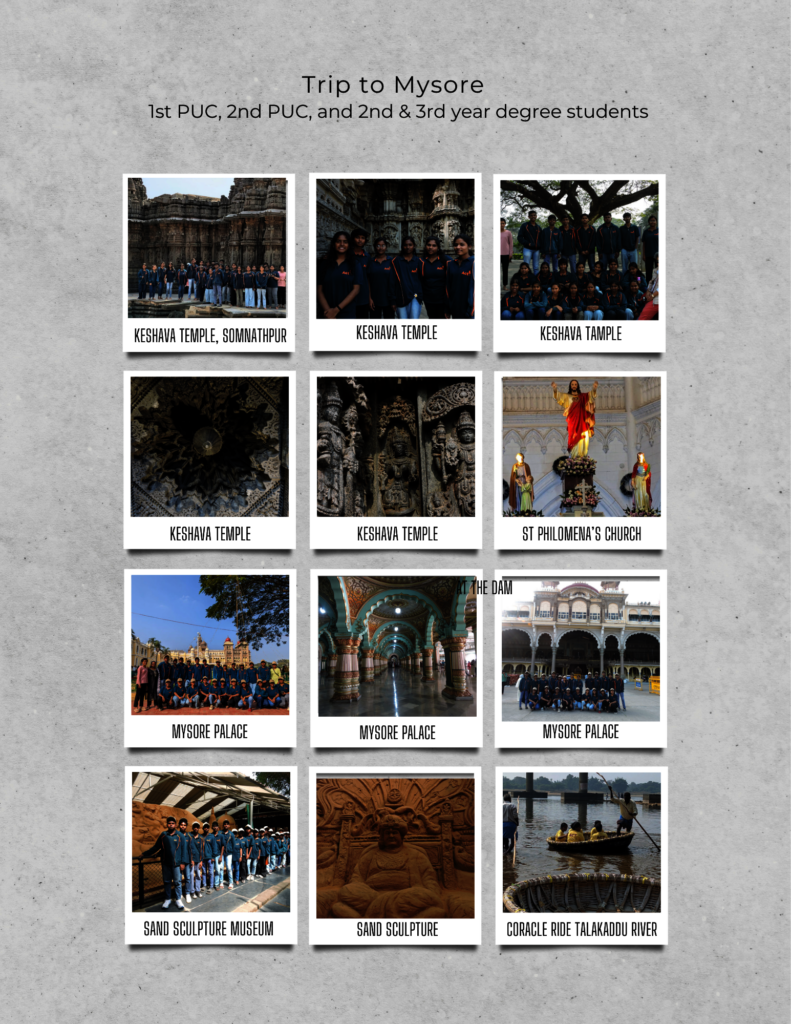
A two-day educational trip to Mysore was organized for senior students of 1st PUC, 2nd PUC, and 2nd & 3rd year degree. A total of 23 students participated, accompanied by four ACT team members and the Founder Trustee. The trip aimed to provide exposure to architectural excellence, cultural heritage, and historical learning.
On the first dayStudents visited the Keshava Temple, Somanthpur, where they learned about its architectural and religious importance.
This was followed by a visit to the Sand Museum, which showcased creative sand sculptures and encouraged appreciation for artistic expression.
The group then visited Mysore Palace, gaining insights into the royal heritage and history of Mysore.
The day concluded with a visit to St. Philomena’s Church, admired for its neo-Gothic architecture and historical importance.
On the second day, students visited Talakaddu - a historic town located on the left bank of the River Kaveri, known for its rich cultural and religious heritage. Once home to more than 30 temples, many of which now lie buried under sand, the town offers a unique glimpse into the region’s ancient history, where they enjoyed coracle rides on the River Kaveri. This experience provided opportunities for relaxation, enjoyment, and bonding, adding a recreational dimension to the educational journey.
Conclusion
The educational trips to Chitradurga and Mysore successfully demonstrated ACT’s commitment to experiential and student-centred learning. The active involvement of the Founder Trustee, combined with student-led itinerary planning, greatly enhanced the depth and quality of the learning experience. By encouraging exploration of both renowned heritage sites and lesser-known locations, these trips fostered curiosity, independence, and a deeper appreciation for history, culture, and nature. Such initiatives continue to play a vital role in the holistic development of ACT students.
![ACT Children at Mysore]()
ACT Children at Mysore
![Share on Twitter]()
![Share on Facebook]()