By Raeed Abd-Allah Chowdhury | Assistant Manager, Content
Friendship’s Education Program
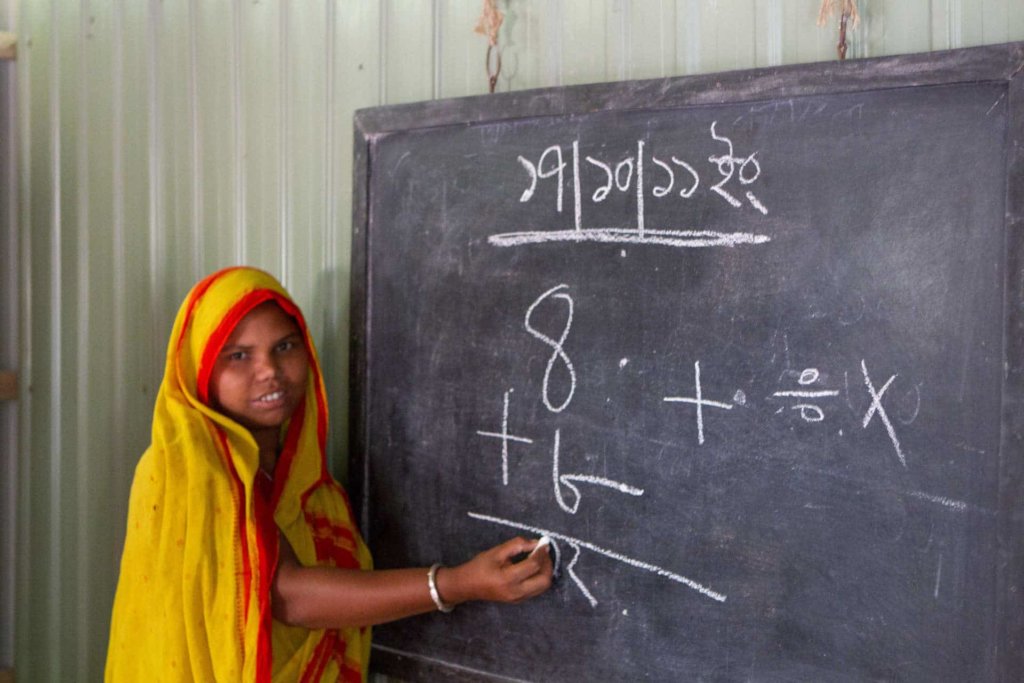
The Mission Statement in the strategic planning of Friendship for its Education Program is “To enable the children of the chars and coastal areas of Bangladesh to develop their potential through quality education, teaching them character building and awareness of their rights and obligations, and also to provide functional literacy for adolescents and adults”.
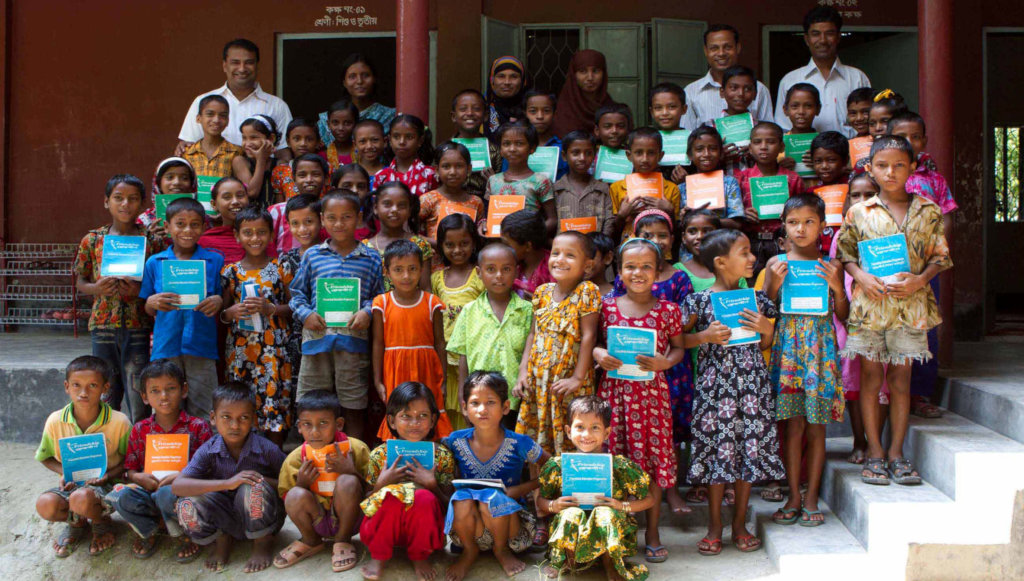
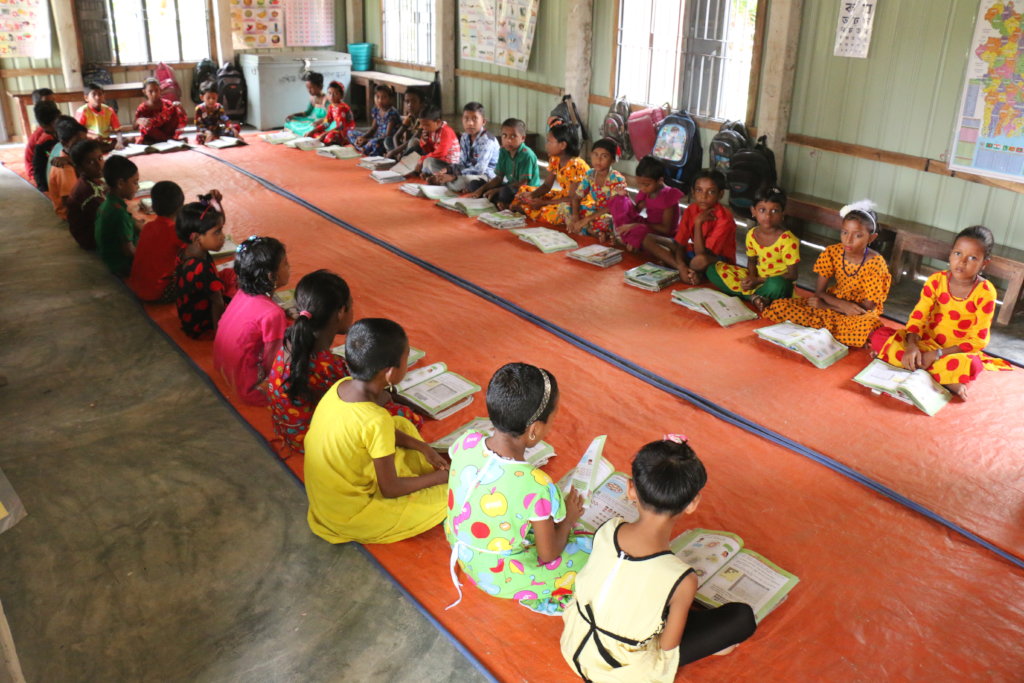
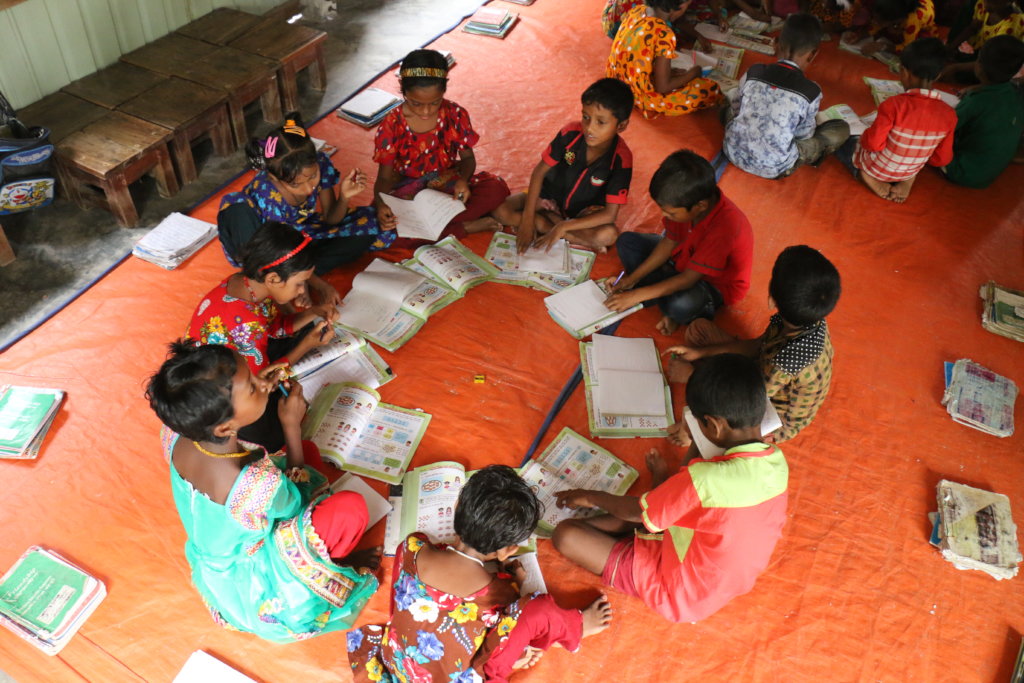
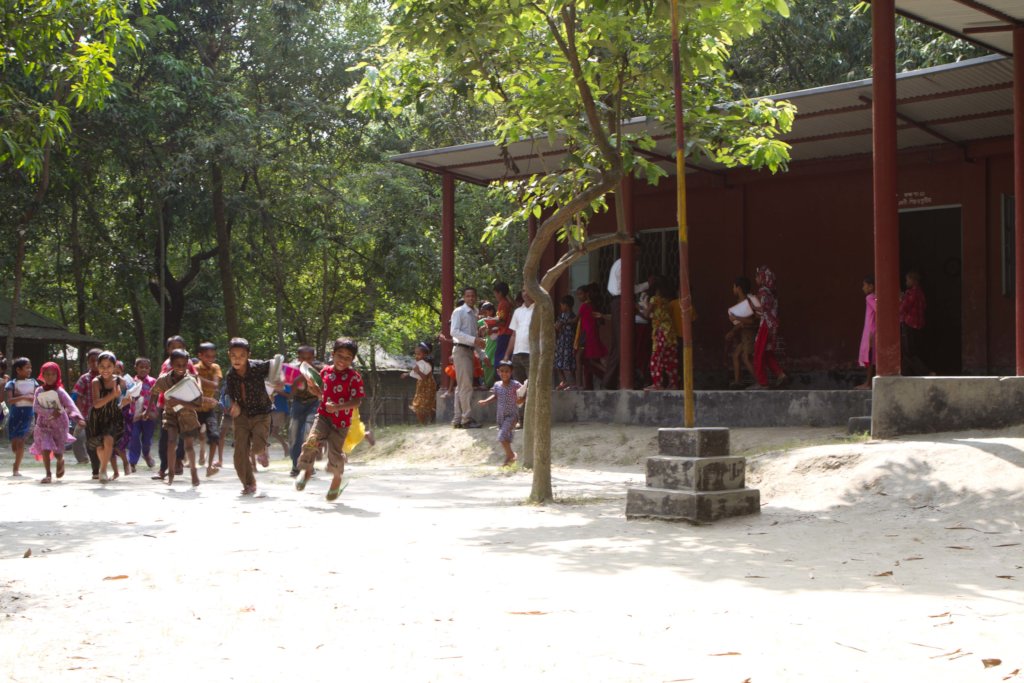
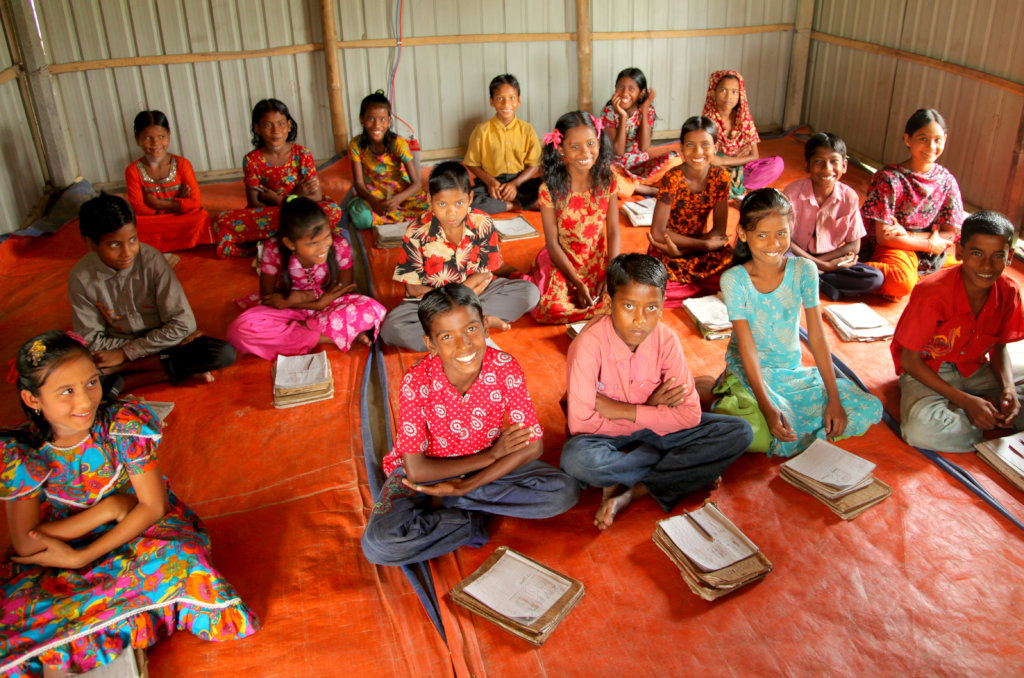
The program is currently implemented through 42 primary schools and 49 adult literacy centres in Gaibandha and Kurigram Districts in the North of Bangladesh.
Friendship is the only NGO that deliberately recruits teachers with below SSC (Secondary School Certificate exam in Bangladesh) qualification for its schools. Friendship recruits these teachers from the very communities in which the schools are located, as they already have rapport with the community and is likely to relocate with the same community in case of migration to a new area.
This recruitment mode has proved to be the only one by which student attendance can actually be ensured, as even qualified teachers recruited from outside the community cannot remedy the overwhelming absentee rates. Commendably, teachers recruited this way from within the communities have shown extraordinary performance upon receiving continuous training Friendship.
Considering the risk of the land being washed away, the schools are built with prefabricated materials so that they can be moved when the land begins to break away from the islands. In an environment where a child’s very home and everything he knows is washed away before his eyes, this ensures a feeling of security and reliance on her/his school. It also makes the programme cost effective in the long run.
Friendship endeavours to offer the best possible cost-effective education to the children and seeks to ensure maximum possible uniformity across the schools
Friendship’s intervention in Education at a glance
Characteristics of the Primary Education Program
National Curriculum Exam
The National Primary Education Completion examination is the target which is set for the Friendship schools. Thus, all primary students need to take this National examination at the end of their 6th year of schooling, i.e. after grade 5.
Friendship students showed extraordinary performance in Primary Education Completion Examination 2018, the national examination conducted for students across the country.
In 2018, most of the 1457 examinees showed extraordinary performance in the exam, with 99.79% receiving A+, A, and A- grades. The percentage of students receiving A+ (around 40.5%) is way higher than the national average. A+ is the highest possible grade attainable for the students appearing in this national exam.
This itself is a big achievement and when this is coupled with the fact that the students are from some of the most underprivileged regions of the country, where passing rate in PEC exam is below 60%. The effectiveness of the program becomes quite apparent from these numbers. In addition, around 9.8% of the appearing students have achieved government scholarship based on their merit, which is higher than the national average of around 2%.
Code of Ethics
In the Friendship primary education program, building the sense of ethics and citizen rights and responsibilities among students is given highest importance.
Code of ethics plays an important role in the education curriculum of Friendship as Friendship believes that its practice in any field of work and personal life plays a vital role in making people, especially children, better human beings and better citizens. Under the code of ethics:
- One topic on ethics is selected every month and a visual is made by Friendship team to be shared among the teachers of the 42 schools. So far, the topics have included dignity, honesty, commitment, humility, etc.
- The teachers, after having the proper understanding of the topic, share it with their students during morning assemblies. Then both the teachers and students discuss about the topic, their feelings, learning, and experience.
- Code of ethics has already had profound impact on the ethical level of the Friendship students who can be easily detected from a group of children because of their high moral standard and integrity.
- After successful introduction of code of ethics in Friendship schools, the organization was approached by District Primary Education office for implementing the same in government schools in Kurigram. So far, the code of ethics has been implemented in 25 government schools, where students are staying back in classes for half an hour after school hour on every Thursday.
Theory of Change
When Friendship first started the education program, there were chars where not even one person who could read or write. Many of those people were cheated while selling their produced goods or making a contract. They also did not know where to go for seeking help or for availing different facilities/ citizen rights.
As of now, because of Friendship’s intervention, in most of the chars, the basic literacy rate has crossed more than 60%. In every household, there is at least one person who can read and write. Therefore, s/he can help keep basic accounts, do basic calculation, and get in touch with the authorities with different complaints. This is something which was unthinkable even a few years back.
Friendship is well-aware that many of these children will not be able to continue education beyond primary schools. But they are taught in such a manner that they can grow with a disciplined mind with strong moral values. Friendship ensures that the graduating students will have a fair chance of getting a modest employment when they grow up.
Environmental Conservation
Through its approaches in Education program, Friendship attempts to provide environmental awareness to the students. At the same time, other steps are also taken to ensure that the environment is harmed as little as possible by community members. The following initiatives within Education program contributes to environment:
Clean home, clean school
In order to build a clean community, Friendship attempts to teach students ways to keep environment clean. Some of the key practices that are highlighted within the initiative are:
Through “Clean home, clean school”, a clean community is created through the awareness being created among children first and then transferring the awareness to the guardians and the neighbors.
Environmental conservation during construction
Since we use only prefabricated materials for school construction, the environment is not harmed due to brick structure. In addition, most of the materials used, including bamboos, are quite eco-friendly in nature and thus promotes our commitment toward mother nature.
Gardening at schools and homes
Almost all of the schools have one flower garden within the school premises. Students, supervised by teachers, are encouraged to work in those gardens. Students are also given knowledge and are encouraged to start gardens in their households.
Friendship Adult Literacy program (an extension of the Primary Education Program)
When the Primary Education Program was first initiated, we identified that the literacy rate among the parents and the adolescents was quite low (below 5%) with people lacking basic literacy skills. Later on, we realized the need of a customized adult literacy program targeted toward the parents of our primary school students, adolescents, and others interested ones in the communities.
Friendship Adult Literacy Program was introduced as an extension of the existing Friendship Primary School Program. We believed that if basic education can be offered to these underprivileged people, the community in general would be able to read and write, do basic calculations, and thus lead a better and an enlightened life by being aware of the social rights that they deserve.
Friendship adult literacy program in numbers:
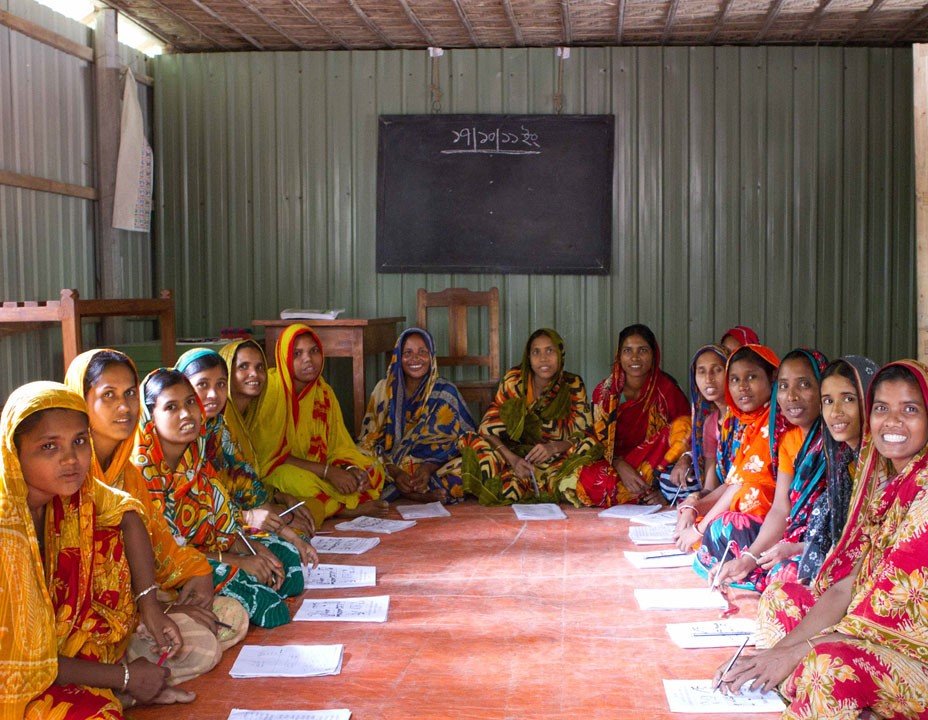
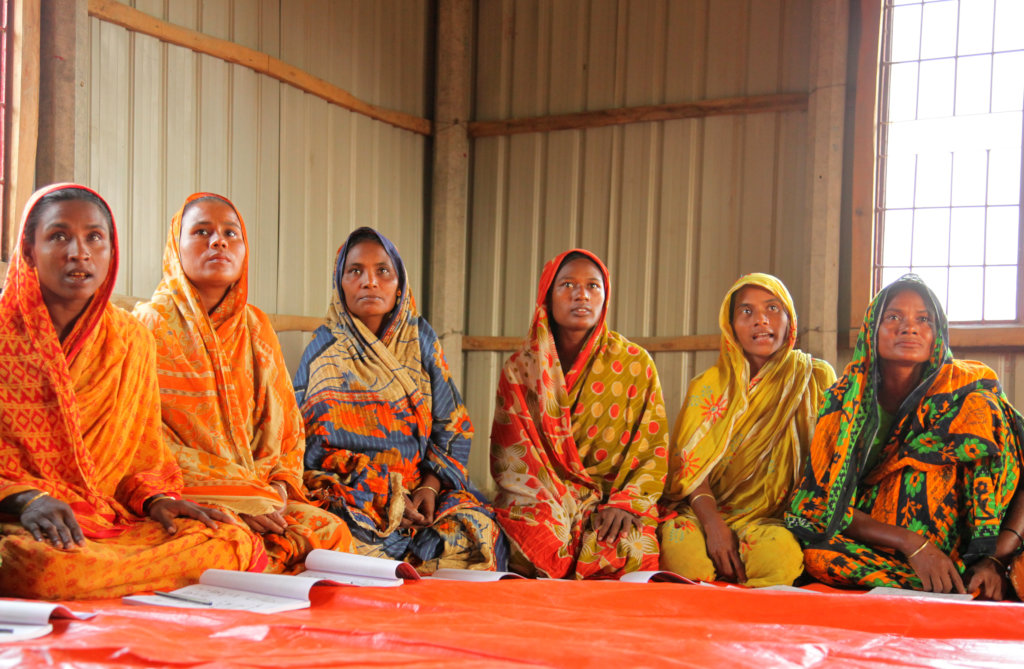
- All of the learners in the adult literacy centers are women.
- For adult literacy program, school hours are flexible and depend on learner convenience. Classes are normally run for 2 hours, thus attracting more adolescents and adults.
- Age group distribution: 35% of the students are adolescents (15-19 years), around 40% are between 20-30 years of age.
Learning Centers with UNICEF in Rohingya camps
Since the recent Rohingya influx in August 2017, Friendship has been doing extensive healthcare, WASH, child protection, and gender-based violence projects in the Rohingya camps. Friendship started implementing Child Friendly Spaces from late 2017 with an aim to provide psychosocial and development supports to Rohingya children. 11 such Child Friendly Spaces are now supporting more than 1,600 Rohingya children on a continuous basis and are helping them recover from the trauma they faced back in Myanmar.
Apart from these, Friendship has partnered with UNICEF since September 2018 in order to construct and operate 100 learning centers in Rohingya camps, targeting 8,000 Rohingya children in total. Each of the learning centers is staffed by one Bangladeshi and one Burmese language teachers, who are provided regular capacity building supports. Apart from receiving regular lessons, students in those learning learning centers are also provided regular healthcare and knowledge about code of ethics, dignity, etc. (the same way in which Friendship’s regular school students are provided lessons on dignity and ethics)
Looking ahead: key milestones for next three years
- Keep the 42 schools and 49 adult literacy centers operational.
- Convert selected one-class satellite schools gradually into full-fledged 6-class primary schools.
- Coordinate and cooperate with local level government in order to ensure that Code of Ethics is practiced across all government schools in Gaibandha and Kurigram Districts.
- Introduce some Friendship curriculum – Code of Ethics, Child Rights, Environmental Studies and Cultural Studies in the Government schools through discussion
- Persuade the Government to adopt the concept of teachers below high school for hard to reach areas with Friendship model of teachers training and monitoring.
- Get a third-party independent evaluation on Friendship’s entire Primary Education project.
Characteristics of the Secondary Education Program
Need Analysis for Secondary Education in Remote Communities
Though Friendship initially started with only primary education, it eventually expanded to secondary education. The unique set of benefits which are gained from secondary education and those which cannot be gained from solely primary education was a compelling reason for this expansion. These envisaged benefits include:
Program Strategy
Friendship’s Secondary Education program gives hope to the remotest communities of the country and gives the people there an opportunity towards a more meaningful and fairer life.
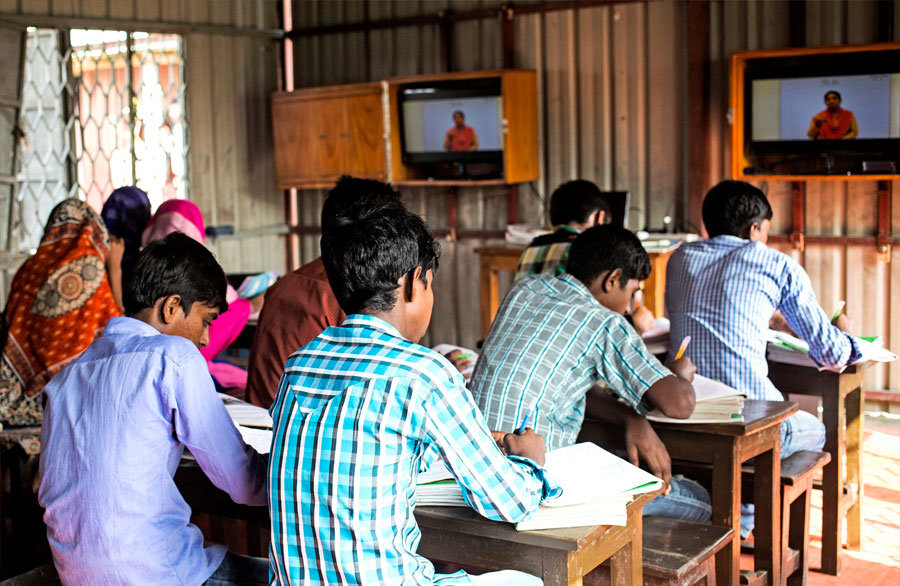
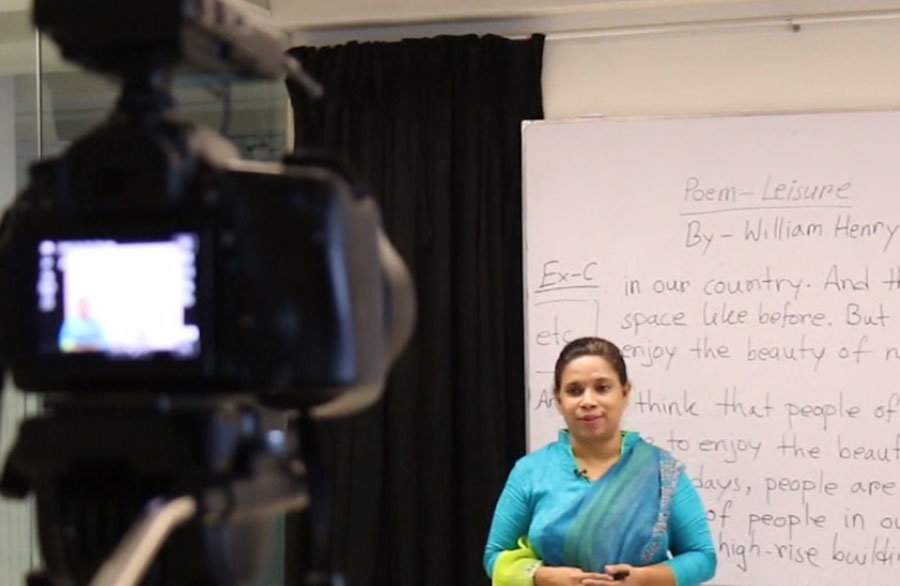
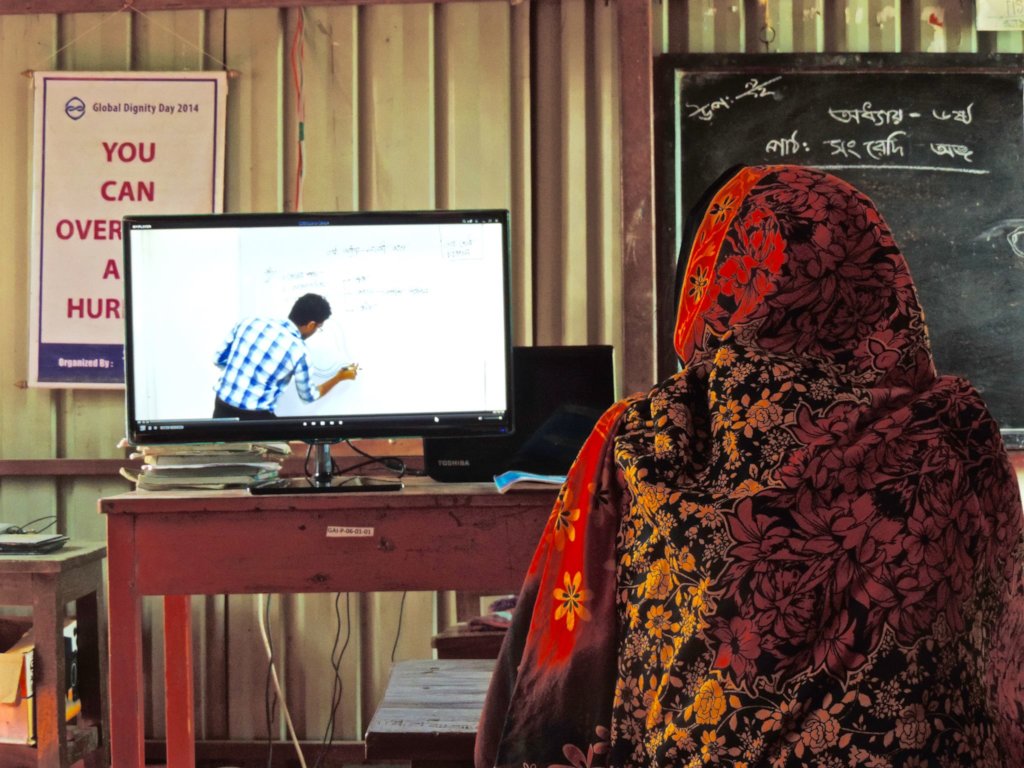
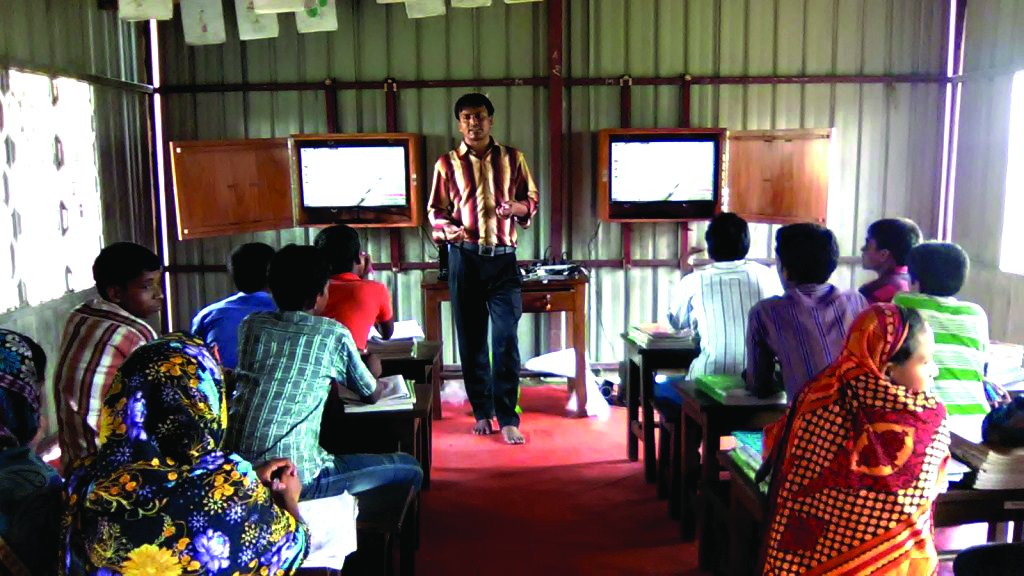
Friendship Secondary Education was initiated in 2015 with Grade VI in five islands. In order to ensure best quality education for the students and recognizing the connectivity issue, Friendship has had made thousands of hours of educational videos on government curriculum taught by the top-quality teachers living in the capital city. Those videos are converted into CDs, sent to the schools, and shown through computers in the classrooms, where the trained primary school teachers work as facilitators.
The demand for enrolment increased over the last few years due to the opportunity of better employability and as an escape from early marriage.
In all of the islands where the secondary schools are implemented, Friendship already had its primary education program operational and selected graduates from only Friendship primary schools were enrolled in the secondary schools. This enrolment restriction was based on the premise that students who did not require primary education access either had access to alternatives or didn’t have the academic preparation needed for secondary level. Girls were given priority since at least few of the primary school graduating boys were able to travel to another island or mainland for getting secondary education, but it was virtually impossible for girls to travel and receive further education.
In each of the classes, around 15 students were enrolled on an average. The demand for enrolment increased due to the opportunity of better employability and an escape from early marriage. As such, around 20-22 students are enrolled for each batch at present.
By the end of 2018, the second batches of students completed Grade VIII and appeared for Junior School Certificate Exam, achieving commendable results, far exceeding the national average. Currently, there are four grades being operated (up to Grade IX) and Friendship envisages to initiate Grade X next year.
The total number of classes operational at the moment:
- Grade VI, Grade VII, Grade VIII and IX: 5 schools
- Grade VI, Grade VII and Grade VIII: 7 schools
- Grade VI: 4 schools (to be started in March 2019)
All students in Friendship Secondary Schools are those who have passed from Friendship Primary Schools.
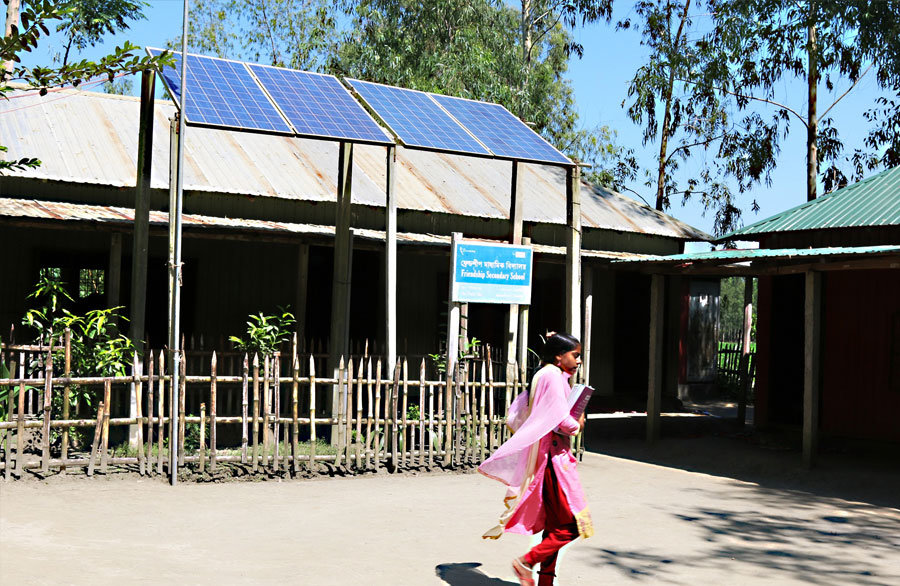
Infrastructure: There are one computer (laptop), two to three monitors (depending on the number of students) and lights in each of the classrooms. There is one solar panel installed in every school for supporting these solutions across the classes.
The classrooms are constructed immediately adjacent to existing Friendship Primary Schools.
Solar grids: This project requires solar panels that provide power up to 8 hours, for all computers in operational classes. Friendship’s own rural electrification program provides the required technical support in this regard.
Primary school teacher as facilitator: The trained Friendship primary school teachers work as facilitators/ shadow teachers and are offered basic subject knowledge beforehand, related to the topics that are taught to the students. During the classes, they answer questions that the students may raise after watching the videos.
Learning method: Videos are made on government curriculum syllabus and saved in portable hard disk drives that are sent to the schools. Prominent teachers from Dhaka have appeared for those videos and concepts have been explained in and easy manner with layman terms for the students. Lessons are recorded and converted into video files for each subject. Teachers from renowned schools of Dhaka, such as Residential Model School & College, BIAM Model School & College, Rifles Public School and College, and Motijheel Ideal College are among those who taught through these videos. In the videos, the teachers focus on conceptual clarity and proper application of learning materials. Each recorded session is approximately 40-45 minutes long.
The videos are shown to the students during class hours and they have the option to ask questions after the classes. The questions are either resolved by the facilitators immediately, or after they discuss these questions with teachers from Dhaka during weekly phone calls.
Call Centre: When students have questions, they are taken down as notes by the facilitator. The facilitators try and understand the solutions to those problems through phone calls with teachers at Dhaka once every week. The teachers also visit the schools from time to time (usually once a year) to understand how they work.
Checking exam scripts: In order to ensure that students get a fair and accurate evaluation of their merit, all the monthly and semester exam scripts are sent to Friendship’s Dhaka head office and are checked by teachers in Dhaka. The checked exam scripts are then sent back to the students.
School Library: Secondary school students are given the opportunity to read different books (novels, fun books, history, etc) from libraries that have been set up in some of these schools.
4 Years of Secondary Education
The journey of Friendship Secondary Education Program until 2018 can be summarised in the table below:
2015 2016 2017 2018
Number of Students 65 123 249 302
Number of male students 28 49 98 124
Number of female students 37 74 151 178
Number of schools 5 5 7 7
Number of classes 5 10 17 19
Number of facilitators 5 10 17 19
Cumulative number of video
lessons available 456 559 1268 1546
Pass rate of JSC - - 100% 98.43%
A press conference for “Friendship’s ICT-aided Schools in Remote Chars Creates Landmark - 100% pass rate in JSC exam” was held at the Daily Star Centre on the 2nd January 2018. The event was a recognition and celebration of the fact that all students from 7 of Friendship’s innovative ICT-aided secondary schools not only had a 100% pass rate, but their results were way above average when compared even to schools in Dhaka and other major cities. The press conference was attended by chief guest Zunaid Ahmed Palak, State Minister of ICT Division, Government of Bangladesh, who praised Friendship and its students for their achievement. The press conference received wide coverage in several media outlets.
Secondary Education Program Highlights 2018 - 2019
The secondary education program is being piloted in 11 schools in the remote char areas. 2018 has been a year of achievement for Friendship Secondary Education Program.
Students from Friendship Secondary Schools appeared in the Junior School Certificate[1] exam for the second time in 2018. 64 students (26 boys and 38 girls) appeared for the Junior School Certificate (JSC) exam with a pass rate of 98.43% as compared to the national average of 53%.
Based on the most recent updates, an overview of Friendship’s Secondary Schools program is as follows:
Though Friendship had initially planned to enrol 10-12 students in each of the classrooms, 142 students were enrolled in Grade VI in 7 schools in 2018, which is equivalent to more than 20 students/ classroom.
This represents an increasing demand for secondary education program in the chars among both students and their parents, who are better aware of the necessity of further studies. In addition, many of the girls are seeking secondary education as a way out of early marriage.
Follow Up
For future employment, Friendship provides training to its graduating students for better opportunities:
Out of the 63 students graduating from Grade VIII in 2018, 49 got enrolled in Grade IX in the same school run by Friendship. 6 of the graduates dropped out and 8 of the graduates (4 male and 4 female) went to different schools to pursue education in class IX.
Future Plan
The following are future plans for the Secondary Education program
Friendship Secondary Education graduates, after completing further studies, will be connected with job-providers after completion of their studies.
[1]The Junior School Certificate, also known as JSC, is a public examination attended by students in Bangladesh after successful completion of eight years of schooling, i.e. after completion of Grade VIII
Project reports on GlobalGiving are posted directly to globalgiving.org by Project Leaders as they are completed, generally every 3-4 months. To protect the integrity of these documents, GlobalGiving does not alter them; therefore you may find some language or formatting issues.
If you donate to this project or have donated to this project, you can receive an email when this project posts a report. You can also subscribe for reports without donating.