By Elizabeth Bintliff | VP for Africa Programs
BUILDING COMMUNITY, INCOME IN KENYA
NYIGON, Kenya—On a cold, early morning in this small community, women and girls are already working on farms. Bent over and holding short hoes, they tease the hard, unyielding earth, submitting it into production. Not far from the farms, cattle graze in fenced pasture, precariously built from scraps of wood and thin lines of barbed wire to keep the wild animals out. From a distance, the landscape of the Kenyan countryside is beautiful, but up close it reveals the realities of small farmers trying to make a life by navigating the delicate balance of the productive earth. “If you don’t have a cow, you plant,” said Augustine Cheruiyot, then country program manager for Heifer International’s East Africa Dairy Development (EADD) project. “If you don’t have land, you work for others,” he continued.
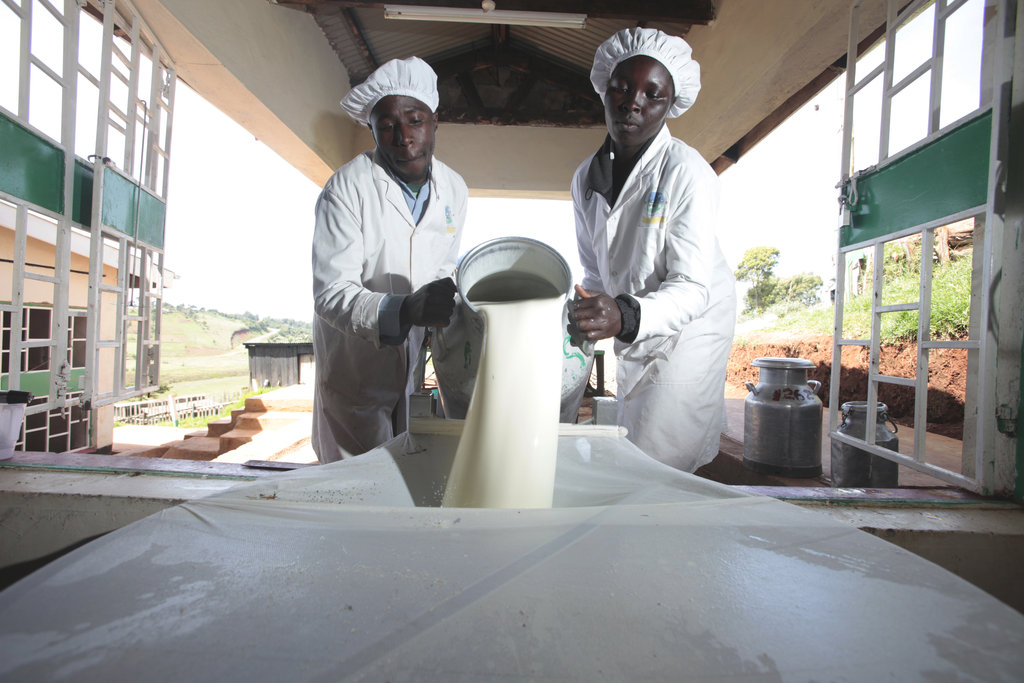
Within this community, most of the people rely on agriculture for their livelihoods. Those who own land they inherited from their ancestors are considered lucky. Those who own livestock are considered luckier. Together, farmers have come together to form a group that has a shared vision of participating in the booming dairy industry that is developing around the milk chilling plant which Heifer International installed in the community as part of EADD, funded by the Bill & Melinda Gates Foundation in 2008.
They started small by collecting their milk in a small makeshift shed in a field several years ago. Then, as they increased their ability to aggregate larger volumes of milk, they obtained a loan to build a cooling tank with the capacity to hold more than 1,300 gallons of milk. Almost 900 farmers now supply milk to this facility, where all the suppliers are also shareholders.
Behind the small chilling facility, a financial service association—or village bank—is under construction. In many ways it resembles a retail bank anywhere in the world. There are two counters for the tellers, an office for the manager and a vault in the back for the money. Jasper, a young man in a dark suit becoming of a banker, runs the operations. Under his shrewd but gentle leadership, the community is navigating the creation of a business in the same manner as one would broker the launch of an Initial Public Offering in a sophisticated multimillion-dollar corporation on Wall Street.
“Shareholders buy shares on a check-off system,” Jasper explained. They pay a small amount with each milk delivery. He said that within the first two to three months, no shares are deducted from the revenue of farmers, but as the site begins to turn a profit, farmers begin to receive dividends on their investments as well as better prices for their milk.
The benefits of membership extend well beyond shareholding. Members have their milk transported to the chilling plant for free, while non-members have to pay. Members also get cheaper access to healthcare within the health insurance network that has sprung up along with the myriad of services and other businesses that are developing around the chilling plant.
It is clear that Jasper is smart enough be in any investment firm in London or New York. Yet, unlike most young people in Kenya, he has chosen to stay in his community. “I want to work for the community,” Jasper said. “This is the community that educated me. I get satisfaction from serving the farmers. I am a member of the community. I am also a farmer.”
The chilling plant in Nyigon is only one of several that have been installed in the area since the project began. EADD heralds a return in rural community development that far exceeded the expectations of the project’s design. Farm families that once produced milk at a subsistence level—just enough for home consumption—are now able to not only produce surplus but also become involved in larger formal economies. This is a manifestation of what Heifer International envisions for the families it assists.
Project reports on GlobalGiving are posted directly to globalgiving.org by Project Leaders as they are completed, generally every 3-4 months. To protect the integrity of these documents, GlobalGiving does not alter them; therefore you may find some language or formatting issues.
If you donate to this project or have donated to this project, you can receive an email when this project posts a report. You can also subscribe for reports without donating.