By Cecil Laguardia | Communications Manager
Africa Region > COVID-19 response update
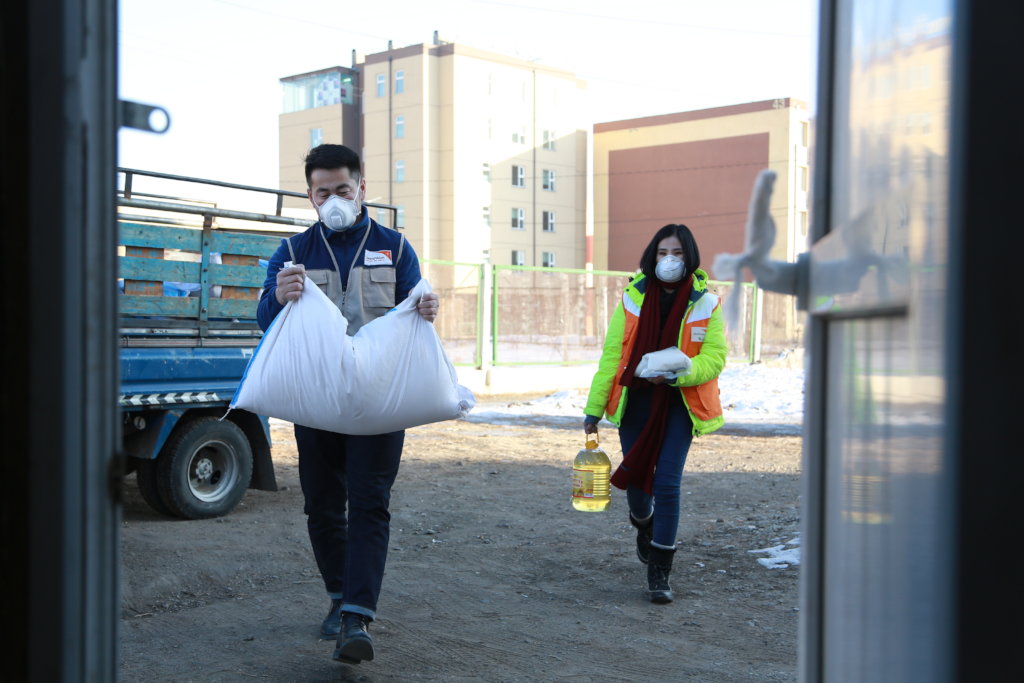
World Vision is concerned about the impact that the COVID-19 health crisis will have on the poorest and most vulnerable, and the risk it poses to already stretched basic social services and pre-existing high levels of food insecurity and malnutrition. This is especially the case amongst refugee and internally displaced populations.
We are active on the ground and scaling up our prevention and response work across Africa, including in fragile contexts. The coronavirus response comes on top of climate change effects such as recurrent drought, torrential floods and locust invasions – all destroying crops and livelihoods. Response work includes preventing loss of progress made towards the global Sustainable Development Goals.
World Vision urges the world to focus on the most vulnerable children, especially those living in communities with low access or weak health systems, and those already battling conditions such as tuberculosis and HIV and AIDS. They must not be left behind and funding for COVID-19 resources must not be diverted from their treatment, care and support.
Country update - SOUTH SUDAN
In South Sudan,World Vision has:
For details on our impact in other African countries, please see the attached report.
529 health workers and faith leaders join World Vision’s campaign against COVID-19 in South Sudan
“It seemed a distant reality at first, but now COVID-19’s impact is felt in South Sudan’s communities. After the declaration of cases in the country and news from surrounding countries that we share borders with reached the people, there is a deeper understanding of the pandemic’s threats”, says Enid, World Vision’s Zonal Program Manager in Western Equatoria Zone.
The operational zone managed from the capital town, Yambio, has trained 330 community health workers and 199 faith leaders who helped reached out to around 30,000 people. The team, with the support of health workers, has screened over 10,000 people with the use of infrared thermometers.
“The staff are constantly reminded of the prevention messages so they can share them with family members and neighbors. It must start with us”, adds Enid.
She further explains, “We realized that for the prevention to be more effective, it has to become a way of life for the people. The task force we organized tries harder to visually show people how infection can happen around them in their daily interactions. The team doing this must also fully understand the messages to be able to illustrate to people and answer questions.”
World Vision, being the lead in the Ebola Virus Disease (EVD) Prevention Program in the zone, has now taken the role of migrating the existing structure intended for EVD and adapt the infection, prevention and control process for the campaign against COVID-19.
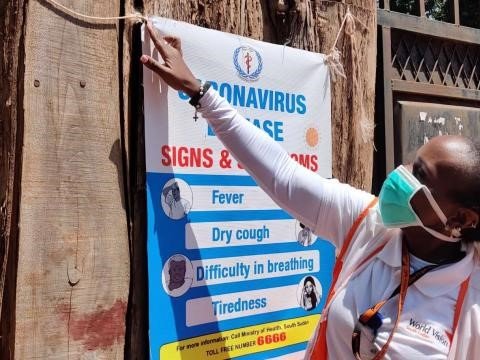
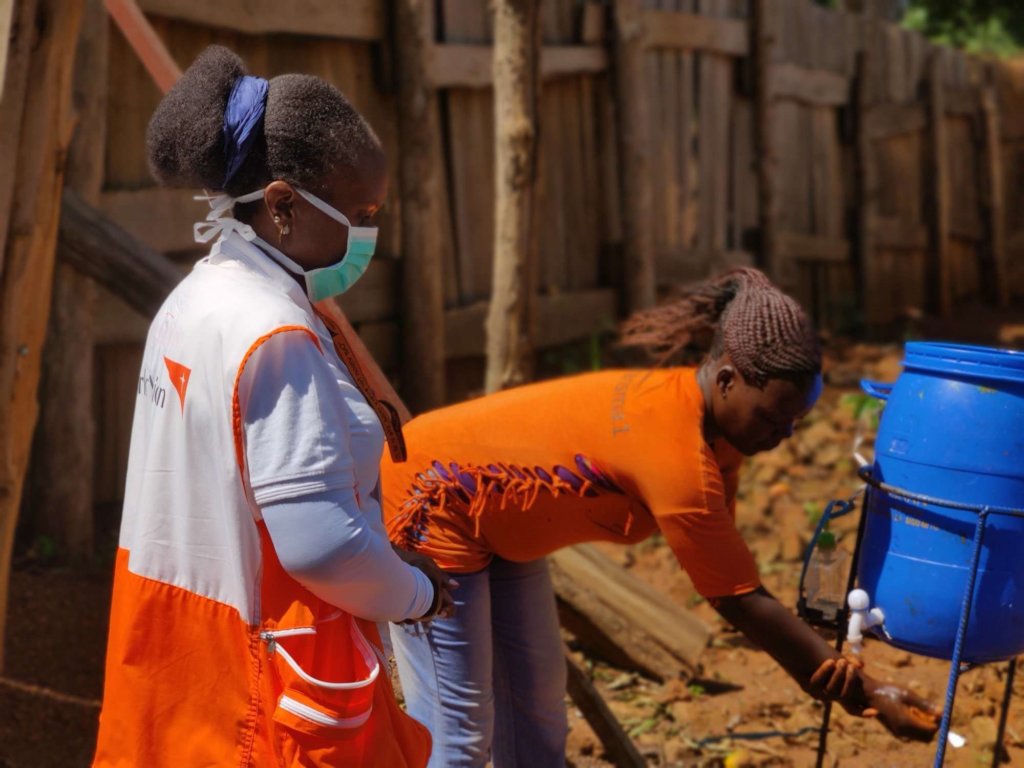
All existing World Vision program teams in the area have worked together to display information materials and banners, established handwashing facilities during activities and key areas and imposed social distancing.
Working with nine points of entries (POE) in the state, some of which affiliated with health facilities), one isolation unit and six holding units, World Vision’s EVD response has screened over 1million people before it was discontinued for lack of cases and threat having been contained.
However, at the onset of COVID-19, 19 screening areas were established in health facilities in coordination with South Sudan’s Ministry of Health (MOH) and the World Health Organization (WHO).
Enid said there are still a lot of challenges ahead as the pandemic impacts communities. She says, “World Vision is very committed to doing the preparedness but it’s challenging to plan how to handle it on a large scale. The best thing is to get more people and groups to work with us for prevention messages to be disseminated all over the zone especially in remote areas. World Vision being on the ground with partners is better positioned to respond.”
She has noticed a lot of changes in people’s behavior and practices, which she considered very positive for the efforts that the teams are doing. “The people have started discussing COVID-19 in a very informed point of view and many are aware of the need for prevention considering the inadequate health facilities to handle an outbreak. Generally, handshake, which is culturally entrenched in communities, has stopped”, Enid explains.
In one of the meetings facilitated by World Vision, one faith leader Pastor Emmanuel of the Seventh Day Adventist Church, describing the pandemic says, “Ebola was a child, COVID-19 is an adult”. This showed how much people have now understood the gravity of the situation. The Western Equatoria State has a land area of 79,342.66 km and is divided into 10 counties with an estimated 1.6 million population.
Project reports on GlobalGiving are posted directly to globalgiving.org by Project Leaders as they are completed, generally every 3-4 months. To protect the integrity of these documents, GlobalGiving does not alter them; therefore you may find some language or formatting issues.
If you donate to this project or have donated to this project, you can receive an email when this project posts a report. You can also subscribe for reports without donating.