By Aleta Margolis | President
March 2020 brought changes and challenges to the world that would have been hard to imagine even 6 months ago. COVID-19 has up-ended our norms and forced us to adapt to unknown and constantly evolving situations; this is especially true in education. Despite these challenges, Center for Inspired Teaching continues our powerful work to build leadership and critical thinking via virtual programming.
At a time when we’re craving in-person conversations and missing the flow that body language can bring to a discussion, Inspired Teaching’s Speak Truth virtual sessions offer a beautiful antidote to all the things we’re growing fond of bemoaning about video conferencing.
It turns out that well-structured, student-led discussions can be effective both in-person AND online because the elements that make them work in a physical space actually translate pretty well to a virtual one.
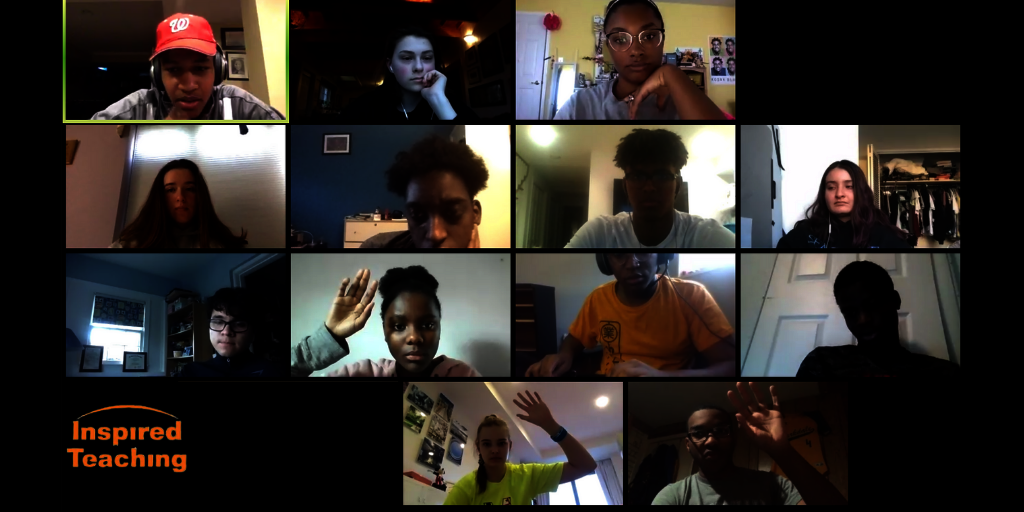
As Inspired Teacher Cosby Hunt opened a session on ZOOM in April 2020 he explained, “Student led discussions are the way things should happen more often in our classrooms. We can be starting student-led discussions even while we’re at home.” He was speaking to a group of about 40 teachers and students who represented schools from up and down the Eastern Seaboard ranging from high school students and their teachers from DC and MD public, private, and charter schools to students and preservice teachers from rural New Hampshire.
This discussion began and was facilitated entirely by a sophomore at Georgetown Prep High School in Bethesda, MD. The topic students would debate for the next hour was: Is the novel Coronavirus exacerbating inequality? Alejandro did a stunning job of keeping the discussion flowing with questions he’d prepared ahead of time, visuals he shared to set up new lines of inquiry, and an effort to balance the voices present so everyone who wanted to jump in could do so. Here is a sampling of the questions discussed:
Speak Truth sessions reflect the core elements of the Inspired Teaching approach. Students are the central experts. Their intellect, imagination, integrity, and inquiry drive the whole discussion. And as teachers, putting them in the driver’s seat for the discussion reflects a high level of mutual respect that they in turn learn to show one another.
In most sessions only a handful of participants know each other in advance, and yet the discussion gets deep very quickly with students sharing their own personal perspectives on the relationship between wealth, power, and race in coronavirus response and ramifications.
For example, in response to a question about whether education is right in the United States, a student from the Maret School in Washington, DC replied, “Not necessarily. As the government does not have any legislation pertaining to explicit human rights regulations, things like the internet for education are often left in the dust. I’d say the government views education as non-essential and therefore internet connection as an extension of that view.”
The points made by the assembled students who ranged from freshmen to seniors in high school were worthy of the most esteemed Sunday morning talk shows and the adults who joined the discussion just to listen shared their amazement after the conversation with the level of sophistication and thoughtfulness on display.
As teachers experiment to find the best way to make use of video-time with students, the Speak Truth model is definitely worth exploring. There is a growing consensus that distance learning cannot replicate what we do in a typical school day and that the emphasis should be less on time spent vs. quality of that time. Having students plan meaningful discussions that you observe as they take place offers both a leadership opportunity for the students and tremendous learning opportunity for you as the teacher.
Even once the threat of Covid-19 passes, school will never be the same. We will continue building out our virtual and face-to-face programs for teachers and students, and use our 25-years of expertise to influence education to ensure students are in the driver’s seat of their education.
Project reports on GlobalGiving are posted directly to globalgiving.org by Project Leaders as they are completed, generally every 3-4 months. To protect the integrity of these documents, GlobalGiving does not alter them; therefore you may find some language or formatting issues.
If you donate to this project or have donated to this project, you can receive an email when this project posts a report. You can also subscribe for reports without donating.



Support this important cause by creating a personalized fundraising page.
Start a Fundraiser