By I. Haines | Communications Specialist
Washington students have big dreams for their future.
In fact, almost 90% of Washington high school graduates want to continue their education, whether that’s through an apprenticeship, a 2- or 4-year college, or a certificate program. Yet by age 26, only 40% of graduates have earned a credential that leads to a family-sustaining career. Without a stronger postsecondary preparation system, this gap between student aspiration and credential attainment will persist.
From 2022 to 2025, our High School to Postsecondary (H2P) Collaborative brought together regional network partners, school administrators, educators, and students. Collectively, we tackled a big question: How can we reimagine and design a postsecondary preparation system that is inclusive of aspirations, lights up possible pathways, and fosters a sense of belonging?
“We knew from previous work that the adults in high schools—not limited to counselors—play a huge role in preparing students for what’s next,” says Tana Peterman, Senior Program Officer at Washington STEM. “The problem is that those adults rarely have the up-to-date information or capacity to help students understand financial aid, dual credit, or what pathways exist. The Collaborative worked to elevate student and staff perspectives about what they most needed for schools, districts, and even whole regions to change that paradigm.”
From one school to a collaborative
In 2019, a career counselor from Eisenhower High School (EHS) in Yakima reached out to Washington STEM and the South Central Washington STEM Network with a hunch: he suspected that Hispanic students were not enrolling in dual credit courses at the same rate as their white peers. Together, we dug into course-taking data and engaged the school community, confirming the counselor’s hunch—and prompting schoolwide changes.
We also uncovered a larger truth: Students, educators, and families were struggling to navigate our state’s disjointed postsecondary preparation system.
Our work with Eisenhower High School served as a pilot for the H2P Collaborative, which was established in 2022. From 2022 to 2025, the Collaborative grew from five schools across four regions to 40 schools across seven regions—ultimately serving nearly 30,000 students.
Guided by student voice and data
With a focus on financial aid, dual credit, student advising, and adult mindset and bias, participating schools evaluated their own postsecondary preparation system with critical support from regional leads. Here’s what our process looked like:
With insights gained from data, surveys, and listening sessions, school teams implemented changes at both the school and district levels. This often included peer advising, deepened relationships with local colleges, and professional development for educators.
What we know now
Almost 90% of Washington high school students aspire to pursue some form of postsecondary education.
This statistic remains consistent across our survey results, regardless of geography, gender, race, or first-generation status. Yet we see gaps across these same demographic groups when it comes to actually completing that postsecondary education.
Structural challenges keep schools from accessing and using their data.
School leaders have a deep interest in student outcomes after graduation. Yet fees and technical barriers have historically hindered their ability to examine postsecondary enrollment and completion data. (See below how our advocacy efforts have shifted this status quo and increased communication between the K-12 school system and higher education.)
Adult mindset is critical to student success.
Our survey results show that school staff believe only 71% of their students aspire to some form of postsecondary education. Understanding this gap between student aspiration and staff perception helped educators meet students where they are.
Our impact
Schools and districts
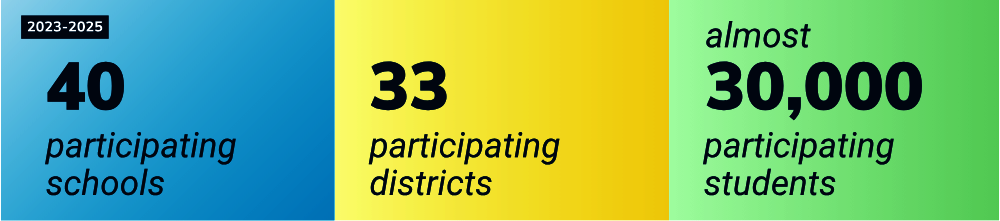
From 2022 to 2025, the H2P Collaborative worked with nearly 30,000 students from 40 schools across 33 districts. Changes in policy and practice at the school and district level will continue to serve students for years to come—including just-in-time professional development for classroom teachers, coordinated efforts to increase financial aid completion, and commitments to examine postsecondary enrollment data.
Read about how Richland School District’s survey results inspired staff to reimagine professional development for teachers.
Regional
Regional leads helped build relationships between high schools and postsecondary institutions, allowing them to more easily share enrollment data and creating smoother transition pathways for students.
Read about how enrollment data helped Quincy School District develop a partnership with Big Bend Community College.
Statewide
We have used the findings of H2P to advocate for legislation that will smooth postsecondary transitions across the state. This includes:
Historically, school and district leaders have had no straightforward way to look for patterns across students’ high school courses and their postsecondary outcomes. In working with the Collaborative to test processes and technical solutions to this problem, we elevated the need for these data sets to be more accessible and interconnected.
This resulted in two major changes to how schools can access their data:
What’s next
Although the H2P Collaborative sunsetted in May 2025, its insights and processes continue to shape our work.
The design and results of the Collaborative informed two initiatives from the Gates Foundation that are dedicated to improving high school to postsecondary transitions and postsecondary enrollment.
The core goals of both the Limitless and Horizons initiatives are to:
Project reports on GlobalGiving are posted directly to globalgiving.org by Project Leaders as they are completed, generally every 3-4 months. To protect the integrity of these documents, GlobalGiving does not alter them; therefore you may find some language or formatting issues.
If you donate to this project or have donated to this project, you can receive an email when this project posts a report. You can also subscribe for reports without donating.



Support this important cause by creating a personalized fundraising page.
Start a Fundraiser