By Laura Peckyno | Development Manager
You may wonder why, as an organization working towards long-term social change and equity, Washington STEM focuses on science, technology, engineering, and math (STEM).
By 2030, less than half of the new, entry-level jobs in Washington state will pay a family-wage. Of those family-wage jobs, 96% will require a postsecondary credential and 62% will require STEM literacy. Despite the upward trend in STEM jobs, science and math education is under-resourced and de-prioritized in Washington state, particularly in schools with higher numbers of students of color, girls, rural students, and those experiencing poverty—our priority population students.
Without significant investment in STEM education, only 16% of Washington high school graduates will be equipped for family-sustaining jobs in Washington’s predominantly STEM-based economy.
But “Why STEM”? Why not the arts or humanities?
Luckily, this isn’t an either/or proposition. Studying the arts, humanities, and other non-STEM fields helps us develop critical skills, makes us well-rounded people, and adds beauty to the world. Science, technology, engineering, and math don’t exist in a vacuum—these disciplines are integrated and are constantly evolving to help people understand natural phenomena and design solutions.
Washington STEM’s focus is less on the four disciplines included in the STEM acronym, and more on an integrated and applied approach to learning that includes STEM, the arts, humanities, computer science, and career and technical education (CTE). We work to ensure student access to ALL these subjects, programs, and skills, because students in Washington have a civil and basic education right to graduate STEM literate.
A comprehensive education that integrates STEM, language arts, humanities, and the arts prepares students to communicate their ideas, consume information critically, represent complex concepts, and contribute to the local and global community. Towards this end, investing in STEM education has a trifecta of benefits:
1. Developing Critical Thinkers: A science education—learning the basics of cell biology or plate tectonics—also helps students develop higher-order thinking, the kind needed to contemplate complex ideas and to engage with the world around them.
2. Solid Workforce Pipeline: Investing in STEM education will strengthen Washington’s education-to-workforce pipeline and cultivate a highly skilled workforce equipped to meet the demands of our economy.
3. Ending Generational Poverty: Lastly, STEM careers offer a family-sustaining wage that can interrupt generational poverty. Recent research has shown that students from the most economically disadvantaged families quickly overtake their parents’ income after earning a 2- or 4-year degree. We owe it to the next generation to make them ready for the transformational possibilities that STEM skills and education beyond high school can provide.
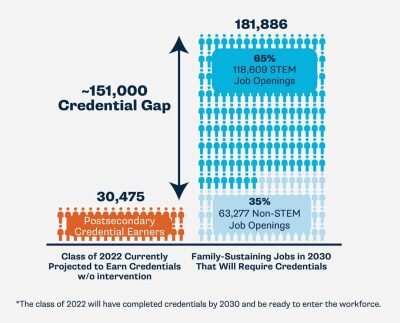
In the next decade—by 2030—there will be 151,411 more STEM jobs than local postsecondary graduates who can fill them, a significant gap. Without targeted investments and collective action in our early learning, K-12, and postsecondary institutions, Washington employers will continue to have to recruit workers from out-of-state. Meanwhile, the majority of high school graduates in Washington will not be prepared for anything other than the lowest-wage jobs in the state.
Collectively, we have a moral imperative to fix the system so that students’ aspirations are met with the support, education, and skills they will need to thrive in family-wage jobs here in our state.
You can learn more about Washington STEM's approach to ending generational poverty, building a stronger workforce, and creating a better future in our blog.
Links:
Project reports on GlobalGiving are posted directly to globalgiving.org by Project Leaders as they are completed, generally every 3-4 months. To protect the integrity of these documents, GlobalGiving does not alter them; therefore you may find some language or formatting issues.
If you donate to this project or have donated to this project, you can receive an email when this project posts a report. You can also subscribe for reports without donating.



Support this important cause by creating a personalized fundraising page.
Start a Fundraiser