By Laura Peckyno | Resource Development and Comms Coordinator
This summer, Washington STEM partnered with Eisenhower High School and OSPI to create a scalable approach to improving equity in dual credit programs.
What is Dual Credit?
Dual credit courses provide students with opportunities to earn high school and college credit at the same time. They can be course or exam based and there are a wide variety of options available.
Why Focus on Dual Credit?
Participation in dual credit programs is beneficial because it often reduces the time and money needed to complete a 2-year or 4-year degree. Dual credit programs can also help students build a college-going identity & confidence, and they are associated with a higher likelihood of enrolling in post-secondary education. But available statewide data show that enrollment in dual credit courses is not equitable along lines of race, income, gender, or geography.
By 2030, 70% of high-demand, family-wage jobs in Washington will require postsecondary degree credentials, so it’s vitally important that we support and improve credential attainment, particularly for Black, Brown, Indigenous, rural, and low-income students. Dual credit is a key lever we can push to reach our goals to ensure Washington students are career- and future-ready.
Improving Equity
Determined to better support their students, the administration at Eisenhower High School and Washington STEM dug deep into the course-taking data to understand student outcomes in relation to dual credit course participation. The data analysis revealed equity gaps—underrepresentation of student populations in various types of dual credit courses.
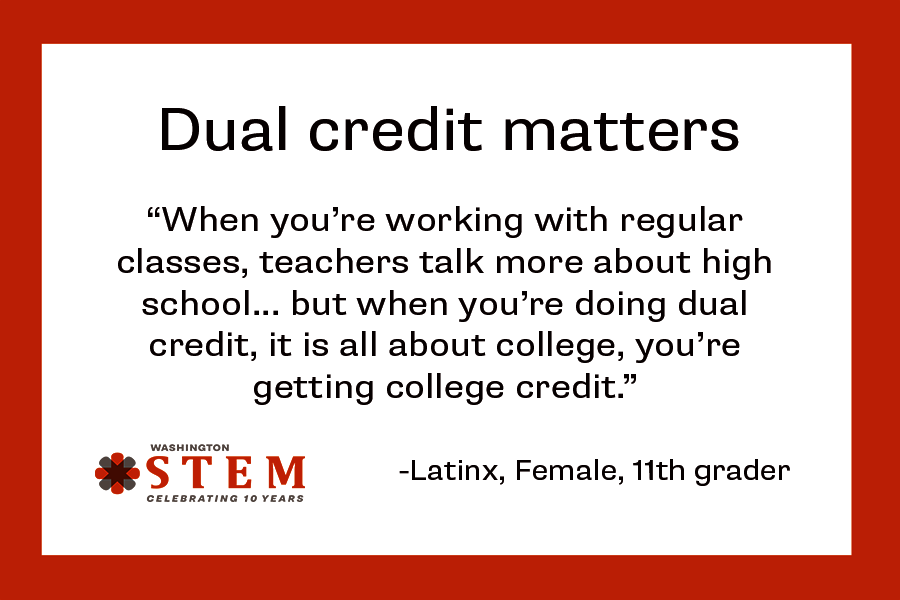
But both the administration and the research team knew that the data alone didn’t tell the full story. Through a series of interviews, with both students and staff, the team leveraged student and educator experiences to gain new insights into current dual credit programs and how to improve them.
Educator and Student Takeaways:
Planning for the Future
With data and perspectives in hand, Eisenhower High School built a plan to change problematic patterns in student access, enrollment, and transcription of dual credit. Beginning in fall of 2021:
Washington STEM's Continuing Work
As for Washington STEM, we’re developing an Equitable Dual Credit Toolkit in partnership with Eisenhower staff and our partners at OSPI. This toolkit is designed to help practitioners dig into dual credit. We’re also developing a strategy, and corresponding technical support, to help us build capacity with our partners to help other schools build equity across dual credit programs statewide. Given our relationships with STEM networks, the WSAC-led Dual Credit Task Force, and state agencies, we see an opportunity to leverage this work to advocate for statewide policies that increase equitable access, enrollment, and completion of dual credit—getting to the heart of what Washington STEM cares about: systems change.
Links:
Project reports on GlobalGiving are posted directly to globalgiving.org by Project Leaders as they are completed, generally every 3-4 months. To protect the integrity of these documents, GlobalGiving does not alter them; therefore you may find some language or formatting issues.
If you donate to this project or have donated to this project, you can receive an email when this project posts a report. You can also subscribe for reports without donating.



Support this important cause by creating a personalized fundraising page.
Start a Fundraiser