By Louise | Managing Director
From Dependency to Agency
When we invest in community-led development, we are not merely funding a program; we are capitalising the latent potential of local entrepreneurs. The story of Gladys, a 47-year-old mother from Burgersdorp, serves as a profound testament to how small, strategic injections of capital—combined with rigorous training—can dismantle generations of financial dependency.
In 2022, Gladys’s financial world was defined by waiting. Despite her husband’s steady employment, her personal agency was limited to the arrival of a monthly R350 ($20USD) social grant. Her journey began not with a grand expansion, but with a humble R20 loan for a community funeral. This was the "seed" moment—the first time Gladys experienced the dignity of self-directed financial choice.
The Multiplier Effect of the SHG Model
Through the Income Generation Training (Module 4), Gladys transitioned from a "borrower" to a "visionary." By identifying a critical service gap in her village—the lack of accessible photocopying—she took a bold R2000 investment. The impact of that investment has since rippled through her household and the local economy:
Financial Independence: Her weekly profit has grown from R2 (her first copy) to over R2000 per week (over $110USD).
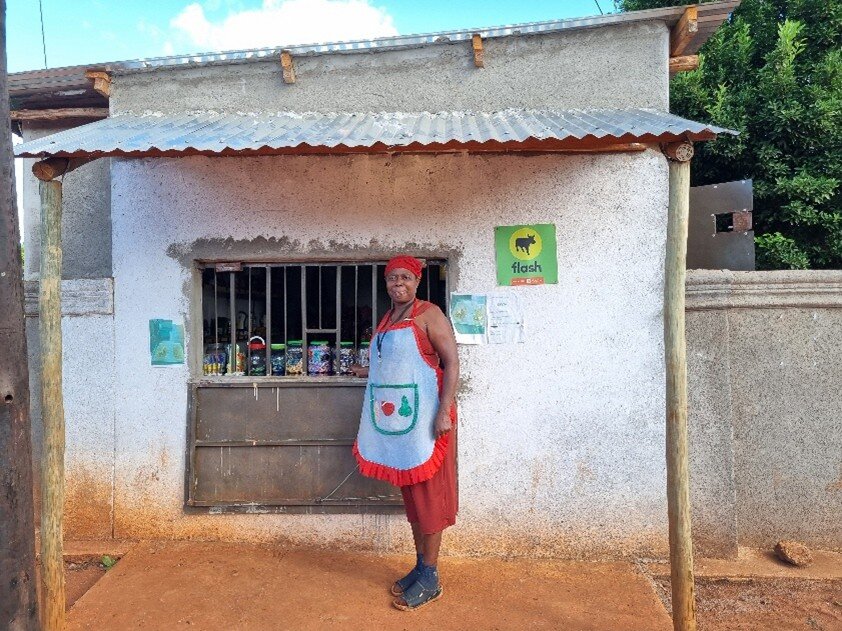
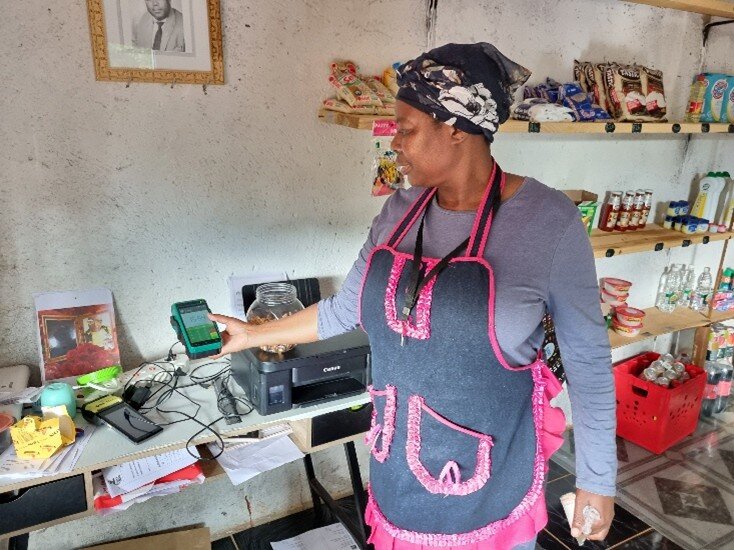
Asset Growth: She has successfully converted her home garage into a formal retail shop, equipped with a Speedpoint and specialized industrial machinery.
Leadership & Legacy: As a member of the Cluster Level Association (CLA), Gladys has moved from seeking a success story to becoming the example that counters the culture of complaint with a culture of results.
Our Shared Vision
Gladys’s goal is no longer just survival; it is expansion and job creation. Her story confirms that when donors provide the "fuel" of capital, the SHG framework provides the "engine" for sustainable, long-term growth. I invite you to read through the page below oon how your investment is not just changing a balance sheet, but is actively rewriting the future of families across the region.
The transformation we see in Gladys—from a woman waiting for a R20 loan to an entrepreneur generating R2,000 in weekly profit—is only possible because of your steadfast commitment.
Your investment provided more than just support through the staff and training it provided the infrastructure of hope. Through your support Gladys has been given the tools to move from a "survivalist" mindset to a "growth" mindset. Today, she is not just a beneficiary; she is a business owner, a community leader, and a role model for every woman in her Cluster Level Association (CLA).
Thank you for believing in the dignity of self-reliance.
Blessings
Louise
Gladys is a 47-year-old married woman with one child and one grandchild. She was born and raised in Burgersdorp, where she also married a man from the same town. Gladys attended school in Burgersdorp but dropped out after failing matric. On March 13, 2022, she joined Tiakeni SHG after hearing about the program from one of the pilot phase groups in Burgersdorp. Gladys's husband has worked for many years with EPW (Extended Public Works Program - a government program to employ people), and his salary has been sufficient to support their family.
After joining the group, Gladys’s first loan was for R20, which she used for a funeral in the community. This loan provided her with a sense of financial freedom, as she no longer had to wait for her husband to come home to ask for a small amount of money. This was the starting point of her financial independence, and although she frequently took loans and repaid them, she did not have an income she would sometimes use her son’s SASSA (South African Social Security Agency a grant equal to $20USD/month ) to repay the loans.
In 2023, the CF (Community Facilitator) came to train the SHG on module 4 - income generation. During the training, Mhloti asked the group what they bought at the local plaza and what they already had that they could sell in town or around the community. Gladys thought of a photocopying machine because in the community always struggle to make copies. On September 9, 2023, she boldly decided to take a loan of R2000 ($110USD) to purchase a photocopying machine outright. After getting a quote the local merchant for the machine, paper, and ink totaling R1800, she made the purchase. When she told her husband about her decision, he asked if she was sure, and she confidently replied that she was.
After buying the machine, Gladys began advertising her business to the women in her group, and word quickly spread. She still remembers her first client—a young girl needing a copy of her birth certificate—which earned her R2. This small amount profoundly impacted her life. Gladys noted that it's easy for people to underestimate the value of R2 (10cents USD), but to her, it signified financial freedom. Although business was slow in the first week after her purchase, she decided not to give up.
By October, as children began their exams, her business started to pick up. In just two weeks, she made over R500 ($27USD) profit, confirming she was on the right path. After repaying her first loan, she took out another loan for R1500 ($83USD) and began selling snacks from her garage. She was happy with her customer base and the profits she was making, often earning more than R1000 ($55USD) weekly from her copying and snack-selling business.
In 2025, Gladys and her husband discussed transforming their garage into a proper shop, which they did. She took a loan for R10,000 ($550USD) to buy a machine for making slap chips to sell kotas. Now, she has a speedpoint in her shop and sells airtime, bread, and cool drinks. Now Gladys makes more than R2000-00 ($110USD) weekly profit from her business and she is able to assist in households needs and repay her loan. What motivated her to grow her business was being part of the CLA has been eye-opening for Gladys. While other groups would complain about loan repayments, she recognized that she wanted to be one of the people with success stories, leading by example. Her dream is to eventually buy a car and expand her business further and employ other people.
Links:
Project reports on GlobalGiving are posted directly to globalgiving.org by Project Leaders as they are completed, generally every 3-4 months. To protect the integrity of these documents, GlobalGiving does not alter them; therefore you may find some language or formatting issues.
If you donate to this project or have donated to this project, you can receive an email when this project posts a report. You can also subscribe for reports without donating.