
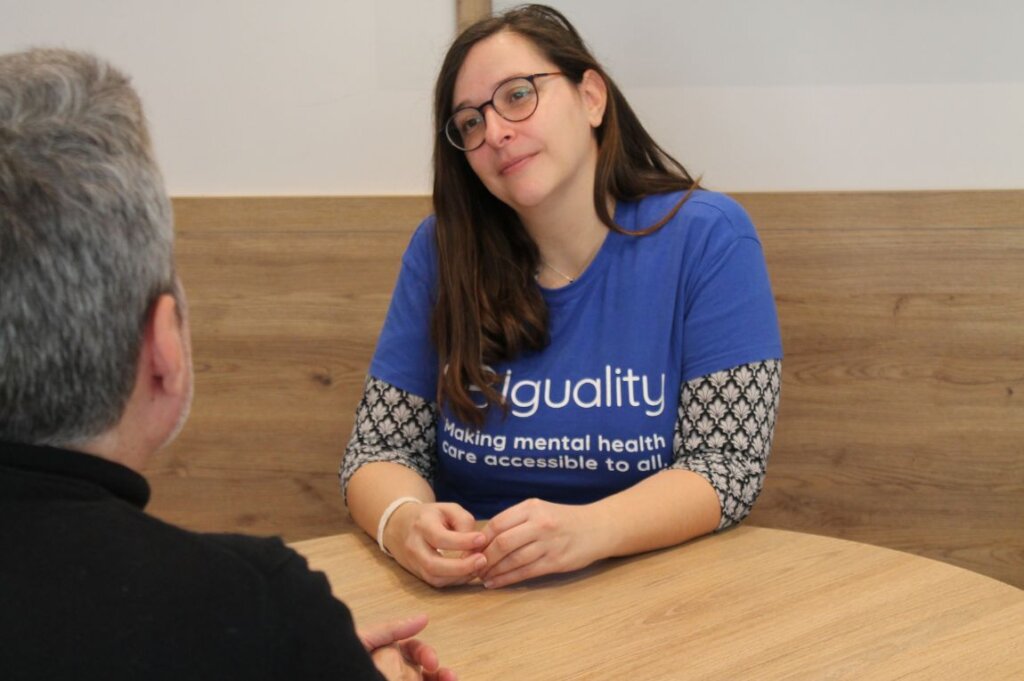

The mission of Associacio Iguality Lab i Comunitat is to ensure equitable, free, and culturally sensitive access to mental health and psychosocial support for people in situations of social and economic vulnerability, particularly migrants, refugees, LGBTQ+ individuals, and youth facing structural barriers. Its aim is not only to respond to unmet mental health needs, but to foster recovery, empowerment, and long-term social inclusion. This mission responds to a structural gap in access to mental health care. According to the Spanish National Health System Report (2023), 1 in 3 people in Spain experiences a mental health problem, most commonly anxiety and depression (6.7%). The report also h... read more The mission of Associacio Iguality Lab i Comunitat is to ensure equitable, free, and culturally sensitive access to mental health and psychosocial support for people in situations of social and economic vulnerability, particularly migrants, refugees, LGBTQ+ individuals, and youth facing structural barriers. Its aim is not only to respond to unmet mental health needs, but to foster recovery, empowerment, and long-term social inclusion. This mission responds to a structural gap in access to mental health care. According to the Spanish National Health System Report (2023), 1 in 3 people in Spain experiences a mental health problem, most commonly anxiety and depression (6.7%). The report also highlights the strong link between mental health and socioeconomic conditions, with higher risks of depression among people facing economic hardship and a higher prevalence among women. Despite this, Spain allocates only 5% of its total health expenditure to mental health and has around 6 psychologists per 100,000 inhabitants, compared to a European average of 18. Eurofound (2021-2022) further estimates that one fifth of unmet medical needs in Spain relate to mental health. At the same time, primary care is overstretched, with waiting lists of 7 to 9 months for specialised attention, limited consultation time, and high turnover of professionals, all of which undermine continuity of care and recovery processes. As a result, those who can afford it turn to private services, while those who cannot are left with significantly fewer options. Iguality is grounded in the understanding that mental health is shaped by social, economic, and cultural conditions. Many of the communities it serves face intersecting forms of exclusion-such as precarious living conditions, administrative instability, discrimination, and isolation-which both increase psychological distress and limit access to care. In addition, stigma and discrimination continue to influence the willingness to seek support, particularly among vulnerable groups, where cultural taboos, fear of judgment, and distrust in the healthcare system can delay access to help. Women, low- and lower-middle-income populations, and LGBTQ+ individuals are identified among the most affected groups. In this context, the organisation acts as a complementary bridge, addressing gaps left by existing systems and reaching those who remain underserved. Rather than relying on a purely clinical model, Iguality adopts a holistic, community-based approach. It combines psychoeducation, emotional support, and capacity-building strategies to help individuals understand their mental health, develop coping mechanisms, and actively engage in their own recovery. This also responds to the need for early detection and continuous support, identified as key factors in preventing the chronicisation of mental health conditions. At the same time, the organisation places strong emphasis on collective spaces as drivers of wellbeing. Group activities-including art therapy, sports, and community sessions-are designed to foster peer support, rebuild trust, and strengthen a sense of belonging. Recovery is approached as a relational process, shaped by social connection and participation, not only individual intervention. This perspective is reinforced through relational support initiatives such as the buddy programme, which connects participants with trained volunteers. These relationships facilitate integration, provide emotional support, and help individuals navigate daily life and access local resources, extending the impact beyond formal service provision. Alongside direct support, Iguality works to challenge stigma and transform public perceptions of mental health. Through awareness-raising actions and community engagement, it promotes more inclusive environments where seeking support is understood as a right rather than a weakness. Accessibility and inclusivity are central to its mission. All services are free of charge, removing financial barriers, and interventions are designed using intercultural and gender-sensitive approaches to reflect the diverse realities of participants. This mission is already reflected in Iguality's trajectory and results. To date, the organisation has provided emotional support to 207 beneficiaries, 63% of them women, with the involvement of 136 volunteer mental health professionals, 81% of them women. It has also organised 217 community sports sessions, helping improve emotional wellbeing, reduce social isolation, and strengthen community cohesion. In the area of awareness-raising, Iguality has delivered 32 events, talks, and training sessions in universities, specialised forums, and community spaces on mental health, stigma, and social inclusion, reaching 1,020 participants and amplifying these messages through social media and the media. These figures show that Iguality's mission is not only conceptual, but already embedded in a practical and growing model of community-based mental health support. The organisation mobilises a strong volunteer base-psychologists, social workers, and other professionals-expanding its capacity while fostering a model of shared responsibility and community engagement, supported by training and supervision to ensure quality. Finally, Iguality integrates continuous monitoring and evaluation to assess its impact on wellbeing, inclusion, and perceived support, allowing for ongoing adaptation and improvement of its programmes. Ultimately, Iguality's mission is rooted in the belief that mental health is a fundamental human right and a collective responsibility. By combining psychosocial support, community-building, and awareness-raising, it seeks not only to address immediate needs, but to respond to systemic gaps and transform the conditions that generate inequality and exclusion.

Each of GlobalGiving’s nonprofit partners is required to send quarterly donor reports detailing the impact of their work. Here are some of their recent updates:



