By Sierra James | Program Manager
The last several months have been filled with exciting progress on the Women Driving Peace and Economic Develop project that Ba Futuru is undertaking with the local organization Haburas Moris (OHM) based in Bobonaro Municipality.
We are successfully raising awareness of women’s issues, providing training that encourages women’s empowerment in the domestic decision-making and economic environment in which they live. It encourages entrepreneurial thinking, building business skills and confidence with the goal of their creating better livelihoods whilst also addressing disproportionate economic opportunities for women compared to men.
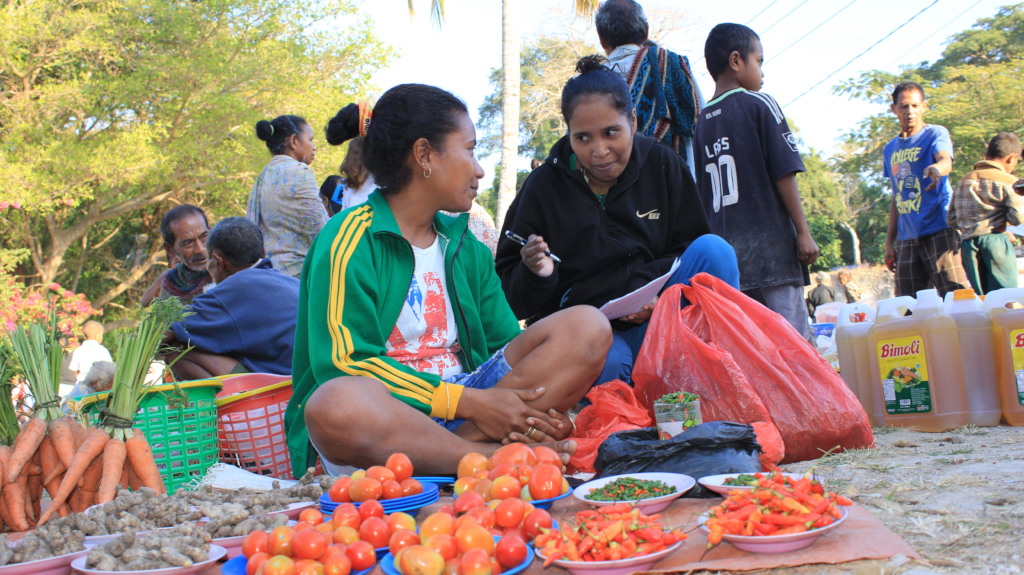
The project has included four community theater performances that have taken place in four different market places with an audience of more than 500 people at each performance. Dramatizing the information allows important knowledge transfer and behavior change messages to be understood across the community.
One 44-year-old female who is a seller in the market place said: “I am very happy with the theater performance I watched because through it I was able to gain information about how to run my own business. Every day I am busy selling goods and do not have time to watch television. In addition, I am happy because I can now better understand the resources that I have to increase my business. I want this kind of theater to continue to be performed in the market place, so that we can understand more on how I can be more successful in my business.”
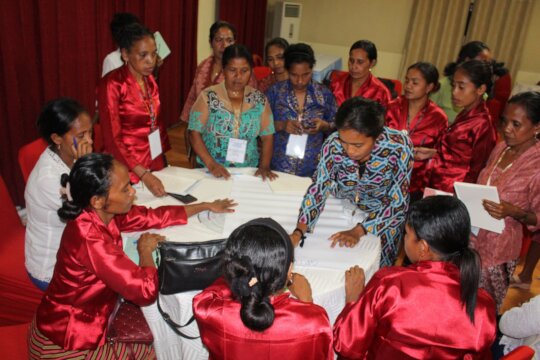
Thus far, we have also worked to empower 19 women with new skills through eight intensive days of training on topics including economic empowerment, conflict resolution, gender-based violence prevention, access to referral networks, budget planning, business promotion and marketing. We’ve also provided women guidance on making economic decisions in the household.
We also held focus group discussions in the target community before the training to encourage women to be able to participate.
One 45-year-old female said, “I am happy to participate in this activity because I can learn and share information with other participants about the importance of women in managing their own business and sharing the household work with their partner. I can now understand that when women make the decision to run a business it can help to increase the family income, and I understand that men can also do household work, not only women.”
Another 43-year-old female who is the head of a women’s group said, “I am very happy to participate in this training because it provided me with information about how to run a business, investigate what my existing resources are, better understand budgeting and gave me the opportunity to make an action plan to make things happen. Before attending the training, I did not realize that in our group we have different kinds of resources that can help us to increase our businesses. Now I can also better budget for and manage our income. Moreover, I appreciated the training because I was able to understand how to realize my objective through developing an action plan. I would like to recommend continuing the training.
Before and after the training participants were provided with assessment surveys so that there could be a gauge of their changes in attitudes and knowledge. Feedback from participants has been very interesting. When asked if they believed they could resolve conflict in the family and community without using violence before the training, 53% said yes, but afterwards this increased to 74%.
When asked if they agreed if a woman or man should hit their wife or husband when they disagree about spending money that was not according to their plan, beforehand 32% agreed and afterwards this decreased to 11%.
When asked if a person hits a member of their family inside their house, if this is a violation of the law, beforehand 47% said yes they believed it was a violation and afterwards this increased to 95% who said yes they knew it was a violation.
Participants all aksed that we continue to support rural Timorese women through this project.
Project reports on GlobalGiving are posted directly to globalgiving.org by Project Leaders as they are completed, generally every 3-4 months. To protect the integrity of these documents, GlobalGiving does not alter them; therefore you may find some language or formatting issues.
If you donate to this project or have donated to this project, you can receive an email when this project posts a report. You can also subscribe for reports without donating.