By MSF Staff | MSF-USA
“I was the only midwife on the day Sedra’s* mother came to MSF’s hospital in Syria,” says Amanda Godballe, a Danish midwife working with Doctors Without Borders/Médecins Sans Frontières (MSF) at one of its projects inside Syria.
“She was only six months pregnant, but the delivery had already begun,” Godballe continues. “She was expecting her first children, two twin girls. There was no way to stop the delivery as it was already too far along.”
Given the ongoing security and supply issues inside Syria, it’s proven extremely difficult to find or bring in all the equipment teams would live to have, or even that most Syrian hospitals had on hand before the war started. “In our hospital we had very limited possibilities of taking care of premature babies,” says Godballe. “We had no pediatricians, incubators, or medicine to treat babies this premature. And as I was the only midwife at the hospital that day I had to do some creative thinking, especially because I knew that the children were likely to need resuscitation to stabilize them enough to be transferred to a more fully equipped hospital over the border, where treatment was possible.”
So, she says, “I got my Belgian co-worker and nurse to help me in the delivery room, although she had never assisted with a delivery before. But inexperienced hands are better than no hands! At the same time I had my good Syrian colleague to help me and also an interpreter.”
“Both children were quickly born. First Sedra and then her sister. They each weighed about 1,200 grams [not quite 3 pounds]. Sedra was reasonably well stabilized with the help of an oxygen mask and an electric radiator to keep her warm. Unfortunately, her sister did not do as well. She died only 30 minutes old.”
Sedra, though, made it through those first few fraught moments. “Sedra was transferred to the border, in one of MSF’s ambulances, along with her mother. And there I was, in the backseat of an ambulance with a teeny tiny vulnerable human being, who had so many odds stacked against her. At the border we had to wait, and when the medics finally came I had to hand them the small bundle across the barbed wire fence, drive back to our makeshift hospital, and hope for the best.”
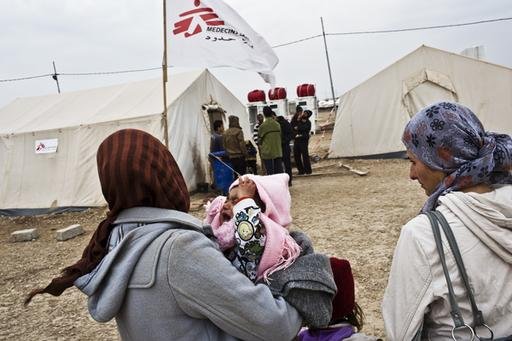
Later, an MSF logistician, Mario Travaini, who was working in the same makeshift hospital in Syria met Sedra and her mother when they visited the hospital to get Sedra’s birth certificate and thank the staff. The little girl had survived and was now in stable health.
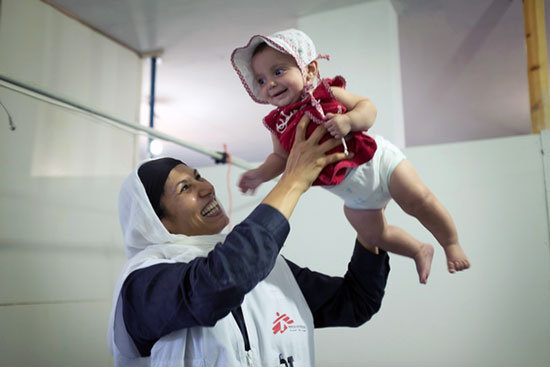
“It is touching to hear how they have done afterward,” says Godballe, who is now back in Denmark. “Sedra is doing well despite her hard beginning, which was followed by 24 days in an incubator. It is experiences of this kind that give you a sense of purpose. I can only do what I can with the limited resources available to me, but even that makes a difference.”
*name changed
“I was the only midwife on the day Sedra’s* mother came to MSF’s hospital in Syria,” says Amanda Godballe, a Danish midwife working with Doctors Without Borders/Médecins Sans Frontières (MSF) at one of its projects inside Syria.
“She was only six months pregnant, but the delivery had already begun,” Godballe continues. “She was expecting her first children, two twin girls. There was no way to stop the delivery as it was already too far along.”
Given the ongoing security and supply issues inside Syria, it’s proven extremely difficult to find or bring in all the equipment teams would live to have, or even that most Syrian hospitals had on hand before the war started. “In our hospital we had very limited possibilities of taking care of premature babies,” says Godballe. “We had no pediatricians, incubators, or medicine to treat babies this premature. And as I was the only midwife at the hospital that day I had to do some creative thinking, especially because I knew that the children were likely to need resuscitation to stabilize them enough to be transferred to a more fully equipped hospital over the border, where treatment was possible.”
So, she says, “I got my Belgian co-worker and nurse to help me in the delivery room, although she had never assisted with a delivery before. But inexperienced hands are better than no hands! At the same time I had my good Syrian colleague to help me and also an interpreter.”
“Both children were quickly born. First Sedra and then her sister. They each weighed about 1,200 grams [not quite 3 pounds]. Sedra was reasonably well stabilized with the help of an oxygen mask and an electric radiator to keep her warm. Unfortunately, her sister did not do as well. She died only 30 minutes old.”
Sedra, though, made it through those first few fraught moments. “Sedra was transferred to the border, in one of MSF’s ambulances, along with her mother. And there I was, in the backseat of an ambulance with a teeny tiny vulnerable human being, who had so many odds stacked against her. At the border we had to wait, and when the medics finally came I had to hand them the small bundle across the barbed wire fence, drive back to our makeshift hospital, and hope for the best.”
Later, an MSF logistician, Mario Travaini, who was working in the same makeshift hospital in Syria met Sedra and her mother when they visited the hospital to get Sedra’s birth certificate and thank the staff. The little girl had survived and was now in stable health.
“It is touching to hear how they have done afterward,” says Godballe, who is now back in Denmark. “Sedra is doing well despite her hard beginning, which was followed by 24 days in an incubator. It is experiences of this kind that give you a sense of purpose. I can only do what I can with the limited resources available to me, but even that makes a difference.”
*name changed
- See more at: http://www.doctorswithoutborders.org/news/article.cfm?id=7182&cat=voice-from-the-field#sthash.4RcS9yf6.dpufProject reports on GlobalGiving are posted directly to globalgiving.org by Project Leaders as they are completed, generally every 3-4 months. To protect the integrity of these documents, GlobalGiving does not alter them; therefore you may find some language or formatting issues.
If you donate to this project or have donated to this project, you can receive an email when this project posts a report. You can also subscribe for reports without donating.