By Mike Hall | Senior Advisor
Sudan has been in a state of conflict since mid-April, when violence first erupted between the Sudanese Armed Forces (SAF) and the Rapid Support Forces (RSF). Since then, more than 3.1 million people have been displaced, thousands of people have been killed and scores of women and girls have experienced conflict-related sexual violence. There have been additional reports of entire neighborhoods being destroyed, extrajudicial killings, ethnic violence and heightened rates of poverty and hunger. As of July 19, more than 2.6 million people have been displaced within Sudan and 750,000 others have fled to neighboring countries.
Challenges to providing aid in Sudan include insecurity, lack of visas, poor internet, power outages, lack of fuel, supply shortages, damaged facilities, restricted access, lack of access to funds in banks and attacks on humanitarian premises and warehouses. International Medical Corps is continuing to administer healthcare services in Sudan and surrounding countries despite these obstacles, but the increased destabilization and upcoming rainy season threaten to further complicate program delivery.
International Medical Corps Response
To meet increasing humanitarian needs in Sudan and surrounding countries, our teams are expanding existing programs in Sudan, the Central African Republic (CAR), Ethiopia and South Sudan.
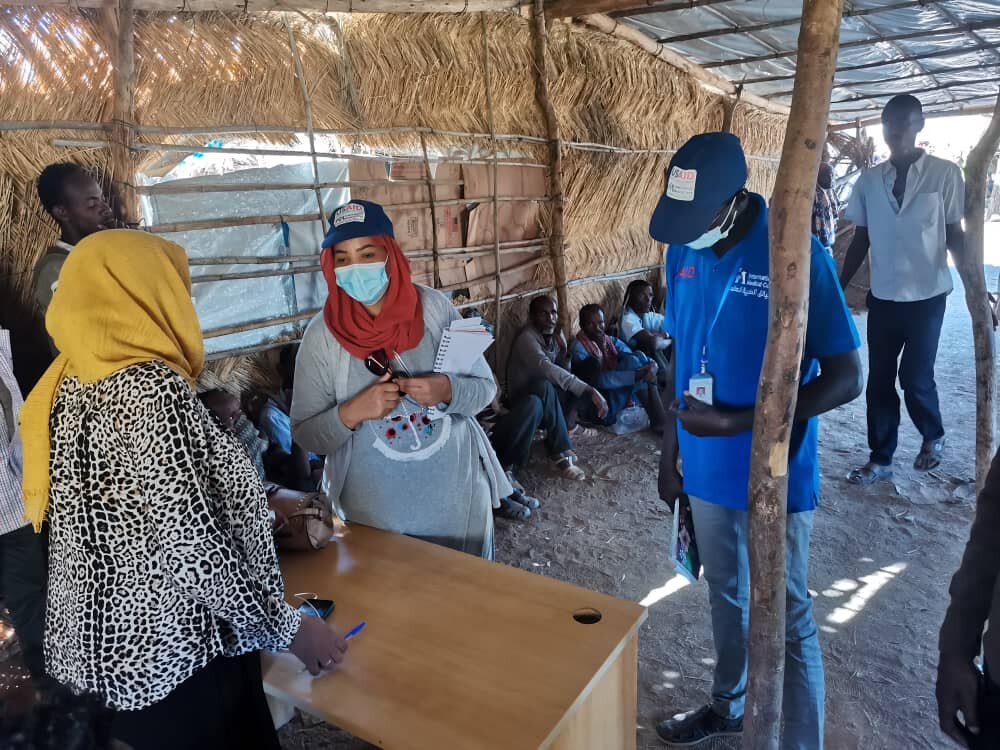
In Sudan, International Medical Corps is operating a mobile medical health and nutrition team (MHNT) in Souqatra Camp in Madani, where more than 1,200 internally displaced persons (IDPs) are residing. On average, the team is providing more than 100 outpatient consultations per week in Souqatra Camp. Most cases have been related to diarrhea, malaria, gastritis and malnutrition. In addition to outpatient consultations, the team is also providing reproductive health, immunization and health education services, reaching some 150 people per week. Last week, despite the Eid holiday, our team provided 163 reproductive health services, including 142 antenatal visits and 13 deliveries. The team also administered 142 vaccines to children under 5. The team will soon expand operations to include Fadasi and Shagdi Camps in Al Jazirah, where more than 3,000 people are sheltering.
In Sennar—where more than 50,000 people have sought safety—International Medical Corps is launching an MHNT to provide services in Karkoj in El Suki. We also will launch additional MHNTs in Sennar, working with the state Ministry of Health, to provide critically needed services in this area.
To support additional health needs in conflict-affected areas, International Medical Corps has partnered with a local network of doctors and nurses providing critically needed services and ensuring continuity of services in functioning hospitals. In June and July, the team performed 155 surgeries and provided services to 2,633 injured people in Khartoum, and performed 147 surgeries in Nyala. Care varies from minor surgical procedures to major surgeries in conflictaffected areas; the majority of services provided have been orthopedic surgeries, trauma care and urologic surgery.
International Medical Corps is also deploying a team to North Khartoum to coordinate with local health authorities to identify secure routes to transport medical commodities, supplies and pharmaceuticals to support healthcare facilities in Bahri locality. Before the conflict, the health infrastructure in Sudan was already weak, with nearly 80% of healthcare services located in Khartoum. The destruction of healthcare facilities in Khartoum effectively means paralyzing the entire healthcare system in Sudan.
We are continuing to work with the federal Ministry of Health (MoH) to identify opportunities to support functioning healthcare facilities to strengthen services. Primary needs reported in healthcare facilities include antimalarials, antibiotics, pediatric medicines and drugs for noncommunicable diseases. In addition to the healthcare needs in Sudan, needs around water, sanitation and hygiene (WASH) have intensified, with damage to infrastructure affecting the availability and quality of water. In the immediate days following the beginning of the crisis, International Medical Corps procured and distributed hygiene kits and infection prevention and control (IPC) materials to health facilities in Madani. Our teams are working to procure additional IPC and WASH items to support functioning facilities and families residing in the camps where our MHNTs are operating. Further WASH needs—supplies and hygiene kits for IDPs, IPC materials for hospitals and water trucking—have been reported in the affected region.
In Darfur, where access remains a challenge, International Medical Corps is working with partners to import and transport essential pharmaceuticals, medical supplies and consumables to Sudan through Chad.
Congestion in Port Sudan has delayed shipments from international suppliers, so International Medical Corps is working quickly to identify local vendors to provide immediate support for supplies, pharmaceuticals, medical equipment and commodities. Cold-chain facilities for pharmaceuticals are scarce in the country, but International Medical Corps is looking for alternatives to ensure that the quality of medical commodities is maintained. We are attempting access to the Darfur region by road from Port Sudan on a case-by-case basis, but so far such access is not guaranteed. Cross-border operations from Chad remain as the most accessible supply route, although many security constraints remain. The rainy season, from June to September, is also expected to pose additional access challenges due to the high potential for flooding, which complicates movement and supply delivery. Despite the obstacles our teams are facing, we are continuing to coordinate with partners, other NGOs and local authorities to ensure continuity of care to the affected region.
International Medical Corps has been working in Sudan since 2004, providing critically needed health, nutrition, mental health and psychosocial support (MHPSS), protection and WASH services. We have also supported efforts by the country’s MoH to strengthen health systems and build capacity for providers.
In CAR, International Medical Corps remains the only NGO supporting refugees and returnees in the border town of Am Dafok, where we are continuing to provide primary healthcare, MHPSS, nutrition and protection services despite ongoing challenges. We were in the process of relocating Korsi, a new site in Birao, where almost 1,200 people have sought safety, but the transition was interrupted by heavy rains, flooding and insecurity. Compounding these challenges, inflation in CAR has drastically increased, with the price of necessities having tripled. Am Dafok and Birao are both on the brink of falling into a food crisis.
In response, International Medical Corps has supported nutrition activities in Am Dafok’s health facility, including detection, management of severe acute malnutrition (SAM) and prevention activities. Our teams also identified 11 new community health workers (CHWs) whom we have trained in screening and who have carried out systematic screening at the health facility and community level. Since May, we have screened more than 2,700 children age 6–59 months for malnutrition. Working with local authorities, we have continued to provide health and protection services to asylum seekers and host communities, reaching 3,268 children with a measles vaccination campaign; providing 7,435 curative consultations; administering antenatal care to 218 women; assisting with 43 deliveries and providing case management services; providing gender-based violence (GBV) support and psychosocial support (PSS) to 234 survivors of GBV; and distributing 147 dignity kits to vulnerable women and GBV survivors. Working with resident community leaders and leaders of the asylum-seeking community, we have established a protection committee of 15 community volunteers who we have provided with information on GBV and on sexual exploitation and abuse basic concepts and guidelines. The volunteers conducted awareness-raising sessions for the host and asylum-seeking communities, reaching 1,151 people. To mitigate the lack of women’s and girls’ safe spaces, our teams gathered 454 women and 655 girls to conduct smallgroup psychosocial activities, such as group discussions, dancing and singing.
Our teams have worked in CAR since 2007, providing support in primary healthcare, nutrition, GBV treatment and prevention, and reproductive, maternal and child health. International Medical Corps has also provided training for healthcare providers, midwives and protection assistants to help build the capacity and awareness of community groups.
Though International Medical Corps currently has ceased Sudan response activities in Ethiopia due to the unavailability of funding, we have transitioned services to the zonal Ministry of Health and the partners present at the Metema point of entry. UNICEF is currently undertaking activities at the Metema Transit Center, while another international NGO is providing medical and nutrition programs at Kumer refugee site. At the Metema Transit Center, our team provided more than 2,400 consultations to refugees and asylum seekers. More than 65,000 people have crossed into Ethiopia since the onset of the crisis in Sudan. Food, shelter, WASH, transportation and protection services remain among the primary needs at all points of entry and the sites where returnees and refugees are sheltering.
International Medical Corps has worked in Ethiopia since 2003, with programs in nutrition, primary healthcare, community health, sexual and reproductive health, MHPSS, GBV, livelihoods, disaster-risk reduction and WASH. We have provided services in more than 60 woredas in eight regions: Afar, Amhara, Benishagul-Gumuz, Gambella, Oromia, Somali, Southern Nations Nationalities and People’s Region (SNNPR), and Tigray.
In South Sudan, where International Medical Corps has been responding to the influx of refugees and returnees since May, we are providing primary healthcare, GBV and nutrition services at the Malakal Bulukat Transit Center and Renk Transit Center. More than 170,000 people have so far crossed into South Sudan from Sudan, with significant numbers of people still coming into the country each day. Approximately 1,000 to 1,500 people are arriving per day through the Renk Transit Center, while 500 to 1,000 people are arriving daily through the Malakal Bulukat Transit Center.
The new arrivals have added more pressure to already-scarce resources, leading to stock shortages at International Medical Corps-supported facilities. Since the increased utilization of services has resulted in shortages of drugs and medical commodities, we are requesting interagency emergency health kits (IEHKs) from the WHO to support our operations in the centers. Additional challenges include the lack of accommodation in Renk for supervision and technical support visits, and a lack of vehicles for the movement of staff, supplies and patient referrals. Many returnees and refugees traveling from Sudan have been exposed to diseases during their travel, due to the lack of shelter, poor WASH infrastructure and equipment, and the rainy season, which has increased cases of malaria and diarrheal diseases, especially among children.
International Medical Corps has so far helped 109,926 people in South Sudan. Over the past month across both transit centers, our teams have provided 7,494 people with outpatient consultations; reached 28 people with mental, neurological and substance-use consultations; delivered MHPSS services to 267 people, provided GBV response services, including PSS activities, for 3,169 people; screened 3,816 people for malnutrition; distributed 227 dignity kits to women and girls; and vaccinated 787 children under 5. We are continuing to coordinate at the implementation sites and at national and international levels to ensure the extension of service delivery, despite ongoing challenges in the response.
International Medical Corps has worked in South Sudan since the mid-1990s, offering primary, secondary and tertiary healthcare, maternal and child health, nutrition, GBV prevention and response, and MHPSS services.
Project reports on GlobalGiving are posted directly to globalgiving.org by Project Leaders as they are completed, generally every 3-4 months. To protect the integrity of these documents, GlobalGiving does not alter them; therefore you may find some language or formatting issues.
If you donate to this project or have donated to this project, you can receive an email when this project posts a report. You can also subscribe for reports without donating.



Support this important cause by creating a personalized fundraising page.
Start a Fundraiser