By Christin Runkle | Communications Consultant
On June 24, Northern Venezuela was hit by two devastating earthquakes in rapid succession. The earthquakes caused severe structural damage across Aragua, Carabobo, Caracas, Falcón, La Guaira and Miranda states, and left more than 6,500 dead, nearly 17,000 injured and 24,000 displaced.
As of October 15, International Medical Corps has provided health services to more than 20,000 people impacted by the earthquakes. This is how we did it.
International Medical Corps’ mission in Venezuela, which opened in 2019, sprang into action, conducting needs assessments the day after the quakes and coordinating with the Ministry of Health on how best to respond. Meanwhile, our Emergency Response Unit (ERU) and Logistics teams at headquarters began mapping out how to bring outside resources into the country.
While the Venezuela team deployed mobile medical units with the supplies and staffing they had on hand, the ERU and Logistics teams started the process of deploying our EMT Type 1, an outpatient field clinic that can help more than 100 patients a day.
For the Logistics team, deploying the EMT is a major endeavor.
“The deployment of an EMT Type 1 requires about four Logistics staff members to run procurement, fleet, stock management, site setup and IT management,” says Ronny Elfassy, Senior Director of Global Logistics and Supply Chain. “There’s a lot to do under the umbrella of operations.”
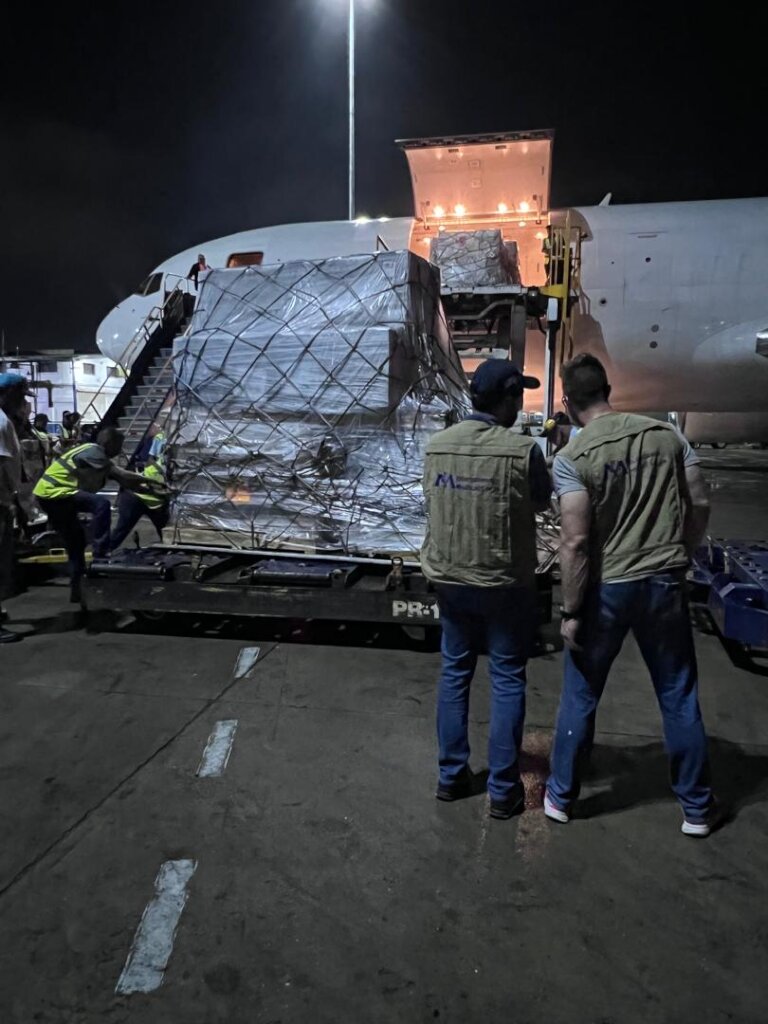
The Logistics team reached out to our partner FedEx, whose warehouse in Memphis stores the EMT’s supplies, including tents, air-conditioning units, generators, furniture, and water, sanitation and hygiene (WASH) supplies—everything except for medical equipment and pharmaceuticals, which our supplier Imres stores for us in the Netherlands. The EMT is made up of 150 pallets, weighing roughly 35 tons—“about six elephants’ worth of weight,” Ronny says—so we also reached out to our partner Airlink to see if we could charter a plane to transport it to Venezuela.
In Panama, we had previously prepositioned an emergency-response field unit—a non-medical kit that we can deploy and set up quickly, with all the furniture, generators and WASH items needed to run a small mobile clinic. Because deploying the EMT can take some time, we told the Ministry of Health that we would deploy first this field unit to provide services until the EMT was up and running.
The airport in Caracas, which was damaged by the earthquakes, was only accepting incoming humanitarian charter planes, so we worked with the Red Cross to get our supplies cleared through customs quickly and with Airlink to get our planeload of supplies onto the tarmac, where US State Department officials were helping to unload planes.
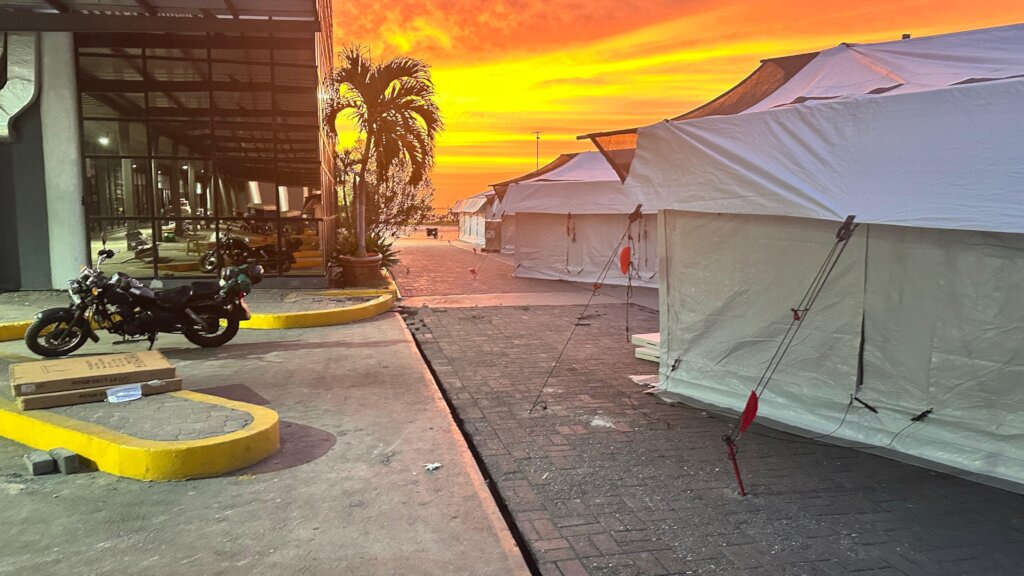
After assessing the area, the ERU decided to set up the EMT at a bus terminal 20 minutes from Caracas airport that was not functioning due to earthquake damage, but could accommodate the EMT’s tents and infrastructure. Logisticians and members of our WASH team quickly set up the facility, assisted by a contracting company that had previously helped another NGO set up similar tents. Teams worked around the clock, with many people sleeping only two hours a night.
“Once the supplies arrive, our goal is to get the site set up within 48 hours—and that’s not easy to do,” Ronny says.
The Logistics and WASH teams designed the layout of the EMT to optimize patient flow. The teams set up the warehouse tent first so that we could store and organize our pallets and protect them from the elements. We then set up our pharmacy, with an HVAC unit to keep medicines at the proper temperature. In the bus terminal, the WASH team found a 90,000-liter water tank that they emptied, cleaned out, disinfected and filled with trucked-in water, which they then treated with chlorine and tested for safety; water from that tank is now being piped all around the EMT. We contracted with a local company to provide portable latrines and ongoing cleaning services.
Fortunately, the bus terminal still had electricity, which gave us the ability to hardwire all of the tents to power, and use generators only when the power went down, which did happen occasionally. We also hired a security company to provide 24-hour security at the site to prevent theft.
“There are a lot of moving pieces,” Ronny explains.
Typically, the EMT requires about 35 staff members to operate, which means that Logistics also needs to bring in a fleet of seven or eight vehicles to transport them to and from base camp. Fortunately, during this response we found a hotel within walking distance of the EMT. Having a hotel nearby lowers our fleet needs and takes stress off the infrastructure of the EMT, since it doesn’t have to host staff members overnight. After a structural engineer reviewed the hotel and confirmed its safety, our team moved in. Since then, the hotel owners have been extremely supportive, catering breakfast and dinner for us from their restaurant and going out of their way to connect us with urgently needed supplies, such as generator fuel or ice.
Because of the tremendous damage the earthquakes caused, there is a huge need for healthcare services in the area. The EMT is now seeing about 140 patients each day. The high volume of patients requires us to procure large quantities of medical supplies and pharmaceuticals as quickly as possible.
It’s never easy to respond to an emergency or set up an EMT, but International Medical Corps’ teams have once again risen to the occasion, and succeeded through knowledge and teamwork.
“This response was a very large logistic lift, but we what we noticed was that the ERU and the country team integrated and worked very well together in a really supportive way,” Ronny says. “It was just an amazing partnership.”
Project reports on GlobalGiving are posted directly to globalgiving.org by Project Leaders as they are completed, generally every 3-4 months. To protect the integrity of these documents, GlobalGiving does not alter them; therefore you may find some language or formatting issues.
If you donate to this project or have donated to this project, you can receive an email when this project posts a report. You can also subscribe for reports without donating.


Support this important cause by creating a personalized fundraising page.
Start a Fundraiser