By Yuliia Magera | Donors' stewardship manager
For children who have lost one or both parents as a result of the war, the opportunity to spend time in a safe environment, make new friends, and experience a sense of support is especially important. War changes not only the circumstances of their lives but also their sense of stability, trust in the world around them, and confidence in their own future. Psychological recovery, social connection, and personal development are therefore essential components of long-term support for these children.
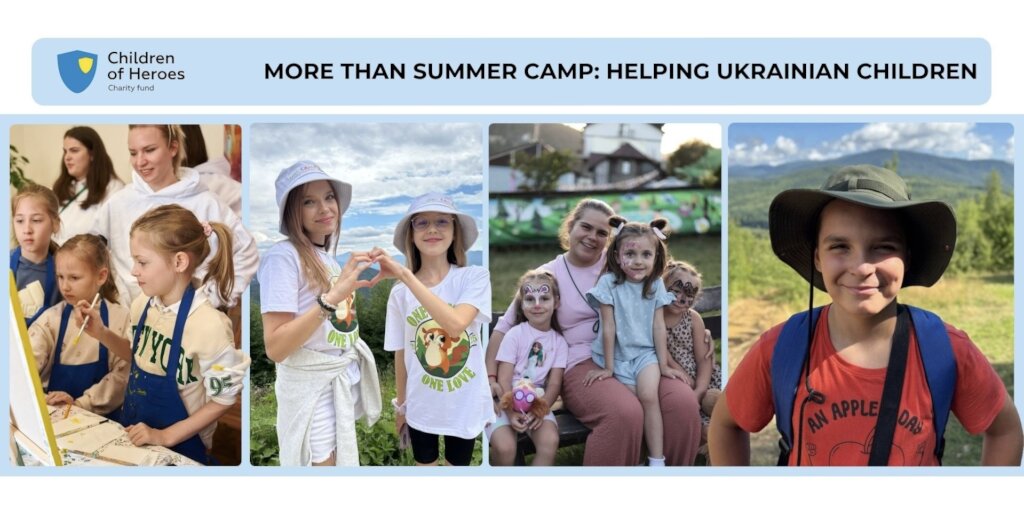
Between July and September 2026, the Children of Heroes Charity Fund once again organised a series of camp programmes designed to help children regain emotional balance, develop new skills, and enjoy positive experiences through interaction with their peers.
Svitliachok Camp, Terra Heroica, Smart Money Camp, Syla v tobi Camp, and One Camp Italy programmes offered different formats and activities, ranging from psychological support for children and their mothers to financial education, creative development, and outdoor recreation. Yet they all shared a common goal: to create an environment where children who have experienced loss could feel safe, discover new opportunities, and gradually rebuild confidence in their own abilities.
Svitliachok Camp: a space for recovery for children and their caregivers
In July and September 2026, the Children of Heroes Charity Fund organised three sessions of the Svitliachok psychosocial recovery programme in the picturesque Carpathian Mountains near Bukovel. A total of 241 people participated, including 125 children and 116 adult caregivers.
What makes Svitliachok Camp distinctive is its family-centred approach to psychological support. The programme is designed not only for children who have lost one or both parents because of the war, but also for the adults who are also affected by the loss.
Throughout the projects, families participated in individual counselling and group sessions with psychologists, creative activities, and shared recreational experiences. Spending time in nature, away from the pressures of everyday life, provided an opportunity for emotional recovery, stronger family relationships, and meaningful connections with other families facing similar challenges.
Participants reported positive changes in the emotional well-being of both children and adults. Children became calmer, more open, and more confident, while mothers described feeling less overwhelmed and better able to restore their emotional energy. Another important outcome was the development of new friendships and a stronger sense of community support.
Impact Story #1. Mykola: Rebuilding a Sense of Safety
Mykola lives in Kyiv with his mother. Following the start of Russia's full-scale invasion and the death of his father, the family faced constant anxiety, uncertainty, and emotional exhaustion. Repeated Russian attacks only intensified the stress experienced by both mother and son. According to his mother, Mykola gradually lost his sense of safety, while she herself lived with a constant fear for their lives.
Participating in Svitliachok Camp gave the family an opportunity to spend time in a peaceful environment, receive professional psychological support, and regain some of their strength. During the project, Mykola began sleeping better and his appetite improved. His mother also found that the psychologists' support and time spent in a safe setting helped her restore some of her emotional resilience.
Team activities were particularly beneficial for Mykola. He especially enjoyed trips to Bukovel and Yaremche, group games, and evening activities. For his mother, the psychological counselling sessions and conversations with other women facing similar difficulties were especially valuable.
"Thanks to the Svitliachok project, my son received much-needed psychological support. Our daily routine improved: he started going to bed on time, and his diet became more varied – he even began eating meat. I felt tremendous support from the psychologists and was able to regain some of the emotional strength I need as a mother while staying in a safe place," Mykola's mother shared.
For their family, the camp provided a chance to step away from constant stress, rebuild everyday routines, and enjoy positive experiences together.
For many participants, Svitliachok Camp was more than an opportunity to rest. It became a place where they could feel supported, regain emotional strength, and build new social connections. The three projects demonstrated the importance of comprehensive assistance that supports not only the child but also the adult caring for them. Children's psychological well-being is closely connected to that of their closest family members, and positive shared experiences can help families gradually restore a sense of stability and confidence in the future.
Terra Heroica: helping children rediscover their inner strength
From 6 to 16 September 2026, the final session of the Terra Heroica psychosocial recovery project took place in Tatariv, a village in the Carpathian Mountains, welcoming 80 children. Across three sessions, the project provided comprehensive support to 240 children who had lost one or both parents as a result of the war.
The project was organised in cooperation with Solidarity Fund PL in Ukraine, with the involvement of psychologists from the Children of Heroes Charity Fund and the One Camp team. Its primary goal was to help children recognise their inner strength, rebuild self-confidence, and understand that even after experiencing profound loss, they can continue to dream, grow, and shape their own futures.
The programme combined individual counselling and group sessions with psychologists, art therapy, sports, excursions, and recreational activities. This approach made it possible not only to address the emotional consequences of loss but also to create positive experiences of friendship, communication, and shared activities.
Following the camp, parents reported improvements in their children's emotional well-being, greater openness to communication, and the formation of new friendships. Families particularly valued the professional support provided by psychologists, the atmosphere of safety and trust, and the opportunity for children to take a break from the pressures of everyday life.
Impact Story #2. Ivan, 12: ten days without constant fear
Ivan grew up in the small border town of Druzhba in a family of railway workers. Following the start of Russia's full-scale invasion, his father volunteered to defend Ukraine. On 14 January 2023, he died in a hospital in Zaporizhzhia.
After losing his father, Ivan moved with his mother, Oksana, to Konotop. The boy struggled deeply with his father's death. According to his mother, he often cried, found it painful to see other children with their fathers, and frequently spoke about how different life might have been if his dad were still alive.
The constant attacks on Konotop only intensified his anxiety. Ivan developed sleep difficulties and frequent headaches. He was already receiving psychological support from the Children of Heroes Charity Fund, and his participation in Terra Heroica became another important step in his recovery.
When Oksana applied for the camp programme, she hoped that a change of environment, time with peers, and professional support would help her son feel better. Her hopes were realised. According to his mother, Ivan did not complain of the headaches that regularly troubled him at home throughout his stay in the Carpathians. He enjoyed the camp programme so much that he did not even want to leave.
For Oksana, those days also brought a welcome sense of relief. Knowing that her son was in a safe environment, supervised by responsible adults, allowed her to go to work without constantly worrying about his safety.
"I'm almost embarrassed to admit it, but after the camp programme, he didn't want to come home," Oksana shared. "He told me that he never had a headache during the programme, whereas at home, unfortunately, he complains about headaches all the time. For those 12 days, I could go to work without constantly worrying that my child was spending the night alone at home, surrounded by air raid alerts and explosions."
Ivan's experience illustrates how essential a sense of safety is to psychological recovery. Even a relatively short stay in an environment where a child can escape constant threats, make friends, and receive support can have a positive effect on their physical and emotional well-being.
It also highlights the importance of a comprehensive approach that combines psychological support with recreation, new friendships, and positive experiences. For children who have lost a parent, such programmes offer not only an opportunity to regain strength but also an experience of trust, acceptance, and belonging.
One Camp Italy: new horizons and growing self-confidence
From 11 to 18 August 2026, 14 teenagers aged 13 to 15 who had lost one or both parents as a result of the war participated in the international One Camp Italy programme. Held in Tonezza del Cimone, in the province of Vicenza, the camp offered children an opportunity to discover a new country, experience European culture, and develop independence through travel.
The journey took participants from Ukraine through Hungary and Slovenia to Italy. The programme combined educational excursions, outdoor activities, creative workshops, and opportunities to connect with peers. Children visited Venice, Lake Garda, and Sirmione, participated in sports and team games, treasure hunts, arts and cooking workshops, and interactive English-language activities.
For many participants, this was their first trip abroad and an opportunity to discover a world beyond the everyday realities of war. New cultural experiences, shared activities, and a welcoming environment helped the teenagers develop independence, self-confidence, and communication skills.
The programme's variety was particularly valuable, keeping children actively engaged, encouraging them to discover new interests, and helping them build friendships. According to feedback from families, participants returned home with positive memories, new connections, and a desire to continue exploring the world.
Impact Story #3. Daniil, 15: from loss to new discoveries
For 15-year-old Daniil's family, the war brought an irreversible loss: his father was killed. The first days after receiving the tragic news were filled with grief, tears, and confusion. The children repeatedly asked their mother why this had happened, while the family struggled to gradually rebuild a sense of normality, drawing support from loved ones and professionals.
When the opportunity arose for Daniil to attend One Camp in Italy, his mother could hardly believe that he might be selected. Above all, she wanted her son to see more of the world, gain new experiences, and feel that life could continue despite the tragedy he had endured.
The journey was particularly meaningful for Daniil. It was his first time travelling abroad and his first opportunity to spend his holidays in such an international environment.
After he returned, his mother noticed a change in his mood. Daniil came home smiling, full of enthusiasm and new impressions. He eagerly shared stories about the friends he had made, the activities he had enjoyed, the places he had visited, and the experiences that had made the trip so memorable.
The camp became a place where he could feel supported, make new friends, and rediscover the joy of connecting with others and exploring new things.
Daniil is passionate about history and antiques. He enjoys metal detecting, running, football, and physical training. Travelling to Italy allowed him to broaden his interests, discover another country's cultural heritage, and gain experiences that will stay with him for years to come.
"A happy child means a happy mother." This is how Daniil's mother described the most important outcome of her son's participation in the programme. She said he returned more open, cheerful, and full of new experiences. For her, it was especially meaningful to see that, despite the loss he had endured, her son could once again find joy, make friends, and approach the world with curiosity.
Daniil's story demonstrates that supporting children who have lost parents to war must go beyond helping them cope with the psychological consequences of grief. It is equally important to provide opportunities for personal development, exploration, independence, and a positive outlook on the future.
For the participants of One Camp Italy, the journey was not simply an introduction to a new country. It was an opportunity to discover their own independence, build meaningful friendships, and realise that many new experiences and opportunities still lie ahead.
Results and impact
The camp programmes organised by the Children of Heroes Charity Fund between July and September 2026 formed an important part of its comprehensive support for children who have lost one or both parents as a result of the war.
Despite their different formats, all the programmes worked towards a shared outcome: helping children regain emotional balance, develop social and practical skills, find support, and gradually build confidence in their own futures.
Psychosocial recovery programmes provided an environment that helped reduce anxiety, strengthen emotional resilience, and overcome social isolation. Educational programmes equipped children with knowledge and skills essential for independent living. Meanwhile, outdoor activities, creativity, and time spent with peers gave them opportunities to enjoy positive childhood experiences.
What makes this approach particularly important is that support does not end when the programme comes to a close. For many children, these programmes form part of a longer recovery journey that includes continued psychological, educational, and social assistance.
By supporting children today, we are creating opportunities for their future. Ukraine's recovery will depend not only on rebuilding its cities and infrastructure, but also on a generation of children who will grow, learn, develop their talents, and eventually help shape the country's future.
We are sincerely grateful to GlobalGiving donors, our partners, and everyone who helps create safe environments and new opportunities for Ukrainian children to recover, grow, and thrive.
By Oleksandra Mishkevych | Donors' stewardship & support manager
By Oleksandra Mishkevych | Donors' stewardship and support manager
Project reports on GlobalGiving are posted directly to globalgiving.org by Project Leaders as they are completed, generally every 3-4 months. To protect the integrity of these documents, GlobalGiving does not alter them; therefore you may find some language or formatting issues.
If you donate to this project or have donated to this project, you can receive an email when this project posts a report. You can also subscribe for reports without donating.


Support this important cause by creating a personalized fundraising page.
Start a Fundraiser