Project Report
| Nov 6, 2023
Progressive Report
By Imani Haule Mathias | General Manager of the organization
Southern Highland Participatory Organization (SHIPO) is a non-governmental organization based in
Njombe Region. The organization works in three Districts which are Njombe, Wnging’ombe and Ludewa,
SHIPO also works in partnership with other organizations in and outside Njombe Region in providing
services to the community. SHIPO involves it self 100% to help the government in solving different
challenges as part of its responsibility to the community, however SHIPO supports local communities in
rural and urban in their efforts to improve their standards and alleviate poverty.
To contribute to ensure inclusive and equitable quality education and promote lifelong learning opportunities for all (SDG 4).
Recently, nothing to report, The fund raising is still ACTIVE on the GG platform with 95 USD donation already secured and still more funds to start the project on RWH..
Otherwise, thank you for the contributions towards welfare of the people in Tanzania.
![Share on Twitter]()
![Share on Facebook]()
Jul 17, 2023
PROGRESS REPORT
By Imani Mathias | RAIN WATER HARVESTING & WATER RECHARGE SYSTEM
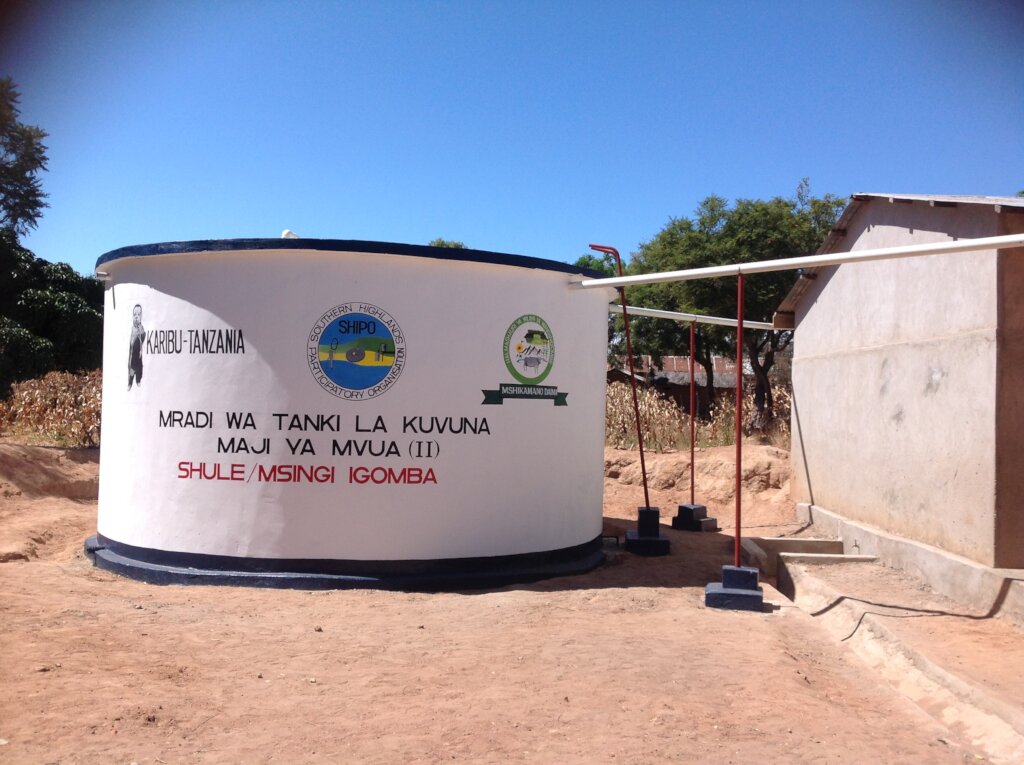
There is sufficient evidence supporting the fact that climate change and variability are pervasive realities that are strongly impacting both human and natural systems, including conservation of edible orchids in Southern Highland of Tanzania. Rainwater harvesting (RWH) is one possible appropriate technological option to improve water supply and water recharge for restoration of the water to its nature. The challenges are the scarcity of water in an area of which came from climate change. More than 64512 in the project schools are affected by the drought. The community that are affected shall benefit from the solution including students as well the community surrounding the public institutions where the projects are intervened. Getting water shall not depend on fetching water from the natural source where found its scarcity, instead water will be matched from building roofs such as Schools, Health centers and others such as community that shall be trained and practices from the water catchments of which after uses of that water, the remaining shall get recharged underground and later to get recycled for water restoration to its nature. It may include conservation of new area to enable other habitats and orchid species to migrate in response to climate change. In order to assess stress and mitigation for assisted migration, monitoring, research and scientific experiments can be applied over long duration of time . Such measures will help to avoid bias and allocation of species for unsustainable habitats including an area with abundant invasive species Unfortunately, The project is still under donation, not reached and ready for implementation.
The project is still under donation, not reached and ready for implementation
![Share on Twitter]()
![Share on Facebook]()
Mar 9, 2023
PROGRESS REPORT
By Imani Haule Mathias | General Manger
There is sufficient evidence supporting the fact that climate change and variability are pervasive realities that are strongly impacting both human and natural systems, including conservation of edible orchids in Southern Highland of Tanzania. Rainwater harvesting (RWH) is one possible appropriate technological option to improve water supply and water recharge for restoration of the water to its nature. The challenges are the scarcity of water in an area of which came from climate change. More than 64512 in the project schools are affected by the drought. The community that are affected shall benefit from the solution including students as well the community surrounding the public institutions where the projects are intervened. Getting water shall not depend on fetching water from the natural source where found its scarcity, instead water will be matched from building roofs such as Schools, Health centers and others such as community that shall be trained and practices from the water catchments of which after uses of that water, the remaining shall get recharged underground and later to get recycled for water restoration to its nature. It may include conservation of new area to enable other habitats and orchid species to migrate in response to climate change. In order to assess stress and mitigation for assisted migration, monitoring, research and scientific experiments can be applied over long duration of time . Such measures will help to avoid bias and allocation of species for unsustainable habitats including an area with abundant invasive species Unfortunately, The project is still under donation, not reached and ready for implementation.
The project is still under donation, not reached and ready for implementation
![Share on Twitter]()
![Share on Facebook]()