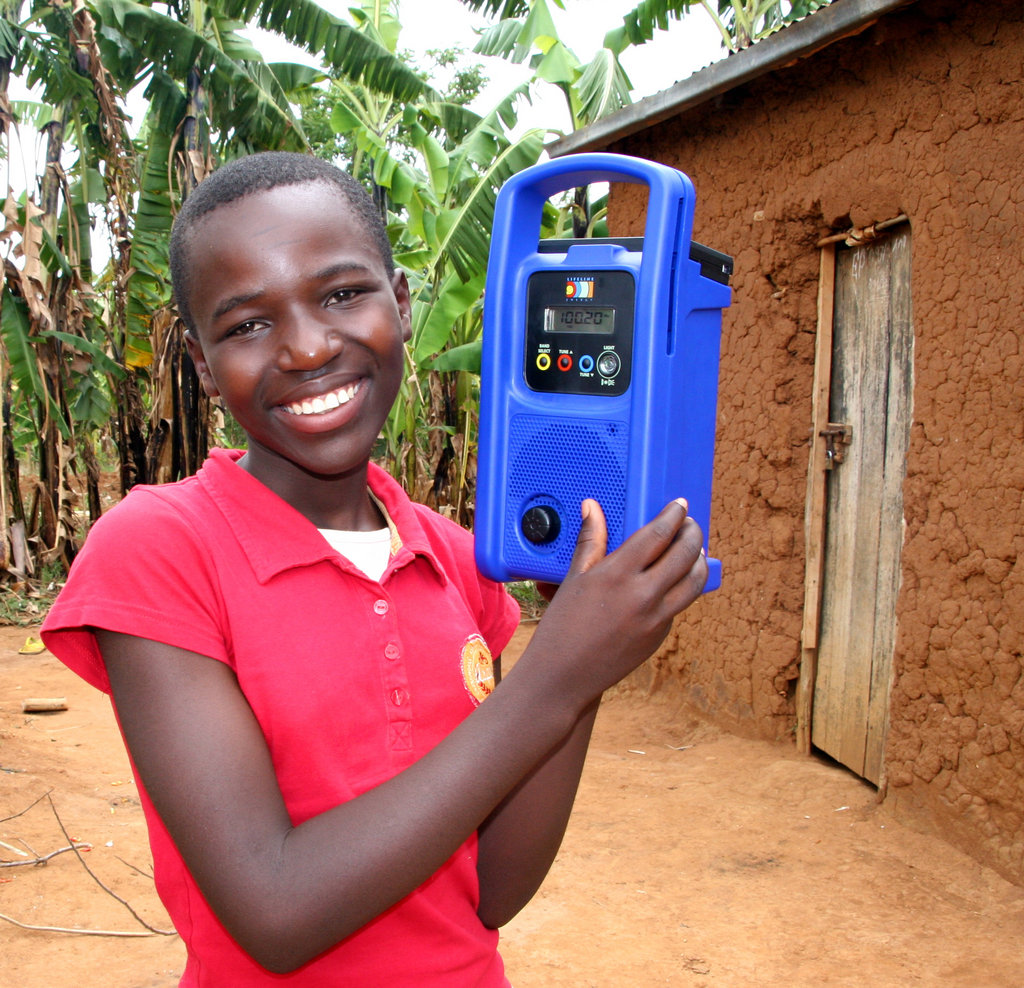
Those of you who have read previous Global Giving reports on Rwanda by the Freeplay Foundation will remember Jonathan Macumi a 14-year old Rwandese we met first during a large distribution of Lifeline radios in Nyamata District in 2002. A photograph of Johnta carrying his Lifeline radio on a hoe has been featured internationally in newspapers and magazines, on the cover of a conference brochure and even five stories tall on Times Square.
During the Freeplay Foundation’s recent field mission to Rwanda in July 2006, Kristine Pearson and Alison, a Vassar student volunteer, were due to travel to Nyamata District south of Kigali to see Johnta and make a local radio distribution on a Saturday morning.
On the Friday prior at 16h00, the government declared Saturday a national holiday. It had decided to restart the Gacaca trials - a system of participatory justice built on traditional community conflict resolution to prosecute those accused of genocide crimes. This meant that everything except hotels, restaurants catering to tourists, essential services and petrol stations were closed.
Kristine Pearson takes up the story:
“Accompanied by members of a local NGO, Trust, and our in-country partner, CARE, we drove past three Gacaca trials taking place under trees.
The journey to Nyamata town, south of Kigali (pronounced 'chee-gali' locally) is reached by one of the worst roads in the country. Work has started on a four-lane super-highway through Nyamata District that will link up with the Burundi border – a road that will also bring a new set of problems. The journey to Nyamata town has already been halved to 40 minutes by repairing the potholes.
When we first visited Nyamata in 2002, there were maize and sorghum fields and it seemed a hub of agricultural activity. Today, with the drought and environmental degradation caused by over-farming, tree chopping and erosion, the soil is poor and there is a food crisis. The Rwanda Millennium Development Village is located here.
We knew from Frank Reidy, our Rwanda distribution coordinator for an earlier project, that Johnta was now a border at the Ecole Secondaire Kanzenze. Frank had visited Rwanda the week before, having raised $12,000 in Ireland toward a new house for Johnta and his four siblings and also to buy goats for local child families. We stopped at Johnta’s school hostel in town, where it was confirmed that he had left earlier to go home since the school term had ended. It took us an hour to drive to his house from there and it took Johnta three hours by foot.
No NGOs work in this area, so a white SUV attracts attention. By the time we reached Johnta’s home, at least 50 children were swarming around the vehicle. We spoke first with Eriminata Eribiganzi, the young 20 year old who lives next to Johnta and who was featured on a BBC Freeplay Foundation Earth Report segment. Since last seen, she and her four sisters and brother have taken in another orphan girl. We were interviewing her on video when Johnta appeared.
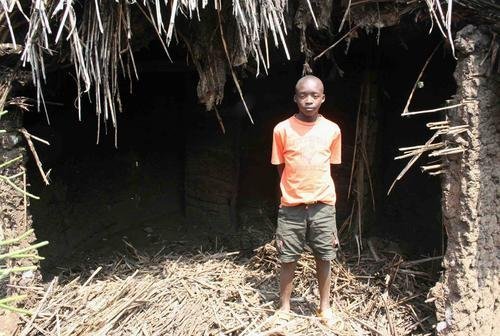
Johnta showed us his derelict house - now a meeting spot for chickens, birds, wasps and other insects - that had collapsed in a storm some weeks earlier. Thank heavens for Frank and the Irish! In the interim the children are staying with a neighbor, who has a house with two rooms.
We gave Johnta a stack of photos previously taken of him and the family. We showed him letters he has written to the Foundation that we have saved. When we handed him more self-addressed and stamped envelopes he said, “No! E-mail!”
It turns out that Kanzenze is one of six schools in Rwanda that are part of the Nepad e-schools initiative. Who could ever have imagined the Johnta we first met asking for an email address!
The four younger children look exactly the same. Two wore the identical ragged clothes as last year, although Johnta was neat and tidy in new t-shirt and shorts Frank had provided.
Johnta produced his radio, solar panel intact, and both were in good working order. He leaves the Lifeline at home for the other children when he is in school. We quizzed him about life, his family, what they learn from the radio and now his schooling. He loves his classes and particularly math and biology. We asked him what he wanted to be when he gets out of school. He replied: “A doctor.” “Why?” “Because people have helped me and I want to be able to help others.”
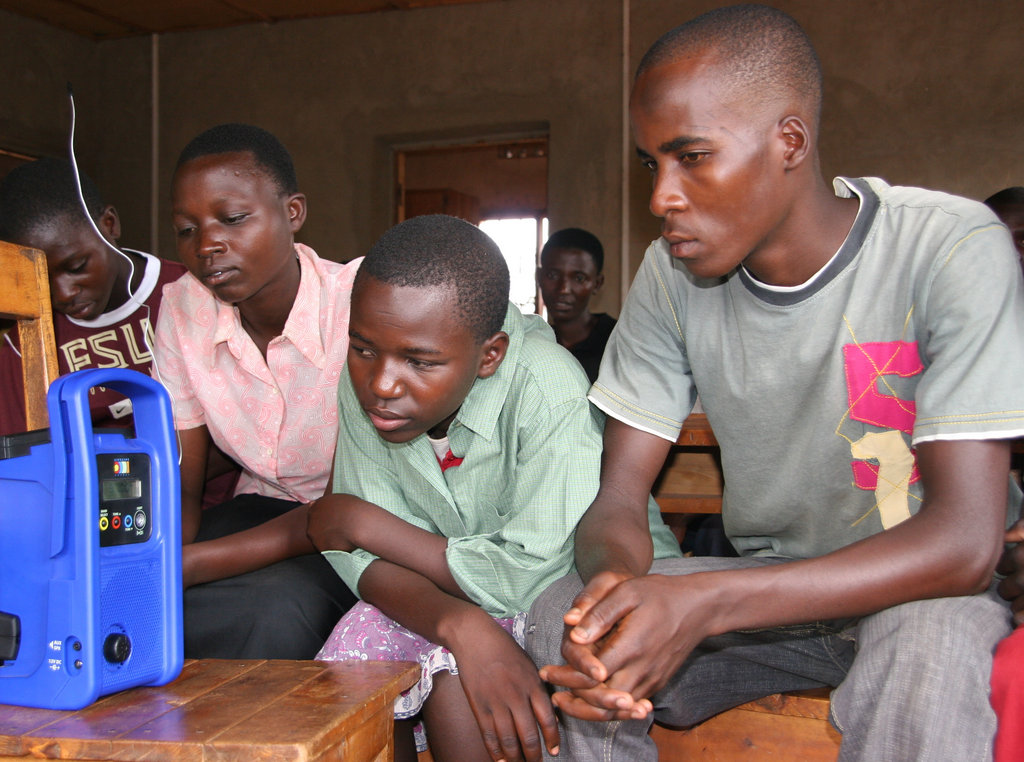
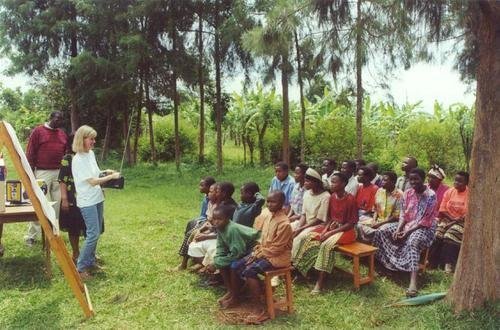
Johnta has acquired a few words of English but most of our conversation still takes place via an interpreter. We conducted a small distribution of five Lifeline radios to neighbor orphans that Johnta identified. He demonstrated real leadership qualities in selecting the children. Then he organized them for training on Eriminata’s rough-hewn benches under a tree and helped directly with the training.
One boy, Jean Olivier, 16, had contracted polio in 1998. It left him with paralyzed arms, so carrying or winding a Lifeline radio is impossible. We therefore went to his house after the training to show his younger brother how to use the radio. These two boys have nothing inside their tiny house, no furniture and only a couple of mats to sleep on. Being disabled in this environment is unimaginable.
By now up to 100 children and a few old women were following our every move. Alison had brought about 100 pens. When she asked Johnta to distribute them, he was mobbed. These children are feral. In this dusty corner of Rwanda, so remote from the outside world, who is raising them? We saw no men, only children of all ages and a several grannies. Some youngsters go to school, but most are unable to attend, having to work for their own survival and that of their siblings. There is no one to supervise them and oftentimes no human being just to love them. When we ask Rwandese orphans who loves them, their usual response is God.
Nyamata is a pretty awful place to be a child.
At the same time, for Johnta, his family and some of his neighbors we are making a tangible difference in their lives. In our support of children like Johnta and Jean Olivier we have to tread a careful path, trying to ensure they do not become a target of jealousy for others without Mazungus (foreigners) to help them. Johnta himself helps because he shows great responsibility and leadership in his local community.”
For the Freeplay Foundation, Johnta’s story has become a symbol for what is possible when the outside world wakes up and takes notice of the desperate plight of orphans of Aids and genocide in remote rural areas of Rwanda. Access to information and education through the donation of a self-powered Lifeline radio changes the lives of children like Johnta. We thank Global Giving donors for joining us in this challenge to provide the most basic of human rights to 65,000 child-headed households in Rwanda. Over 10,000 Lifeline radios have already been distributed in Rwanda and with your help, we will distribute many more.
![Share on Twitter]()
![Share on Facebook]()