By Aryeh Shell | ArtCorps Education and Training Director
ArtCorps’ capstone Creative Systems course piloted this spring as part of the Gulf of Honduras Creative Conservation Project, and seven Belizean conservation organizations came together in Punta Gorda to develop their capacity for “systems thinking”.
Fritjof Capra: “… systems thinking is based on the fundamental shift of perception from the world as a machine to the world as a living system.“

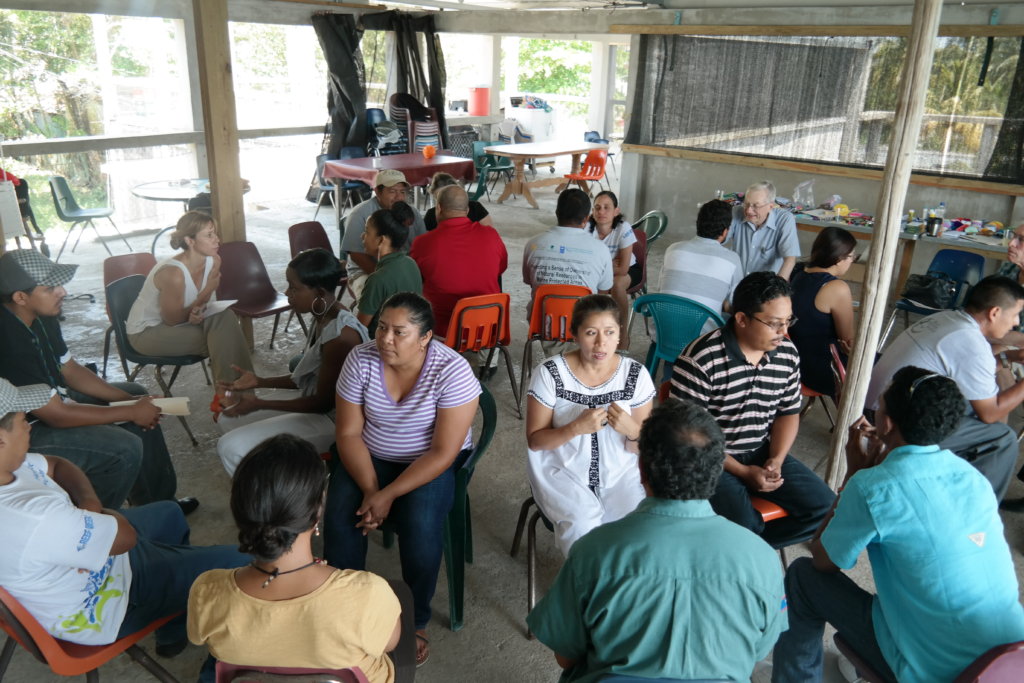
What does it mean to apply systems thinking to our work for social change? Eighteen conservation professionals, operating in the Gulf of Honduras, joined together in March for a three-day training where they explored this heady topic with their minds, hearts and bodies. One participant Christina, the Executive Director of the indigenous conservation organization Ya’axché Conservation Trust, exemplifies the enthusiasm and deep commitment we witnessed from everyone.

Christina, Ya’axché Conservation Trust Executive Director – Photo: Ya’axché
Christina jumped into the first activity with a skeptical look but an open mind. Her group was given the task to physically represent the characteristics of a rainforest, or living system, while the other group physically depicted the qualities of a machine. Though a little shy at the beginning, Christina soon grabbed the blue scarf and flowed through the group, laughing and representing the fluid nature of water which gives life and connects everything together.
Based on their improvisations, we reflected on the difference between how living systems operate in dynamic, adaptive and interconnected relationships and how a mechanistic approach often keeps us isolated and fragmented; efficient in some ways, but working in silos. Applying these ideas to the management of her organization, Christina reflected how a living systems approach would help to create more trust, involvement and participation with her staff and stakeholders.
In this pilot ArtCorps Creative Systems course, seven Belizean conservation organizations came together in Punta Gorda to develop their capacity for “systems thinking”. Over the course of three intensive days, participants looked at the world, not as a machine, but as a living system. They looked to the natural world as a model in order to create more just and sustainable human systems in their communities and organizations.
For example, since living systems are comprised of interdependent parts that self-regulate and adapt by exchanging information, participants learned that an issue can best be understood and addressed by creating effective communication channels so we can better respond and adapt to changes in our environment.

To demonstrate a creative tool for community dialogue, we created a fishbowl shape with chairs set in concentric circles and engaged in a lively discussion about the enforcement of sustainable fishing practices. The participants role-played different stakeholders such as fishers, NGOs, government ministers, large-scale developers, and the Fishery Department. They also represented a future being and a little fish (or nature) – two stakeholders who are deeply impacted by our actions but whose needs are often not considered in our decisions.
People in the outer circles listened and entered the inner dialogue if there was a perspective that hadn’t been shared.Christina stepped in as a Community Member, bringing the concerns and challenges of feeding one’s family with limited options for livelihood. She pushed the group toward ensuring that information is more accessible for community members to understand the issue and get involved.
One principle we teach in ArtCorps trainings is that the transformation of belief systems is a key factor in affecting social change. Our values and beliefs shape the kinds of systems we create and how we participate in them. The participants learned how to use popular culture as a powerful tool to reframe and transmit messages more effectively, in order to challenge or transform existing beliefs about an issue.

Cormorants
Photo: David Comb
For example, one group developed a theater skit and media campaign of “Saving Memo the Manatee” to encourage tour boat operators to engage in safe driving and manatee protection efforts.
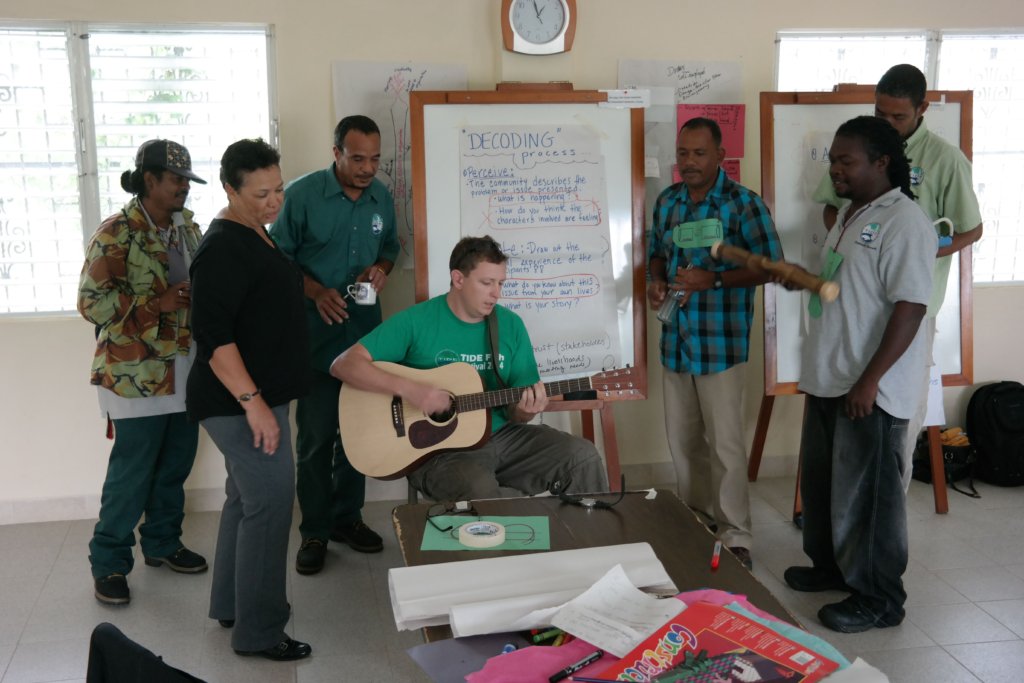
Christina’s group rewrote the lyrics of a well-known Garifuna song to teach communities and farmers about good fire practices, called “Fyah, Fyah, Save We Land!” With small instruments they played and sang the catchy tune to challenge some current beliefs about burning land and transmit information about effective fire prevention methods.
Participants also developed their capacity for long-term thinking by playing a game about the management of marine resources over a period of time. Christina pushed for the different “fishing cooperatives” to form an alliance so that they could share data and ensure that everyone could maximize their catch without depleting the ocean for future generations.
One cooperative resisted however, in spite of the cajoling and bribes of the other groups! This led to some interesting dialogue about how to get fisher communities to understand the need for no-take zones in the face of climate change and declining fish populations.

At the end of the training, the participants wrote moving letters of commitment to future generations. Christina shared her heartfelt letter with the group, expressing her profound love of the Earth and her fierce dedication to never give up in spite of all the challenges. She reflected how “mind-blowing” it was to think about her work from a systems lens and how important creative approaches are to help communities understand complex information about the impacts of climate change.
As conservationists, we know that we are an integral part of nature and that our survival depends on the preservation of our natural resources. Applying this perspective to our work allows us to create more innovative approaches rooted in the wisdom of living systems. We look forward to seeing how Christina, her staff at Ya’axché, and all the other conservationists in the room incorporate new creative tools and systems thinking to their important work of protecting the land – from ridge to reef!
Project reports on GlobalGiving are posted directly to globalgiving.org by Project Leaders as they are completed, generally every 3-4 months. To protect the integrity of these documents, GlobalGiving does not alter them; therefore you may find some language or formatting issues.
If you donate to this project or have donated to this project, you can receive an email when this project posts a report. You can also subscribe for reports without donating.