
Exploring five basic principles of collaboration through frozen human sculptures.
ArtCorps is providing training and technical assistance to a select group of marine and terriestrial conservation organizations in both Belize and Guatemala, as part of the two-year Gulf of Honduras Creative Conservation Project. December 1-3 brought these organizations together for the Creative Collaboration Course, the third installement of ArtCorps' four-part curriculum.
What does it take to truly collaborate? In the first week of December, seven different conservation organizations from across the Gulf of Honduras came together in Punta Gorda, Belize for three intensive days with ArtCorps to find out. Maximiliano Cal, a participant from the indigenous-led non-profit Ya’axché Conservation Trust, summed up both the objective and outcome of this training with great clarity: “No one person has the answer. The answer lies in everyone working together.”
We know that collective action is essential if we are going to transform unsustainable systems and practices that threaten people and the planet. We also know that collaboration can be tedious and time-consuming due to the challenging dynamics of poor conflict management, miscommunication, competition, time pressure, or top-down approaches that generate mistrust and apathy. While good collaboration is not easy, it is vital. As ArtCorps’ Director of Development Tracie Hines reflected on her participation in the training, “We think we save time by working alone or in silos, but real collaboration makes our work more effective, vibrant, interesting and creative. We actually save time in the long run and are able to accomplish something much bigger than our individual efforts could ever do.”
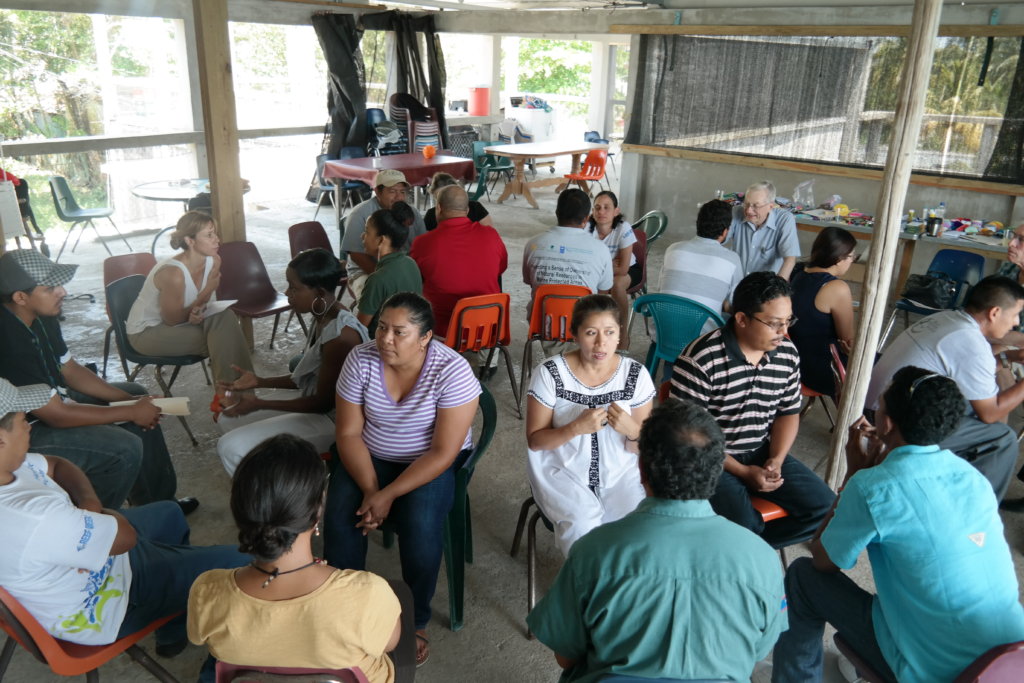
To lay the foundation for our collaborative inquiry, the group in training examined five basic principles of collaboration – Participation, Trust, Accountability, Communication and Shared Goals – by creating collective human sculptures. Working together in small groups, they created frozen images with their bodies to depict the value, obstacles and skills related to each principle. The physical images were used as a launching pad to share their personal and professional experiences and to understand how they can transform collaboration challenges that are common in their conservation work.

“The Hand Team” presenting an artistic representation of the team’s identity, inclusive and reflective of each member’s strengths and contributions.
Next, charged with creating a team name and an artistic representation that expressed their “special sauce”, or unique identity as a group, they formed teams by identifying the strengths each person brought to the table. The room buzzed with laughter and creative energy as the teams collaborated quickly to generate poems, songs and visuals that were inclusive and reflective of everyone.
After establishing that inclusive participation is critical, the participants moved into an examination of their individual social identities by creating visual mandalas and openly sharing their stories of inclusion and exclusion with each other. They shared the negative messages they have received and difficult experiences they have had based on their gender, race, class, family of origin, age or other socially constructed category. This opened up profound reflection for all participants to understand the negative impact that marginalization and trauma can have on one’s ability to contribute. The participants expressed a renewed commitment to be aware of this dynamic and to ensure that everyone’s voice is heard and considered in the development of a collaborative project or campaign.

Working together in experiential trust building.
The group also worked on building trust with each other. In small groups, they formed tight circles in which each person had a chance to stand in the center and fall in any direction, allowing themselves to be caught by their teammates. The shared goal was to ensure everyone’s safety. This process generated a lot of emotion, prompting discussion about what it takes to establish trust, how to repair trust if it is broken and the role of accountability in effective collaboration. In a very visceral way, the participants realized that each person in a team needs to be responsible so that no one falls to the ground. They applied this insight naturally to the important role that each person plays in making their organizations strong and effective, regardless of their position or title.
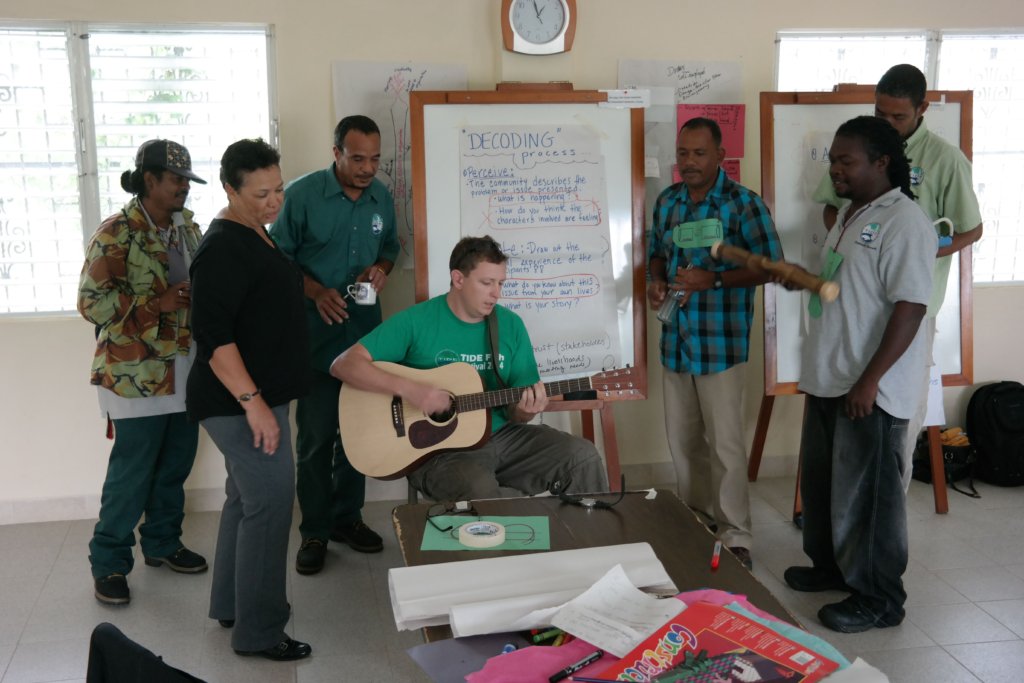
In addition to trust building games, participants engaged in communication role plays, parallel thinking around an issue, saying “yes, and…” to build on each other’s ideas and identifying creative activities they can use to improve collaboration within their organizations and communities. They ended the training with strong words of appreciation for each other and their time together:

Every perspective is critical to collective action and Creative Collaboration !
“I am stunned by how interconnected we are and by how far we have come in three days.”
“I have learned that by making ‘I statements’, I can change a situation from conflict to connection.”
“I am much more able to trust my co-workers now.”
“So many possibilities open up when we make room for everyone’s perspective,”
and
“We need everybody!”
In this pivotal time, these last words ring true. We need everybody to participate in building a just, thriving and sustainable world. Every perspective is critical to understanding the true needs of our communities and to making culturally appropriate and informed decisions about how to manage our resources. If you are wondering what it will take to make lasting and transformative change, just ask our Belizean partners in creative conservation. They know that the answer lies in everyone working together.