By Rachele Rosati | Research Fellow
Dear GlobalGiving Donors and Followers,
in my previous report, I described how I was able to establish live cancer cells from children with neuroblastoma (NBL). Initially, I started with two samples, and I was able to test with the help of robotics instruments >300 drugs! Without employing robotics and computers to analyze the data these experiments would have taken many years, so thank you for your help to support this innovative and time-saving approach! As you know, identifying less toxic and more effective treatments for children with NBL is urgent.
Since, to gain a more general view of how the findings in the first two samples may apply to other children with NBL, we have obtained additional specimens from our collaborators at the Children Hospital of Philadelphia (CHOP). The comparison with this second group of additional NBL samples was essential to verify that the results could be potentially applied to other children. Note that each sample/child has different genetics, and while every case is unique, there may be drugs that work across all samples and others that only work best for some. To understand these differences, we analyzed the expression of >700 cancer related genes!
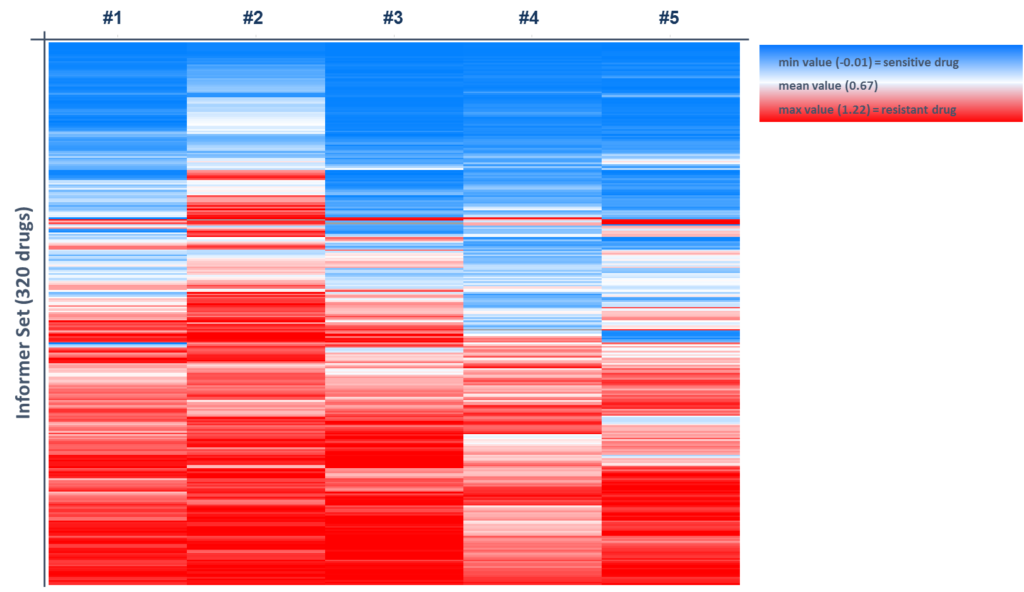
For each drug and each patient, we generated a “HEAT MAP” that recapitulates and highlights drug response (BLUE) or lack of drug response (RED), using the area under the curve (AUC) as a parameter. The drugs in blue are the most effective ones in inhibiting the growth of cancer cells and the ones represented in red have no effect on cell growth.
There are multiple possible angles how we can start analyzing this large amount of data: searching for drugs that are able to kill all the NBL cells across all the 5 samples, searching for specific individual drug sensitivities or searching for drugs which may show the best efficacy in combination with another drug.
A first very important discovery from these robotics-driven testing has highlighted four drugs that are targeting an important pathway necessary to sustain energy levels inside the NBL cancer cells!
These are exciting results and indicate a new angle to attack NBL, a new Achille’s heel that was not known before. In the near future, we plan to confirm these findings in Avatar mice to make sure they can be validated in a live organism. Your help will bring this discovery one step closer to the clinics. In fact, the two drug we have found to be most effective are FDA approved for other diseases which would allow a faster application for NBL.
Thank you so much for your invaluable support
Project reports on GlobalGiving are posted directly to globalgiving.org by Project Leaders as they are completed, generally every 3-4 months. To protect the integrity of these documents, GlobalGiving does not alter them; therefore you may find some language or formatting issues.
If you donate to this project or have donated to this project, you can receive an email when this project posts a report. You can also subscribe for reports without donating.