By Racehele Rosati | Lead Scientist at Cure First
Dear Cure First and Project Neuroblastoma Supporters,
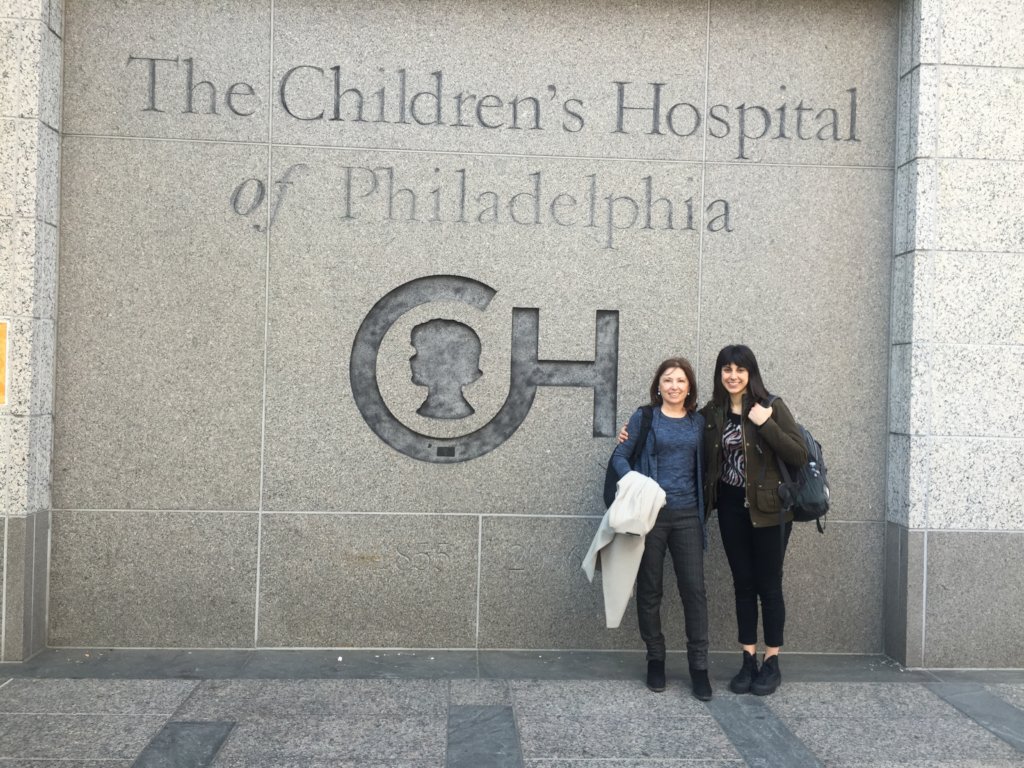
As we continue our research to advance novel drugs as well as to repurpose existing drugs (already approved for adults) for children battling neuroblastoma (NB), , Dr. Grandori and I travelled to Philadelphia this past April to meet Dr. Maris and his team, worldwide experts in treating children with NB, at the Children Hospital of Philadelphia (CHOP). We discussed respective updates from both laboratories, in particular our newly identified NB targeting drugs, which are aimed at each tumor’s vulnerabilities, and their possible link with individual genomic alterations. Using a functional precision medicine approach, both single drugs as well as novel drug combinations were identified using NB patient-derived organoids. CHOP has a dedicated facility where living avatar mice are carrying the same NB models that were established at Cure First as 3D organoids in vitro. During the meeting, CHOP’s team presented the in vivo data of NB mouse models treated with the drug candidate (single agent) identified by our functional test. The evidence indicated that even if the drug did slow down the growth of the tumor, it will be necessary to treat the mice with a drug combination to completely eradicate the tumor.
We also shared preliminary data on identifying novel specific combinations for one of the NB models, which Dr. Maris advised to prioritize as of relevance for clinical advancement.
In summary, to date we have identified one novel treatment based on an existing drug that is already approved for adults which has had a great response for multiple patient-derived cancer organoids in vitro, and for one model, as indicated above, a promising response in avatar mice. The drug, which is FDA approved for ovarian cancer, is safe and well tolerated, with minimal side effects relative to standard chemotherapies. However, the data thus far suggest that to increase its efficacy to block tumor growth, it must be combined with other drugs.
Your support has enabled this crucial research which is identifying new and less toxic approaches for the treatment of children with NB. We need your help now to bring this research to the finish line and ultimately implement it in the clinic. Let’s work together to raise $100,000 this year!
With much appreciation,
Rachele Rosati, lead scientist at Cure First
Project reports on GlobalGiving are posted directly to globalgiving.org by Project Leaders as they are completed, generally every 3-4 months. To protect the integrity of these documents, GlobalGiving does not alter them; therefore you may find some language or formatting issues.
If you donate to this project or have donated to this project, you can receive an email when this project posts a report. You can also subscribe for reports without donating.