By Balu Iyer | Asia Program Director, IDEX
Balu Iyer, IDEX’s Asia Program Director recently traveled to Bangladesh and Nepal in August 2006. While there Balu spoke with several women about their experience with microcredit as part of IDEX’s Credit Women’s Initiatives Program and Balu’s ongoing conversation with women with entrepreneurial minds. Balu’s discussions highlight how microcredit works, the difficulties these women overcame and the challenges that lie ahead. In this first installment Balu talks with Lucky Belgum and Hosneara Ahmed.
I first met Lucky Begum in 2003 when I visited Boaljian Uttarpara Women's Group (Bangladesh). IDEX had supported this group twice (1995 and 2000) and I wanted to see how they were doing. I had found this group’s solidarity to be impressive, as was their performance in terms of savings and credit, and their vision for the future. I spoke with Lucky Begum at length.
Lucky Begum was the president of the group and I recognized that she was a leader to watch. She showed extraordinary dedication and leadership and was effective at keeping the group together through difficult times. The handloom business went into a slump during the late 90s. Lucky helped the group get a loan from SATU to start a cow rearing business. When the floods affected cow rearing, the members went back to the weaving business. This time I went back to check on how she was doing. Lucky looked more prosperous this time; physically she looked well; her house had been renovated and she quite happy to talk.
During our conversation, I came to know that her husband was working as a construction worker in Saudi Arabia and that she had not taken a loan from the group for over four years. I asked her why she was still a member of the group. She said, “This is my family. So what if I am not taking any loan. I am still an active member. Our situation was not like this 10 years back. I wish you had seen us then to see how far we have come. We have had to struggle to reach this stage. Being part of the group, I was able to take loans (she had loans seven times ranging from $40 to $200) and build my family. More importantly, it was the constant support of the other women that kept me going.”
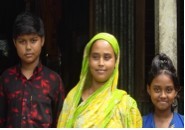
As we conversed, I could also see the change that was taking place among the women in terms of their vision for their children and the future. No longer was it about just sending children to school and meeting basic needs. Lucky Begum had big dreams for her children, who she introduced to us. “I would like my daughter to become a doctor. When it comes to women health issues, there is no one that we can turn to. I want my daughter to fulfill this need of women. I want my son to be a teacher. We all keep complaining about bad teachers, I want him to be role model for others in the village. God willing this will happen.”
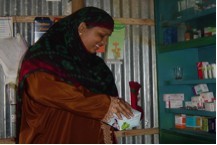
Hosneara Ahmed (coordinator at SATU, Bangladesh) insisted that I meet Firdouz before I left Tangail. Early in the morning we drove to Panch Khania a 30-minute drive from Tangail. We entered into the crowded market place where shops were crammed close to each other. At the particular place where we got off, there were many pharmacy shops, most run as usual by men, except one. This was Firdouz’s shop. In the past I had seen many grocery shops where women would sit, but this was the first time I was seeing a pharmacy store owned and operated by a woman. It’s tough to run any shop, but even tougher to run one where you have to know medical terminologies, read labels and decipher the doctor’s scribble.
“When I started this shop people would often come by to just stare at me. I was a curiosity. Now people just treat me as another shopkeeper. The women from my group still get excited when they see me in the shop.” Firdouz knew about the women groups from childhood, as her mother was a member. Her desire in childhood was to become a doctor, but that dream was cut short when her father was murdered in a land dispute and she was married off when the earliest opportunity presented itself. Even though her in-laws were not supportive, her husband encouraged her to keep her dream alive. She underwent some basic training and started the pharmacy shop with her savings and loans (four of them with amounts ranging from $ 50 to $170) from the women’s group. “I want to show women that we can do something if we want to. Adversity should not make us cut back our dreams.”
Project reports on GlobalGiving are posted directly to globalgiving.org by Project Leaders as they are completed, generally every 3-4 months. To protect the integrity of these documents, GlobalGiving does not alter them; therefore you may find some language or formatting issues.
If you donate to this project or have donated to this project, you can receive an email when this project posts a report. You can also subscribe for reports without donating.