By Sarah Cooperman | Executive Director
As we dash around feeding the 42 Eastern Gray Squirrels we currently have in care, we’re also answering our ringing phone all day long. In fact, our staff answers thousands of hotline calls annually, helping our community members identify when animals need help and guiding folks on how to provide it.
Our hotline is also how we learn about our favorite type of patients: the animals that don’t even need to come into our care! What do we mean by that? Those are the would-be patients who are successfully reunited with their wild parents, thanks to their caring rescuers and our team’s professional guidance. As skilled as we are at wildlife rehabilitation here at RWS, we will gladly acknowledge that a baby wild animal’s real mom will always do it best.
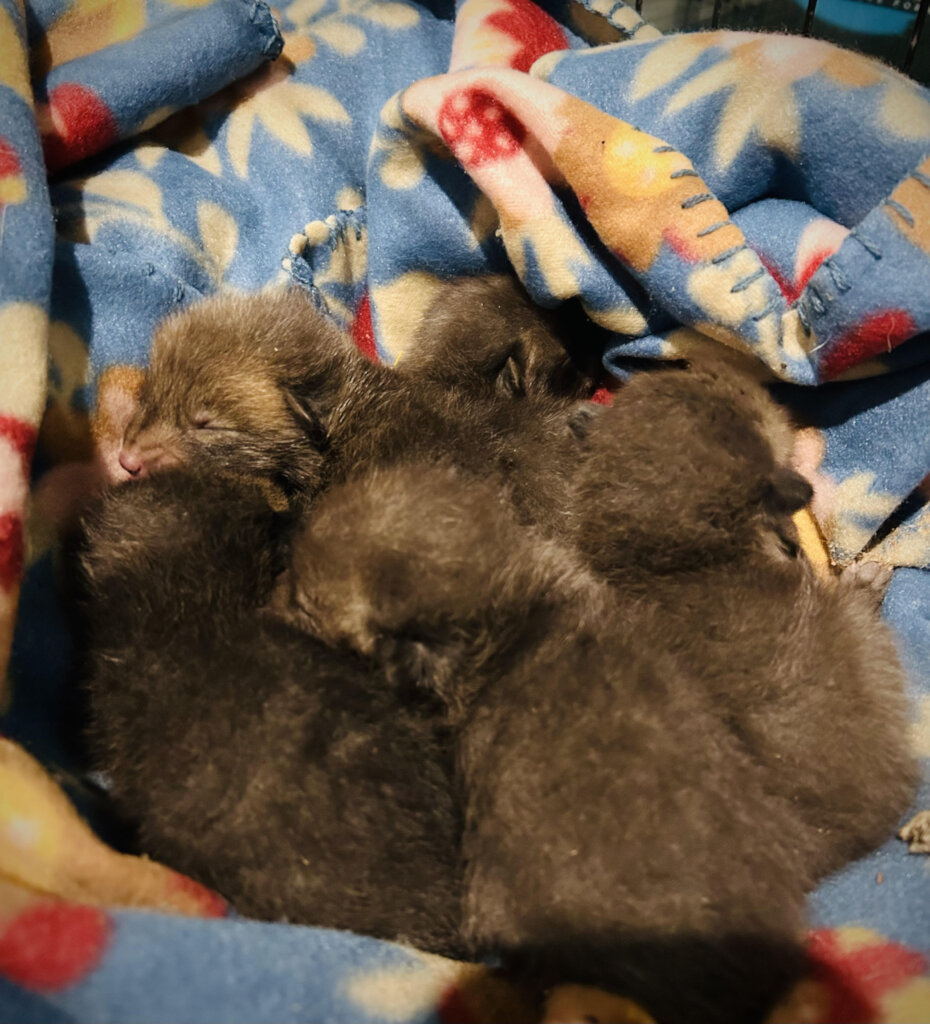
To kick off baby season, we wanted to share one meaningful reunion success story from earlier this week. Meet our “Patients” of the month: an adorable litter of five Red Fox kits, who didn’t need to become patients after all.
It all began when we received a call earlier this week from a rescuer in Albemarle County. Shortly after sunset, a community member’s livestock guardian dog had unfortunately found and destroyed a Red Fox’s den on their property. The dog spooked the mom away from the scene and was difficult to corral, seemingly intent on rooting further through the den. The community member investigated the scene to try and see what the dog was so fixated on and found the five teeny fox kits quietly tucked inside.
Fearing for the kits’ safety and unable to contain the dog, the rescuer put the kits into a box and brought them inside before passing them to a neighbor to keep safe for the night. That neighbor happened to be a rabies-vaccinated RWS volunteer! They knew just what to do for the evening: leave the kits alone. The volunteer-turned-rescuer kept them in a quiet, dark room with heat support and offered no food or water. As a result, the nearly-newborn kits stayed safe and secure through the night. The rescuer then called the RWS hotline first thing in the morning, and we were ready to help.
Our staff members quickly determined that there would be a strong chance of successfully reuniting these healthy, responsive babies with their parents. That’s because Red Fox parents typically construct multiple dens that they use throughout breeding and rearing season. While this particular den was destroyed, there were no reports of dead adult foxes in the area. That meant mom and dad almost certainly were nearby and ready to move their kits to another location (and probably a bit confused where the kits had gone for the evening).
After speaking with our team, the rescuers brought the babies back to the original den site right away and tucked the kits safely into the den’s remnants. Now, you might be wondering: what about the dog!? Its owner was thankfully able to contain the determined pooch for the day, so there was no risk of another nose-driven excavation.
Lastly, it was time for the humans to step away. Mom and dad certainly wouldn’t return if they saw ginormous bipedal predators hovering around all day.
While it was nerve-wracking for the animal-loving rescuers to keep themselves from checking in on the kits, it paid off.
When the volunteer did come back in the early evening, the den was quieter. Only two babies remained! As they scanned the area, they saw it: two unmistakable, glowing fox eyes watching from the tall grass of a nearby pasture. Mom (or dad) was back! The committed parents were in the middle of a relocation mission, moving their babies one by one to another den site.
By the following morning, the den was completely empty. Success! We were thrilled to hear that we would not be admitting five fox kits that morning because, as we suspected, they weren’t orphans after all. We’re grateful to the rescuers for eagerly cooperating with our guidance and helping these babies get back to where they belong — no further rehabilitation needed.
At the end of the day, wildlife rehab at RWS isn’t just about taking care of the patients at our facility. We consider every hotline conversation to be a crucial step of our animal care work, too! Each call gives us the chance to educate community members about how they can recognize an animal in need and provide appropriate, natural-history informed support. In many cases, like this one, we have the privilege of helping young wild animals stay right where they need to be.
Thank you for supporting our work! We hope you'll consider making a gift to help us staff our hotline, feed babies in care, and make magical release moments happen.
Links:
Project reports on GlobalGiving are posted directly to globalgiving.org by Project Leaders as they are completed, generally every 3-4 months. To protect the integrity of these documents, GlobalGiving does not alter them; therefore you may find some language or formatting issues.
If you donate to this project or have donated to this project, you can receive an email when this project posts a report. You can also subscribe for reports without donating.



Support this important cause by creating a personalized fundraising page.
Start a Fundraiser