By Amelia Wu | Director, Philanthropic Partnerships
ENDING GENDER BASED VIOLENCE IN JUAREZ MEXICO
GLOBAL FUND FOR WOMEN
February 2011
BACKGROUND
Femicide has been a persistent serious problem in Ciudad Juárez for many years. Victims as young as six years old have been raped and tortured, murdered, and abandoned, and hundreds have simply vanished. The targets of this violence tend to share certain characteristics in common: most are young women with indigenous features that mark them as “outsiders” to Ciudad Juárez (i.e. from southern Mexico or other regions of Mexico’s interior). Poverty, isolation, and work shifts that end at odd hours of the morning make them easy targets of violence. Despite the disappearances and murders of an official estimate of more than 500 women, Mexican authorities have made very few inroads in solving the murders and ensuring both justice and future safety for women in this area.
RESPONSE
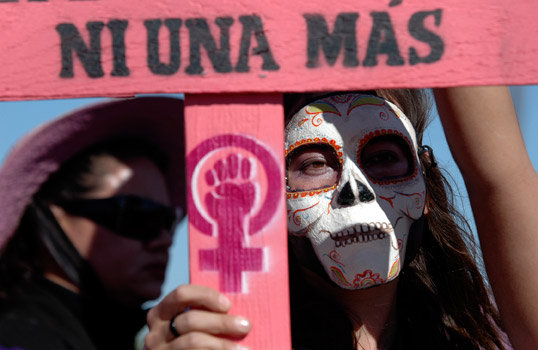
Since 1993, the Global Fund for Women has supported women in Ciudad Juárez and Chihuahua, Mexico who are responding to the horrific acts of sexual assault, torture, and femicide that have been committed. The pattern of violence against women and impunity is complex in nature and involves many different forms of crimes and perpetrators, with widespread institutional failings to prevent and punish those really responsible. Consequently, women’s organizations have responded to the situation using sophisticated, multi-faceted strategies. Around Mexico, in the United States and elsewhere, women’s rights activists are mobilizing to stop the beatings, rapes, and murders of women in Juárez. Women’s groups are challenging governments on both sides of the U.S.-Mexico border to conduct serious, professional investigations into the murders. They have carried out marches, demonstrations, vigils, and letter writing campaigns to educate people about the problem and foster solidarity with the women of Juárez. Many are connecting issues of NAFTA’s free trade model with the social and physical violence in the city. The situation in Ciudad Juárez remains serious with at least 40 reported cases of women murdered last year and continuing impunity, particularly for past cases. As a result, the Global Fund for Women continues to support and align with groups in Ciudad Juárez in their efforts to address the larger issue of gender-based violence in Mexico.
ORGANIZATIONS SUPPORTED
Casa Amiga - Centro de Crisis A.C.
Ciudad Juarez, Chihuahua, Mexico
Casa Amiga is a non-profit organization and a crisis center founded in 1999 by an interdisciplinary group of professionals dedicated to addressing gender violence and fighting for the rights of women in unequal economic, social, political, ethnic and religious situations. The group offers women tools to stop the circle of violence and restore their empowerment by enabling them to recognize and defend their sexual and reproductive rights. Through its crisis center, the group offers professional services to women and children survivors of all types of violence, the first of its kind in the entire Mexican side of the Mexico-U.S. border region.
Centro de Derechos Humanos de las Mujeres A.C.
Chihuahua, Chihuahua, Mexico
Centro de Derechos Humanos de las Mujeres [Centre for Women’s Human Rights] carries out legal representation on behalf of several families in Ciudad Juárez and the city of Chihuahua, whose daughters have disappeared and/or assassinated. The Centre is also involved in education and advocacy work with the municipal, state and federal governments, the United Nations, and the OAS. It also carries out media work, political mobilization and psychosocial accompaniment to some of the families of the victims. While there are other organizations in Ciudad Juárez doing similar work, what sets the Centre apart is its in-house capacity to concretely address the impunity that perpetrators enjoy by bringing forward legal cases.
Justicia Para Nuestras Hijas A.C.
Mexico
Justicia para Nuestras Hijas A.C. [Justice for Our Daughters, Civil Association] (Justicia) seeks to locate women and girls who disappeared or were murdered in Chihuahua, and to promote access to justice for the survivors and their families. Since 2002, Justicia has carried out 35 investigations, litigated 4 judicial processes against alleged murderers, presented 3 cases before the Inter-American Commission on Human Rights, and achieved 6 convictions. As a result of the group’s work, 13 forcibly disappeared women have been located alive. Currently, the group is working to provide legal support, psycho-social support, and new investigative technology for the family members of disappeared and/or murdered women.
Sin Violencia A.C.
Cd. Juarez, Chihuhua, Mexico
Sin Violencia A.C. [Civil Association “Without Violence”] is a civil organization in favor of non-violence that does interdisciplinary actions through prevention programs, attention and intervention to women, children, and adolescents. It aims to facilitate processes of empowerment that promote healthy and respectful relationships between people. The group focuses on providing services in a humane, professional, and multidisciplinary manner to families that surpass and survive in the state of Chihuahua.
Madres en Busca de Justicia
Cuidad Juárez, Mexico
Madres en Busca de Justicia [Mothers in Search of Justice] (Madres) works to prevent femicide and forcible disappearance through a program called Mi Escuela, Mi Entorno, y Porque Te Amo (“My School, My Environment, and Because I Love You”). As part of the Te Amo Project, mothers of forcibly disappeared women provide trainings at secondary schools, teaching students 8 rules that they feel are essential to avoid future disappearances and deaths. The group is almost entirely volunteer-based, with approximately 20 volunteers currently involved with the project.
Links:
Project reports on GlobalGiving are posted directly to globalgiving.org by Project Leaders as they are completed, generally every 3-4 months. To protect the integrity of these documents, GlobalGiving does not alter them; therefore you may find some language or formatting issues.
If you donate to this project or have donated to this project, you can receive an email when this project posts a report. You can also subscribe for reports without donating.