By Evelyn Chen | Director of Development
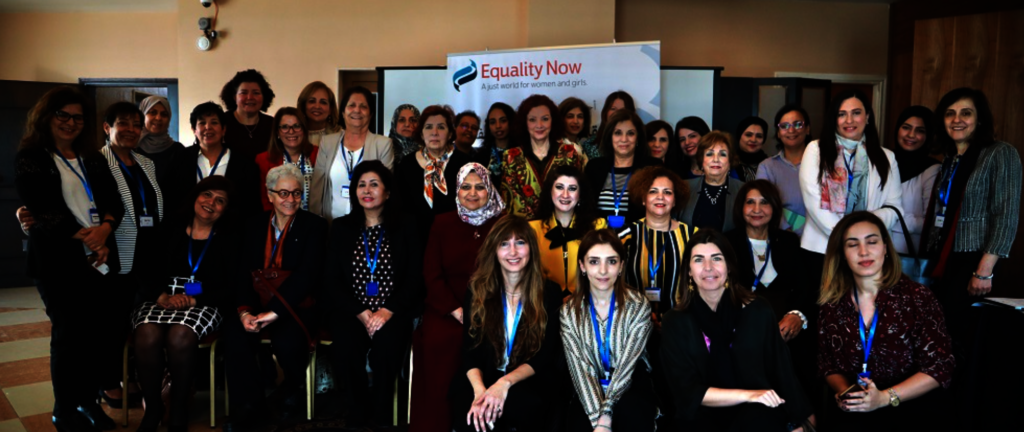
In June 2020 we convened activists from across eight countries in a virtual meeting to share expertise and experiences, and to look for possible connections in their shared work. What we have seen during the pandemic is that challenges facing women in these countries are directly related to the patriarchal, sexist family laws in the region. In addition to the pervasive problem of domestic violence, discriminatory family law also results very directly in immense suffering for mothers who have lost access to their children due to the lockdown, or have stopped receiving spousal and child support, compounding already severe economic hardship. These women have no legal recourse, highlighting the way in which discriminatory family laws in the MENA continue to be the source of much of the inequality and oppression faced by women in the region.
One of the major benefits of gathering all the activists across the network was that they were able to share learnings not only among each individual sub-regional network, but to also draw on examples and expertise from all participants. For example, there are laws in several countries establishing 18 as the minimum age for girls to be married, and yet in many places the exception tends to become the rule: in Jordan, this is based on an exemption that allows religious judges to marry girls as young as 15; in Egypt, parents marrying their daughters off below the minimum age (largely because of poverty) simply wait to register the marriage until she reaches 18; whereas in Palestine, religious exceptions for minors result in girls as young as 12 being married off. In Iraq, judges have discretion to allow marriages for girls as young as 15 (if the child bride is an orphan, etc.), which are further circumvented when judges allow marriages of girls at the age of 14 and one day. Even when existing laws are implemented, sentences are often not carried out or the imposed financial penalties so ridiculously low as to be useless (in one case a fine was imposed of 1000 Iraqi DInar, equivalent to the cost of buying a chocolate bar). Meanwhile, Lebanon stands out for having the lack of any minimum age for marriage. The problem of child marriage is compounded in countries where “marry your rapist” laws still persist (including Iraq, Kuwait, Bahrain, Syria, Libya, and Algeria, as well as significant loopholes in Lebanon). These laws allow rapists to ecape prosecution by marrying their victims; as a result, men who wish to marry an unwilling young woman will rape her, after which “she is gifted to him as a bride.” A participant from Iraq was able to share learnings from her organization’s awareness raising efforts through theatre and drama to advocate for repeal of Article 398, and which has gained the interest of the higher court.
Participants also discussed and shared learnings about their mutual work to address the challenge of mothers being able to retain custody of their children when they remarry (the automatic loss of custody of their children prevents many women from remarrying and moving on with their lives), as well as the gross inequality in dividing common wealth and property following divorce (where women are often completely denied any share of wealth but are still legally responsible for any debt incurred by their husbands). The participants were grateful for the opportunity to convene and to learn from one another about what is happening in other Arab countries regarding similar issues, and to access resources and learn from efforts of activists in other MENA countries to inform their own advocacy efforts. Our next steps with participants are to support the development of advocacy campaigns around these shared issues, and to provide customized training on legal and social media advocacy based on each organization’s needs.
Project reports on GlobalGiving are posted directly to globalgiving.org by Project Leaders as they are completed, generally every 3-4 months. To protect the integrity of these documents, GlobalGiving does not alter them; therefore you may find some language or formatting issues.
If you donate to this project or have donated to this project, you can receive an email when this project posts a report. You can also subscribe for reports without donating.