By Nisreen Tabari | Director, Kayan - Feminist Organization
“Behind every number is a woman who tried to survive”
Dear friends,
We would like to begin by thanking you for your continued support and for believing in Kayan’s mission to provide Palestinian women and girls in Israel a safe space—particularly in the face of emerging and evolving forms of gender-based violence, including digital violence.
In our last report, we introduced Kayan’s support hotline coordinator, Jumana Ashqar. Through her tireless and dedicated efforts, the hotline provided support to hundreds of women and girls who survived sexual and gender-based violence (SGBV). Noticeably, a growing portion of these cases involved digital violence, reflecting a broader shift in how violence against women is perpetrated and experienced.
In January 2026, Kayan produced a report on women’s experiences of violence based on hotline data. Rather than treating these cases as isolated incidents, the report analyzed them as reflections of structural, recurring, and increasing patterns of violence.
Between 2025 and 2026, the hotline received 595 calls from women and girls who were survivors of violence. More than 52% of callers expressed a need for legal support, while only 17% reported the violation to the police. Among survivors of digital violence, this gap was particularly pronounced, highlighting both fear of exposure and limited trust in existing protection mechanisms.
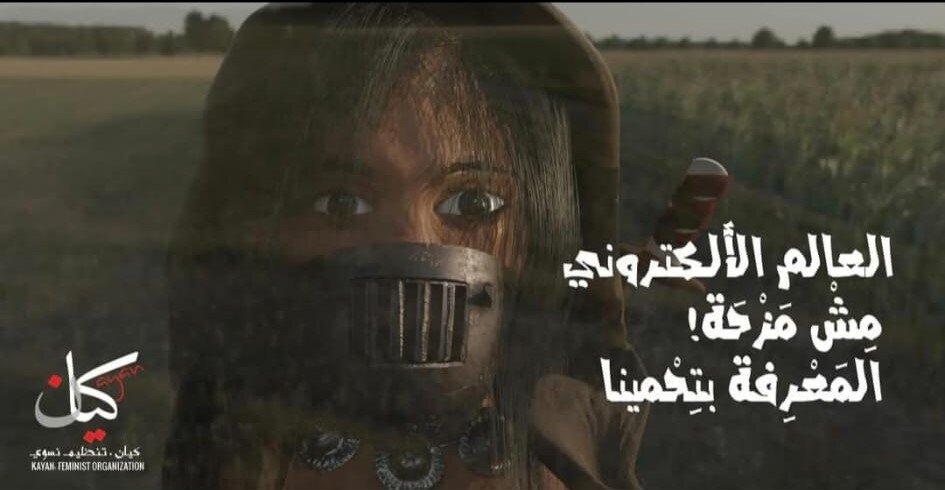
Digital violence—including digital blackmail, online defamation, and technology-facilitated harassment—emerged as a central and expanding pattern of violence in a growing number of reported cases. These cases included threats to publish private images, non-consensual sharing of personal content, and the use of fake social media accounts to harass or defame women and girls. Unlike many forms of physical violence, digital violence is characterized by its persistence and its ability to extend over time, leading to prolonged psychological harm, ongoing fear, and a significant decrease in survivors’ sense of safety.
The report shows that in cases of digital violence, requests from Kayan were directed primarily toward legal support, particularly with the aim of stopping threats, limiting defamation, or preventing further reputational harm. However, this legal pathway does not necessarily reflect a desire to initiate formal judicial proceedings. Rather, legal support is sought as a tool for protection, knowledge, and risk assessment—allowing survivors to understand their rights and options in a context where digital harm continues to unfold. I
mportantly, this focus on legal assistance does not capture the full extent of harm caused by digital violence. The psychological impact is often more severe and longer lasting than the immediate damage, due to persistent fear, exhaustion, and the inability to escape the violence even within one’s private space. This pattern confirms that addressing digital violence against women cannot be limited to legal responses alone, but requires parallel psychological support and survivor-centered interventions.
Protection gaps and the role of the hotline
Although the legal system often requires women to formally report violations, it frequently fails to provide sustainable protection afterward—particularly in cases of digital violence, where harm can continue even without physical proximity. As a result, silence becomes a survival strategy, and support hotlines emerge as the only safe alternative.
One survivor shared: “The hotline was the only place that didn’t force me to choose between safety and the truth.”
Kayan’s report reveals that the hotline is not perceived as a temporary service, but as a fundamental safe space in a context where institutional protection is absent. For many survivors of digital violence, it represents the first space where the harm is named as violence rather than minimized as a personal or digital issue. Beyond listening, the hotline provides validation and reframing, enabling women to recognize their experiences as violations rooted in structural gender inequality.
The hotline also connects callers to legal and psychological support options, allowing them to explore these paths without pressure or obligation. In many cases, it is also the only provider of continued follow-up. In this sense, the hotline not only responds to individual needs but also exposes the broader protection gaps surrounding digital violence, and the disproportionate burden placed on non-governmental initiatives to address the threats that the state fails to prevent.
We extend our deep gratitude to our donors, whose support enables us to continue operating our support hotline and providing essential services to Palestinian women and girls.
Project reports on GlobalGiving are posted directly to globalgiving.org by Project Leaders as they are completed, generally every 3-4 months. To protect the integrity of these documents, GlobalGiving does not alter them; therefore you may find some language or formatting issues.
If you donate to this project or have donated to this project, you can receive an email when this project posts a report. You can also subscribe for reports without donating.



Support this important cause by creating a personalized fundraising page.
Start a Fundraiser