By Caleb Probst | Education Outreach Associate
Progress Report on the Implementation of
CAASE’s New Prevention Curriculum:
Empowering Young Men to End Sexual Exploitation
On any day in Chicago, there are 16,000 – 24,000 women and girls involved in prostitution[1]. However, on that same day in Chicago, there are now more than 500 young men who are aware of this problem and the number is continuing to grow. Because of GlobalGiving and your very generous support, the Chicago Alliance Against Sexual Exploitation has been taking its curriculum, Empowering Young Men To End Sexual Exploitation, into the city’s classrooms on a daily basis. These young men are learning that although society accepts this country’s sex trade industry – including prostitution, pornography, strip clubs, and escort services – as normal, it is not normal and there is something they can do about it.
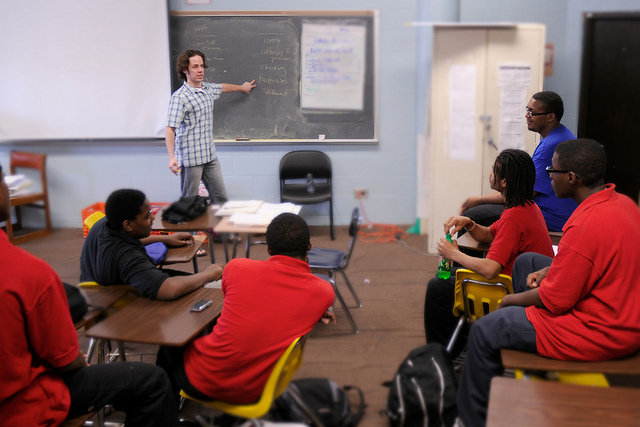
Since the initial presentation of the curriculum at the Nancy B. Jefferson Alternative School in April of 2010, CAASE’s Education Outreach Associate, Caleb Probst, has taught Empowering Young Men in six different high schools in Chicago to more than 500 young men between the ages of 14-18. According to a research study into the behaviors of men who purchase sex, the average age at which men begin purchasing sex is 21[2]. Therefore dispelling the myths that surround the sex industry and reaching these young men with the truth about prostitution while they are still in high school is imperative. The data collected from the curriculum’s pre- and post-evaluations indicates that these young men are getting the message.
At the start of the first lesson, each young man is given a pre-evaluation that asks him his opinion regarding 23 statements about prostitution, and to then place his answer on a 4-point Likert scale – strongly disagree, disagree, agree, strongly agree. When the final session ends, the young men are asked to respond to the same 23 statements in a post-evaluation. The following trends noticed in one recent class have been fairly consistent throughout all of the classes; the growing popularity of the curriculum, however, has prevented Mr. Probst from having the time to tabulate the data from the more than 500 forms. At the start of the presentation, 50% of the young men agreed or strongly agreed that most people enter prostitution by choice, but by the end 78% said they disagreed or strongly disagreed with this statement. The young men were also asked if most people enter prostitution as children, and on the pre-evaluation 88% disagreed or strongly disagreed. On the post-evaluation, however, all but one indicated that he agreed or strongly agreed with this statement. One student even wrote, “I was shocked to learn that the average [age they start] is 12.” In response to the final statement of the post-evaluation, “arresting prostitutes is a good long-term solution,” all but one indicated that he disagreed or strongly disagreed with this idea.
Creating practical solutions to the problem of prostitution, however, is one of the major goals Empowering Young Men sets out for its students. During the final session, Mr. Probst divides the students into groups and assigns each group the task of brainstorming actions that young men can do personally, within their families, and within their communities to reduce the prevalence of sexual exploitation. At the end of the brainstorming session, the groups reconvene and Mr. Probst writes each idea on the board. Some of the most common ideas have included using only respectful language when talking about women, holding their peers accountable to do the same, writing articles for the school news paper to raise awareness, and behaving as a “big brother” to younger kids in the neighborhood. Some classes have even decided to write letters to their representatives and to organize a school-wide food and clothing drives to support a women’s shelter in the community.
At the conclusion of the brainstorming session, Mr. Probst hands a small wallet-sized note card to each student and tells him to pick one of the actions the group generated that he wants to do. Each student then, without consulting his classmates, completes the following statement, “I will…” Mr. Probst encourages each student to keep the card somewhere that it can serve as a reminder for what he has learned and then opens up the floor to allow each young man to share something he will take away from the class. One young man said, “I was surprised to learn that there is still…slavery in the United States.” Another said, “I don’t think being called a ‘pimp’ or ‘boss’ is a good thing anymore.” In agreement with him, another added “I’m not going to make jokes about being a pimp anymore.” Perhaps most encouraging of all, there have been countless young men who have said they intend to treat all of the women in their lives with more respect.
At the start of the 2010-2011 school year, CAASE set a goal to present the Empowering Young Men To End Sexual Exploitation in 10 schools and to 400 students. As of mid-February, Mr. Probst has presented in six schools, and three of them have scheduled regular programs through the end of the school year. Currently there are three additional schools that are determined to find time in their busy spring semesters to bring Empowering Young Men to at least their oldest students. Thus CAASE is on track to reach its 10-school goal. Because Mr. Probst has already presented to roughly 540 students, CAASE has met the 400-student goal. The new goal is for 750 young men in Chicago to have participated in this program by June, 2011. With your continued support of this project, more and more young men will become aware of the huge problem that prostitution presents to their community. As their awareness becomes action, violence and harm will slowly begin to decrease for the prostituted women and girls in Chicago. Thank you again for supporting Empowering Young Men To End Sexual Exploitation, because with support like yours we will be able to continue building a generation of male allies who stand together against sexual harm.
[1] Claudine O’Leary and Olivia Howard, “The Prostitution of Women and Girls in Metropolitan Chicago: A Preliminary Prevalence Report,” (report, Center for Impact Research, Chicago 2001).
[2] Rachel Durchslag and Samir Goswami, “Deconstructing The Demand for Prostitution: Preliminary Insights From Interviews With Chicago Men Who Purchase Sex,” (report, Chicago Alliance Against Sexual Exploitation, Chicago 2008).
By Caleb Probst | Education Outreach Associate
Project reports on GlobalGiving are posted directly to globalgiving.org by Project Leaders as they are completed, generally every 3-4 months. To protect the integrity of these documents, GlobalGiving does not alter them; therefore you may find some language or formatting issues.
If you donate to this project or have donated to this project, you can receive an email when this project posts a report. You can also subscribe for reports without donating.