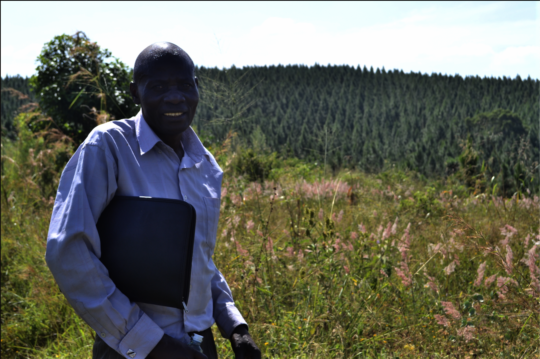
By Kaganga John | Director
The Forest Village in Kikandwa Community in Mityana district created by practicing Analog Forestry and other Nature based practices.
Introduction:
“While the COVID-19 pandemic continues to ravage the world, climate change, a crisis that can cause even greater destruction looms. All crises teach us lessons, but the pandemic has gone further: it has reminded us about the power of nature. A recent poll conducted globally for the IMF found that 43 percent of people surveyed reported being more worried about climate change now than they were before the pandemic, with only 7 percent saying they are less worried. The heightened public awareness about the dangers of unmitigated climate change make this an important moment for policymakers to enact bold reforms. But many challenges lie ahead.”
Kikandwa Environmental Association (KEA) found in Mityana district created a secure food and nutrition security community with reduced poverty, improved soil fertility, turned bare red community into a multi- green belt making it a “Forest Village” which was launched at Kasejjere village on World Earth Day which took place on 22nd April 2021.The forest village has contributed to the reduction of green house gas (GHGs), increased on the percentage of natural and agricultural biodiversity and the restoration of ecosystems hence mitigating and adapting to climate change, the effort has helped people who used to steal food from their neighbors to sell food. This has been possible through community led development mobilization, awareness creation and training people to practiceAnalog forestry which is used as a tool to increase on the biodiversity and ecological resilience of a landscape by making use of natural ecological succession and forest functions consequently strengthening rural livelihoods and mimicking natural forests and connecting landscape ecology.
Other practices similar to analog forestry which have added value to the creation of a forest village are: agro forestry, ecological and family farming, and planting fruit and indigenous trees whereby community members have planted more than 200,000 trees, Saving and Conserving Natural Forest patches, a nature based approach known as Half+Half 1000 Acre Community Forest, practice live fencing, garden and compound tree planting, tree garden saving, farm tree managed regeneration and woodlots establishment collectively standing on many different plots which might be the first of its kind made by the local community at the grass root level in Mityana District, other initiatives which have also contributed to the success creation of the Forest Village include Bee-Keeping and Community Road water Rain Water Harvesting.
Analog Forestry (AF) and its contribution to a Forest Village in Kikandwa community.
Analog Forestry (AF) has helped to restore landscapes, increased on the biodiversity enhancing diversified anthropogenic forests which has provided alternatives to farmers for their households with variety of agricultural products that allow them to complement their diets, thus enhancing resiliency in face of adverse environmental or commercial conditions.AF have made diverse ecosystems thrive and to coexist in better conditions with their surroundings, improving people’s health and nutrition.
This system of ecosystem based restoration have attracted Nature´s functions to come back into a better balance and to enhance environmental services (e.g. pollination, water and carbon cycles, carbon storage, ecological niches, soil health etc.),hence improving resilience and adaption to severe weather events. Women, youth, indigenous groups, and minorities have been involved to take active participation and ownership of AF endeavors, reducing inequality and contributing to a better collective and private management of the natural resources turning their community into a Forest Village.
Challenges:
Although KEA has registered a good number of achievements, COVID-19 pandemic disease has highly spared in Kikandwa community, the disease has disrupted directly and indirectly the lives and livelihoods in the community shaking our environment, social and economic status like deepening hunger, poverty and environmental degradation undoing the achievements KEA has registered through analog forestry and other practices which urgently need local and global joint concerted effort financially and technically. COVID-19 has started to undo what Kikandwa community have achieved already, due to lack of basic needs like soap, medical fee, school fees, food, soap, sugar, salt and many other items by some of the community members, some members have again started cutting trees for charcoal burning and fire wood for sale and for local brew distillation reducing on tree cover and biodiversity in our Forest Village. Some community members have gone back to distill local brew in the wetlands which they had abandoned since analog forestry practice was introduced in the community making it degraded and polluted due to the effluents discharged into it, some have started using convention chemicals in their gardens which end up polluting water, air and the soil, and many are experiencing pre and post food loss and waste due to lack of value chain facilities due to poverty created by COVID-19 pandemic and lockdown.
Future plan and Way forward Our main goal is to look for financial and technical support to facilitate and maintain what we have achieved up to date, improve on and keep intact our Forest village and to green patches which are not yet covered with green by adding more than 200,000 indigenous and frizer and natural pesticide, replicate what we are doing in the whole district and otheruit trees seedlings through analog forestry practices, continue practicing soil and water management and conservation, start to produce bio-fertil districts in Uganda, get development partners and researchers and policy makers to help us improve on what we are doing for its sustainability. Establish an Eco-Agro-tourism Centre and Recreation gardens in the Forest Village for income generation and the development of community Ago-tourism industry in Uganda and to foster the achievement of Vision 2040 and the UN Sustainable development Goal and Agenda 2030.
Way forward :
Our idea is to prove to farmers that adopting regenerative farming practices will solve their most pressing issue: soil’s water retention capacity. Increasing soil’s water retention capacity is vital for farmers because it improves soil and crops’ resilience to droughts and floods, reducing the need for irrigation and stabilizing food production.
As farmers ourselves, we know that farmers need to see it to believe it. We have continued to empower farmers and reduce barriers to adopt climate-positive farming practices. We run large-scale experiments on our Showcase Farm to provide tangible evidence that regenerative agriculture has direct benefits for farmers, including storing more sweet water in the soil;
2) share knowledge and practical tools for farmers to start or continue their transition to regenerative agriculture; and build network by connecting key stakeholders, encouraging peer-to-peer learning and cross collaboration.
By showing farmers that changing their farming practices will improve water retention in soils, we can hugely accelerate the adoption of agricultural practices that are better for people and the planet – combatting climate change, preserving biodiversity, improving farmers’ livelihoods and supporting vibrant local communities.
Established collaborations and partnerships
We have established partnerships with a broad range of public and private organizations this has been achieved through trust of GlobalGiving through its training, Lobby and advocacy programs, participation in calendar events, as we call to continue to joint efforts with other partners and volunteers.
Project reports on GlobalGiving are posted directly to globalgiving.org by Project Leaders as they are completed, generally every 3-4 months. To protect the integrity of these documents, GlobalGiving does not alter them; therefore you may find some language or formatting issues.
If you donate to this project or have donated to this project, you can receive an email when this project posts a report. You can also subscribe for reports without donating.