By Astere Muyango | IBJ Burundi Fellow and Country Manager
Contributing to Provide IBJ Lawyers to Every Minor Accused of Crimes in Three Judicial Provinces in Burundi
During the last third quarter, International Bridges to Justice has continued its mission of supporting the Burundian judicial system in the implementation of the new provisions related to juveniles within the new Code of Criminal Procedure, which render the legal assistance for children accused of crimes compulsory.
The new Code of Criminal Procedure also provides that the hearings in proceedings involving minors are held in camera sessions, even if in principle hearings are public. However, although the legal framework recently introduced seems to align with the content of the Convention on the Rights of the Child signed by Burundi in 1990, the daily practice seems to remain far from the written law.
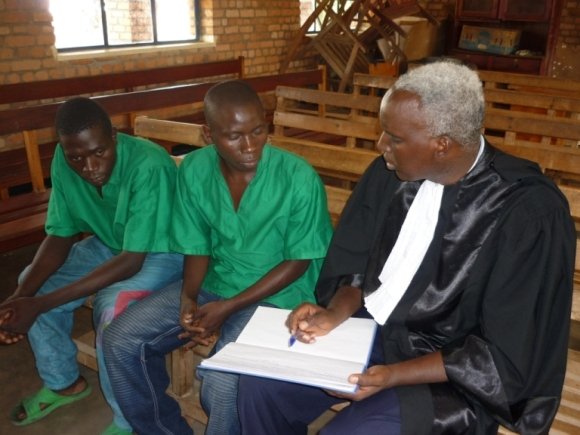
In order to contribute to reducing the gap between practice and the written law, International Bridges to Justice continues to provide legal assistance to children accused of crimes in Burundi. From July to September 2013, IBJ lawyers and volunteers have traveled to three provinces—namely, the judicial province of Mwaro in the central region of the country, Cibitoke which is located in north east, and Bujumbura, a rural province which is located in east. During this period, 18 children received free legal assistance.
Among the beneficiaries of IBJ’s assistance is Bukuru, 17 year-old, who dropped out of school after the death of his parents due to the 12-year civil war that occurred in Burundi and was forced to work to earn a living. However, the sudden loss of his parents led the boy to alcohol abuse and gambling. His fate went wrong in October 2012, when he was arrested for willfully administered beatings and death threats to a woman.
The prosecution in the case requested a sentence of 10 years against the defendant.
The IBJ fellow Astère Muyango defended the child and in his introduction, he explained to the court that the crime for which his client was being prosecuted should be well-qualified because the investigation records, as well as the confessions of the defendant, highlighted his client’s state of drunkenness on the date in question.
In addition, Astère Muyango recalled the basic legal principle that in circumstances, wherein there are contradictory statements leading to doubt, the benefit belongs to the accused. This principle proved useful in this case because the statements of the judicial police officer who was a witness in this case and the victim's statements reinforced a well-founded about the existence of a threat of attack against the person in this case.
At the end of the hearing, the case was taken under deliberation, and a month later , the child was released after after 11 months of pretrial detention. Bukuru was happy to resume his normal life, but he worried about the possibility of finding enough money to continue to run his small business.
What is perhaps most noteworthy is that after trainings organized by IBJ aimed toward the education of various criminal justice system actors, the demands to hold hearings related to juveniles in camera sessions continue to get increasingly positive responses. International Bridges to Justice will continue its efforts until it sees every minor accused of a crime provided with a competent lawyer.
Project reports on GlobalGiving are posted directly to globalgiving.org by Project Leaders as they are completed, generally every 3-4 months. To protect the integrity of these documents, GlobalGiving does not alter them; therefore you may find some language or formatting issues.
If you donate to this project or have donated to this project, you can receive an email when this project posts a report. You can also subscribe for reports without donating.










