By Catarina Morais | Grants Management Associate
Dear Friend,
You subscribed to email updates from Invest in Women! Invest in a Bright Future! by Solar Sister, a project on GlobalGiving. Here's the unedited update from the field:
Solar Sister Turning on the Lights!
By Catarina Morais, Grants Management Associate
PLEASE ADD PHOTO HERE (see word doc attached)
“I can stand anywhere. I am not looking behind. The work boosts my expectations. There is nothing I cannot do.” - Mujeedat, Solar Sister Entrepreneur
The Challenge: The nexus of energy poverty and gender equality. Access to energy is fundamental to achieving several United Nations Sustainable Development Goals (SDGs) such as, alleviating poverty, advancing health, improving education and water and sanitation, and addressing climate change (UN Energy, 2020). However, 940 million people (13% of the world) do not have access to electricity and 3 billion (40% of the world) do not have access to clean fuels for cooking (Our World in Data, 2020). Energy poverty is particularly acute in sub-Saharan Africa, where energy access rates are the lowest in the world. In Africa, roughly 600 million people lack electricity and 890 million cook with traditional fuels (IEA, 2018).
Women bear the brunt of the effects of energy poverty. Women, on average, spend over three times more time on unpaid care and domestic work than men (UN 2019); access to clean and affordable energy can potentially reduce drudgery, and thus also contribute to the empowerment of women (SDG5). As gender equality is considered both an outcome and driver of development, the links between energy access and gender equality run in parallel (Clancy et al., 2003).
What Needs to be done? Solutions exist in the form of decentralized solar energy (among other renewables) for electricity, and clean cooking options range from improved biomass to LPG. Yet, to reach the level of implementation needed for universal energy access, adoption of these solutions requires practical, local, scalable distribution of these solutions to the people who most need them - the women who are managing the daily energy needs of their households. We cannot achieve the SDG goal of universal energy access if we leave out half the population. The solution to energy poverty must include deliberate focus on underserved markets and intentional inclusion of overlooked resources of women’s enterprise.
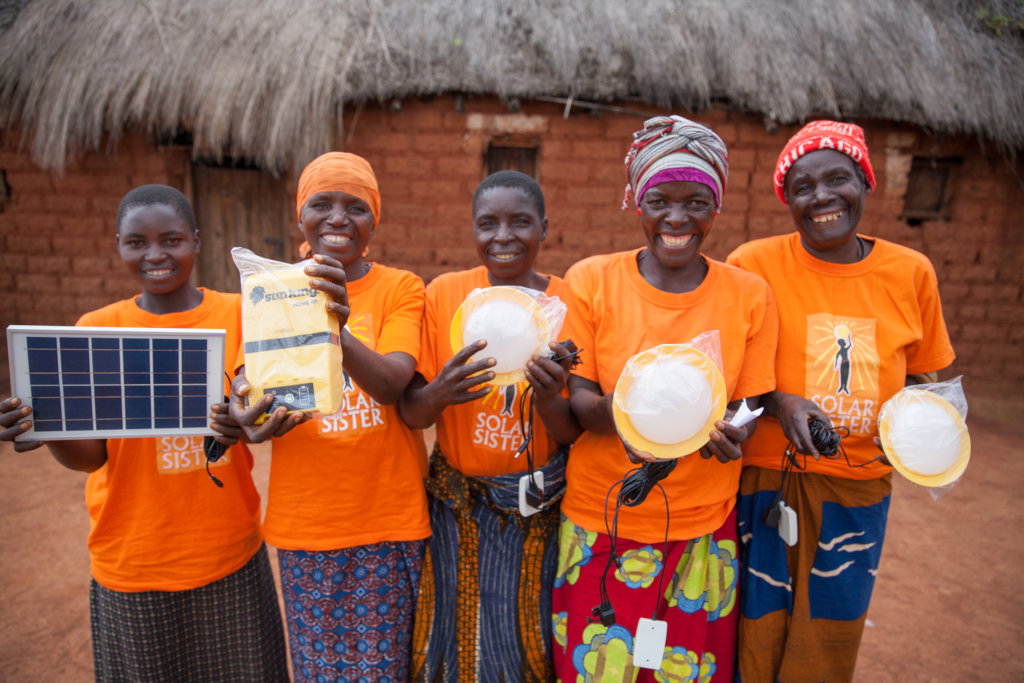
Solar Sister brings energy access and economic opportunity to women entrepreneurs in sub-Saharan African “last mile” communities. Currently working in Nigeria, Tanzania, and Kenya, Solar Sister delivers sustainable energy solutions through women’s enterprise in these communities by providing ongoing training, mentoring, and support for a thriving network of Solar Sister Entrepreneurs (SSEs).
To date, Solar Sister has recruited more than 8,000 SSEs whose businesses bring life-transforming renewable energy solutions to their local communities. Together, these businesses have provided more than 3.4 million people with clean energy and created a ripple effect of positive impacts on the health, education, environment, and economic livelihood of the women entrepreneurs, their families, and their communities. By tapping into women’s enterprise, Solar Sister has designed a market-based solution that is replicable, scalable, and sustainable. Solar Sister provides a grassroots solution that empowers African women as distributors, educators, and end-users. Under the dynamic leadership of local women leaders, our local staff recruit, train, and mentor entrepreneurs at monthly Sisterhood Group Meetings, where SSEs receive training, share about common challenges and success stories, and form supportive relationships with one another. SSEs then educate communities, use personal testimonies as a key behaviour change tool to encourage neighbours and friends to use renewable energy, and provide high-quality solar, clean cooking solutions and after-sales service to their community’s doorstep.
Digital Literacy Training
Solar Sister is working with the Cisco Foundation to build women entrepreneurs’ technological capacity and 21st century business acumen by providing mobile toolkits to Solar Sister Entrepreneurs (SSEs), which in turn improves their ability to collect better customer data. Through innovative virtual and online training tools and newly developed wealth generation pathways, SSEs can develop their entrepreneurial skills, expand their business, and save and reinvest their earned income. This 2nd year program has the following specific activities and goals:
This training provides SSEs with digital toolkits as a means to enhance Solar Sister’s virtual training capabilities and improve SSEs’ digital literacy, which will help amplify their future business success and growth. Comprehensive toolkits will include the digital software and hardware needed to successfully manage their businesses in an increasingly digital world. In conjunction with the toolkits, we will implement a digital literacy training package based on SSE feedback regarding challenges faced and gaps in the skills and tools necessary for business growth and digitization. Training content will include digital marketing techniques, digital financial literacy, financial technology, data collection, and other critical business skills to help SSEs expand their markets and increase sales in the coming year. The toolkits and accompanying training will be particularly useful in helping SSEs collect and analyze better customer data and information. After piloting the toolkits with an initial group of 100 SSEs, we will evaluate outcomes to ensure that the investment is replicable, scalable, and sustainable to roll out to all SSEs.
We Solve Training
WE SOLVE stands for ‘Women Entrepreneurship through the Solar Value chain for Economic development in Tanzania.’ The project aims to tackle the twin problem of (1) the lack of employment and economic opportunities for women in rural Tanzania, and (2) the lack of access to clean energy, especially for rural Tanzanians. It involves a unique global partnership between Solar Sister, BRAC - the world’s largest development organization, and Signify (formerly known as Philips Lighting) - a global company offering high quality, reliable and safe lighting products. In recent years, the partners have been committed to piloting and testing an innovative business and technology model committed to creating clean, safe jobs for women in rural areas whilst simultaneously improving the lives of numerous people living in dimly lit conditions in rural Tanzania. For those who cannot afford to purchase the solar products directly, BRAC Microfinance is offering a new solar loan product, enabling clients to buy solar products, therefore improving their living conditions and earning potential. BRAC already has a robust microfinance network in place to assist with the mission to light up rural Tanzania. The project is funded by the Ministry of Foreign Affairs in Denmark (Danida) and the Signify Foundation, with additional investment from Signify.
Business Booster Program
Through our Business Booster Program, our goal is to provide high growth potential entrepreneurs with the support they need to boost them to new levels of success, generating increased income for the entrepreneur, increased visibility of their business and equipping them to move from micro-entrepreneur to small and medium businesses. The Business Booster program will be delivered as a one-year graduation program, with three cohorts over three years. The program is delivered in a Pilot, Roll-out, and Scale up phase to allow for rapid testing of what works/what doesn’t work during, making improvements in each successive year. Identifying entrepreneurs is the first step to enabling them to succeed. Solar Sister is in a unique position to identify potential high growth entrepreneurs by observing the pool of SSEs’ initial entrepreneurial uptake and selecting those that demonstrate superior ability, agency and ambition. We will identify SSEs using “Booster Selection Criteria '' that will be based on SSE’s term with Solar Sister (at least 1 year), sales volumes, consistency of business and growth of business. Entrepreneurs who meet the qualification criteria will be given an opportunity to apply to the Business Booster program, ensuring they are self-selecting to invest the effort into the program necessary for success.
Solar Sister will custom design a combination of short-term residential training and ongoing training, online/mobile enabled learning support. We have established a framework of training that fosters knowledge transfer and capacity building. Solar Sister’s training program will address the specific needs of these entrepreneurs, including increased product and technology knowledge, problem solving, business planning, financial planning, entrepreneurial growth, access to finance, developing new markets, and additional agency and leadership skills. We are also building relationships between entrepreneurs to allow them to build connections within the cohort. Burgeoning entrepreneurs can gain invaluable assistance from peers to help them continue developing their acumen to successfully build their businesses.
Links:
Links:
Reach out to us at Catarina@solarsister.org
Links:
Project reports on GlobalGiving are posted directly to globalgiving.org by Project Leaders as they are completed, generally every 3-4 months. To protect the integrity of these documents, GlobalGiving does not alter them; therefore you may find some language or formatting issues.
If you donate to this project or have donated to this project, you can receive an email when this project posts a report. You can also subscribe for reports without donating.