By Laurel Lyle | Director-Fundraising Programs
Alzheimer’s research for many years has been dominated by a focus on Abeta “plaques,” a focus that largely has overlooked the other infamous hallmark of the disease—the tau-based neurofibrillary “tangles.” The research world recently has broadened its scope to include significant research into tau.
Cure Alzheimer’s Fund is actively supporting this diversification by funding two tau-based projects: University of Pennsylvania researcher Virginia Lee’s effort to identify antibodies that could neutralize aberrant tau, and a separate attempt by Brigham & Women’s Hospital’s Dennis Selkoe and Dominic Walsh to better understand how Abeta triggers the formation of aberrant tau. Together, these and other tau studies promise to help create a more unified understanding of the entire molecular disease process characterizing Alzheimer’s.
Why tau matters
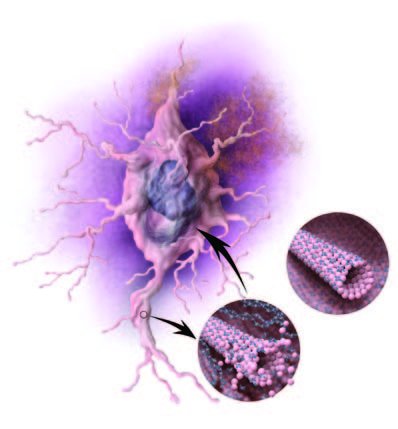
The tau protein is an essential component of microtubules that run through each neuron like train tracks, transporting nutrition and other vital materials. In Alzheimer’s disease, ordinary tau becomes hyperphosphorylated—corrupted by several extra molecules of phosphorus. When that happens, it loses its structural integrity and folds into a twisted mess known as a neurofibrillary tangle. Subsequently, the transport function gets interrupted, and eventually the whole nerve cell gets clogged with unwelcome junk and dies. Studies indicate the amount of hyperphosphorylated tau in a patient’s brain correlates closely to the severity of the disease.
Two essential questions still vex researchers: 1. How does Abeta, which appears first in the Alzheimer’s process and exists outside neurons, trigger the initial misfolding of tau proteins? 2. Once the first batch of aberrant tau is created, how does it spread from neuron to neuron? Answering these two questions may bring us much closer to treatment possibilities.
A tau pioneer
Dr. Virginia M.-Y. Lee, director of the Center for Neurodegenerative Disease Research at the University of Pennsylvania, is one of the true pioneers of tau research. Her seminal 1991 Science article established tau’s essential role in tangles, and she has gone on to receive many prestigious awards for her work. Dr. Lee’s current project for Cure Alzheimer’s Fund builds on her previous research establishing how the destructive form of tau can spread by “seeding,” or converting, ordinary and harmless forms of tau into the dangerous form. In a process that has been described as “prion-like,” the benign, unfolded, water-soluble form of tau becomes insoluble and filament-like when coming into contact with other destructive tau. A chain reaction process apparently helps spread this destructive form of tau from neuron to neuron. Dr. Lee’s work is taking us deeper and deeper inside this malignant conversion process, and she hopes to identify opportunities to stop it. “These interesting tau transmission studies will pave the way for passive immunotherapy for the treatment of Alzheimer’s disease,” she says.
From amyloid to tau
On the other end of the research spectrum is Dominic Walsh, a relative newcomer to tau. Walsh, whose Dublin-based work on Abeta is well-known to the research community, recently returned to Brigham and Women’s Hospital and Harvard Medical School, and teamed up with Brigham/Harvard’s Dennis Selkoe (a well-established contributor to both amyloid and tau research). “We need to know much more about how Abeta and tau interact,” explains Walsh, who sees this project as a “natural extension” of
his Abeta research. “There’s good evidence that Abeta triggers pathologic changes in tau, but it’s not understood how this happens.”
Working downstream
The dominant research focus on Abeta is, in part, attributable to its early role in the disease. “I’ve always worked on Abeta, because I want to understand the disease as close to its start as possible,” says Walsh. “Ideally, you want to treat Alzheimer’s with anti-amyloid therapy to stop it before it begins. This is why it is essential to develop biomarkers that will identify individuals at the earliest stages of the disease.”
“But,” Walsh continues, “if we ever hope to help individuals who already have Alzheimer’s, then we need to target processes downstream of Abeta—this is what is driving our new interest in tau.”
Prior work suggests the noxious effects of Abeta depend on tau, and that Abeta can induce formation of neurofibrillary tangles. But since tau is not ordinarily secreted from the neuron, understanding how misfolded tau spreads from one neuron to another is of vital importance. Current Walsh-Selkoe experiments are exploring the possibility that Abeta triggers an unnatural release of tau. “We hope that by learning more about this secretion process, it may be possible to develop agents that can prevent the secretion and spread of tau pathology,” Walsh says.
Takes time
The Walsh-Selkoe work will use different types of cells in different stages, including neurons produced from the skin of human Alzheimer’s patients. This is slow work, cautions Walsh. It takes time to generate and validate appropriate models. The whole process will take five years and will require long-term NIH funding. Cure Alzheimer’s Fund’s crucial role here is, as in so many other areas, to kick-start the idea and give it room to gain its own momentum. “Cure Alzheimer’s is the springboard,” says Walsh, “and we are very grateful.”
Project reports on GlobalGiving are posted directly to globalgiving.org by Project Leaders as they are completed, generally every 3-4 months. To protect the integrity of these documents, GlobalGiving does not alter them; therefore you may find some language or formatting issues.
If you donate to this project or have donated to this project, you can receive an email when this project posts a report. You can also subscribe for reports without donating.



Support this important cause by creating a personalized fundraising page.
Start a Fundraiser