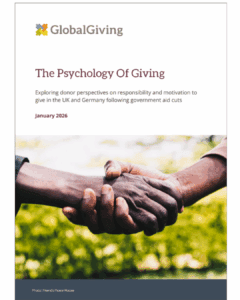
Recent survey results show the importance of reinforcing shared norms and visible collective action following government aid cuts in the UK and Germany.
A new behavioural study conducted by GlobalGiving UK in partnership with Professor Hanna Zagefka at Royal Holloway, University of London surveyed just over 2,000 participants across the UK and Germany to explore how awareness of government aid cuts reshapes social norms around generosity.
The research found that mentioning government aid cuts within survey questions was associated with lower perceived importance of aid and reduced motivation to give. Rather than galvanising generosity, reminders of cuts appeared to normalise them.
When participants were shown information about aid reductions, they were less likely to describe aid as essential, less likely to frame it as a moral duty and less emotionally engaged overall. The signal many appeared to take from government cuts was not “the need is greater, I must act”, but something closer to “this is no longer a priority”.
For a sector navigating shrinking public budgets, this has significant implications. Fundraising strategies that spotlight cuts in an attempt to generate urgency may unintentionally dampen support.
While individual motivation to donate appeared to weaken, expectations of who should step in shifted sharply towards other institutional actors.
Around 80% of UK respondents and 90% of German respondents said philanthropists should help fill funding gaps created by government aid cuts. In the UK, 64% also expected companies to step in, rising to 78% in Germany.
Governments were still seen as primarily responsible overall. After governments, respondents looked to high-capacity private actors rather than individual donors. In both countries, individual donors were consistently viewed as the least responsible for filling the gap.
The study also found that donation behaviour was strongly associated with social norms and emotional engagement. Participants who were emotionally affected by the withdrawal of funding, and those who viewed aid as morally essential, were significantly more likely to donate and to pledge higher amounts.
Generosity proved most resilient when it felt collective. When giving was framed as part of a shared effort, people were more engaged. When it felt isolated or detached from a broader response, motivation weakened.
Explore the full results of the survey.
Find exactly what you're looking for in our Learn Library by searching for specific words or phrases related to the content you need.