By Hannah Barry | Head of Fundraising
UNSEENS WORK
Since Unseen was founded 15 years ago, we have taken over 40,000 calls on the Modern Slavery & Exploitation Helpline, supported more than 600 people through outreach, and provided intensive support to over 280 people in our safehouses. 2023 was our busiest year so far. We received the highest number of contacts to the Helpline – over 11,700. We also supported 270 survivors in our frontline support services and continued making a difference in our policy and research work.
Modern slavery cannot be tackled in isolation. Collaboration is a key value for Unseen as we cannot achieve our vision without working with partners across local and central government, businesses and public services.
THE HELPLINE
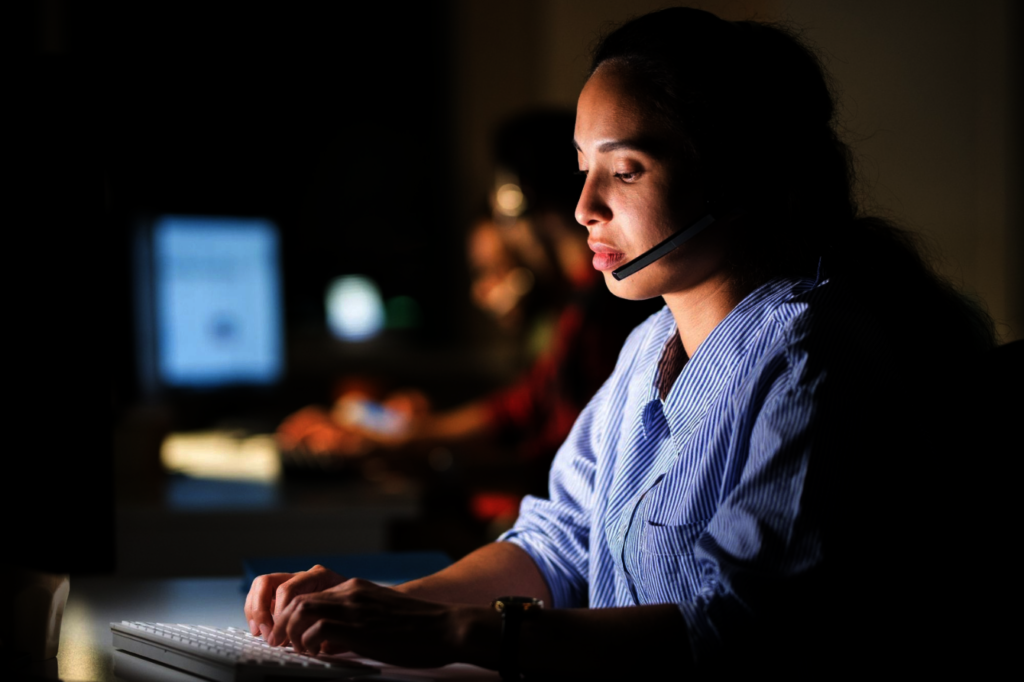
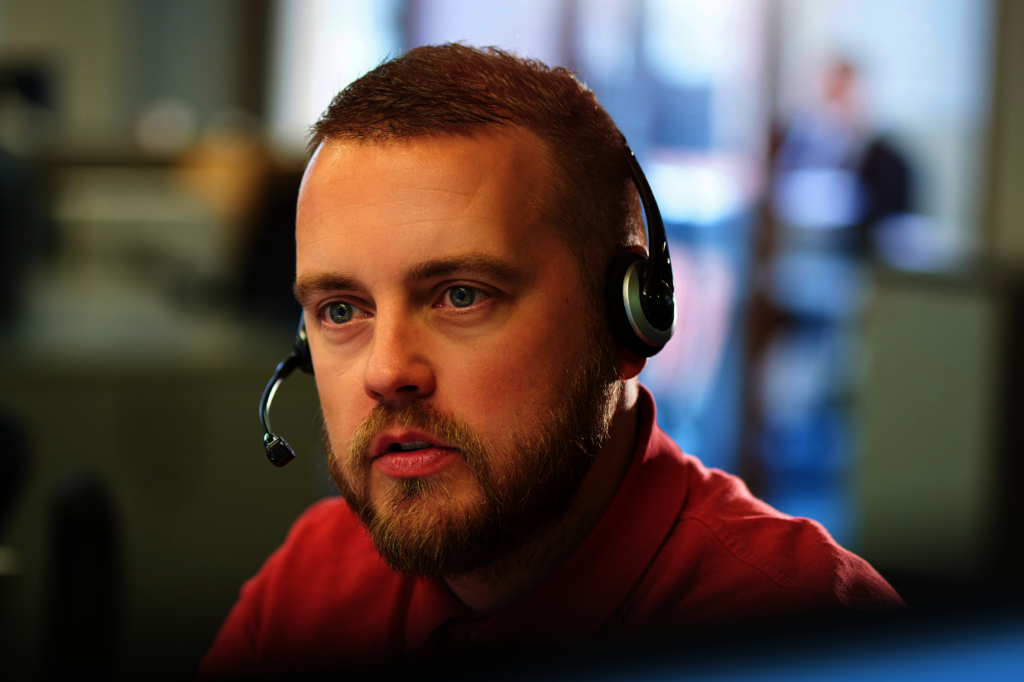
The Helpline was launched in 2016 because survivors in our service explained that they would have welcomed a place to call that was independent of the police and government. Our specialist Helpline Advisors offer impartial, confidential support and guidance to anyone experiencing or concerned about modern slavery. We take calls from potential victims, members of the public, professionals, and businesses. The Helpline is free to call, available in 250 languages and our online app and webform mean that there are a range of ways that people can raise concerns about modern slavery. More detail on the Helpline is included on the last page.
Businesses play a key part in tackling modern slavery and ensuring that individuals are not placed into situations of forced labour. The Helpline continues to work collaboratively with a range of businesses, offering support and guidance on modern slavery risks, the signs to spot and how to report.
THE IMPACT OF SUPPORT
Support out of exploitation
The Modern Slavery & Exploitation Helpline is a place that survivors can call at any stage of their exploitation. Through the Helpline, we support potential victims of modern slavery to get out of their situation of exploitation by offering support and guidance on their options and strategies for them to escape. Our Helpline Advisors carry out safety planning with callers to ensure they can leave as safely as possible. This ensures that people trapped in modern slavery have the information they need to leave as soon as it is safe to do so.
Keeping communities safer
Modern slavery often involves multiple crimes such as assault, sexual abuse, drugs and knife crime. As Helpline data grows, so does our understanding of modern slavery and how it manifests in diverse settings. We make referrals to local police which support local authorities and police forces to reduce crime and keep communities safe. By making referrals to the police, we enhance their understanding of modern slavery. Without the Helpline their ability to respond to what is a pervasive and endemic issue is significantly compromised.
Helpline data provides an early warning system
The Helpline is a valuable source of advice and support for professionals who encounter people held in potential situations of modern slavery. We share up-to-date information about trends in modern slavery during training sessions with professionals in sectors such as the police, NHS, and Local Authority Housing teams. We focus on the shifting trends and patterns by using data from the Helpline and ongoing evaluation of our work. For example, we have responded quickly to the rise in cases in the care sector, sharing our insights and launching a dedicated care sector hub to discuss the issues and potential remedies.
TRENDS IN 2023
Each year, we publish a comprehensive overview of contacts to the Helpline in our Annual Assessment report. We host an online launch event which is an opportunity to share the emerging trends identified and highlight the increase in contacts to the Helpline, with other professionals. This year, we also heard from keynote speakers Eleanor Lyons, Independent Anti-Slavery Commissioner and Shaun Sawyer QPM Hon. LLB, Retired Chief Constable of Devon and Cornwall Police, previously, National Police Chiefs' Council Lead on Modern Slavery and Human Trafficking. This year was a successful event with over 200 people in attendance. See the recording here and view the full report here.
Some key trends for 2023 include a 30% increase in potential victims of modern slavery indicated in the care sector, labour abuse cases are up by 11% and over 10% of all Helpline cases involved minors. Also, following the first such case reported to the Helpline in 2022, four potential organ harvesting cases were reported in 2023. In addition, forced surrogacy (where a potential victim is forced or coerced into carrying a pregnancy for someone else) was reported for the first time, with a total of three potential victims indicated.
Situations of forced scamming have doubled, from 11 potential victims in two cases in 2022 to 41 potential victims across four cases in 2023. In line with historic trends, labour exploitation has remained the most prevalent exploitation type, followed by sexual exploitation, criminal exploitation, and domestic servitude.
INCREASED DEMAND
The Modern Slavery & Exploitation Helpline saw a record number of calls in 2023, marking an increase for the fourth consecutive year. Calls to the Helpline and contacts via the service’s web form and app rose by more than 19%.
Across the UK, we received 11,700 contacts to the Helpline, compared with 9,779 in 2022. There were 2,185 cases reported nationally and 5,876 potential victims indicated in 2023. Despite a significant increase in contacts to the Helpline, the number of cases and potential victims indicated has fallen slightly. This could be an indication that more vulnerable people are contacting the Helpline with issues akin to modern slavery rather than those assessed to meet the threshold. It could also be a reflection of the changing policy landscape surrounding the UK Government’s focus on reducing immigration, meaning more vulnerable people, who have no regularised status, contact the Helpline for support.
Director of Unseen, Justine Carter says: “We remain concerned that the ever-increasing hostile environment in the UK towards migrants and foreign workers means that fewer people feel able to raise concerns and seek the help and support that they desperately need.”
IN THE NEWS
The findings released in the 2023 Annual Assessment received widespread media attention with over 300 local and national print and broadcast mentions, including Sky News, ITV, The Independent, the Mail Online, and multiple radio stations — a testament to the increasing awareness and concern around modern slavery and exploitation in the UK.
You can read the report on Sky news here: https://news.sky.com/story/modern-slavery-helpline-receives-record-number-of-calls-in-2023-report-finds-13117306
CASE STUDY: DANH’S STORY
The Helpline received a call from Danh, who had been forced to cultivate cannabis. He was being abused and his life had been threatened by his exploiters. Danh found the Helpline’s number on a Vietnamese website and within an hour, Helpline staff liaised with law enforcement to get him taken to our men’s safehouse.
He is now receiving the expert support that he needs to recover. Danh has accessed a GP and counselling services, loves cooking meals for the entire house to enjoy and is seeking legal advice so he can eventually return home to be with his family after five years apart.
LOOKING AHEAD
Despite an overall decrease in the number of modern slavery cases raised through the Helpline, care sector cases and the number of potential victims related to those situations are still on the rise. This has been a significant sector of concern throughout 2023 and the issues are continuing. The Helpline will be monitoring cases related to the care sector closely to establish whether there are any new or emerging trends arising from those reported.
The Helpline will continue to establish referral routes with local frontline services across the UK, to ensure that all victims of modern slavery can access support. Partnership working is essential to effectively tackle the insidious issue of modern slavery. As well as adding to the list of support organisations the Helpline can refer to, work is ongoing to expand the pool from which information is received into the Helpline.
Looking to the future, as per our 5-year strategy to 2027, we will prioritise quality support for survivors and the analysis of key data to inform prevention. By 2027, we aim to have responded to 40,000 Helpline contacts and we are on track to meet this target. By that time, we will have more evidence about the need and be better informed to make ambitious strategic goals from 2027 onwards, to continue our work towards our vision of a world without slavery.
We will ensure that our work and the work of partners, particularly those with decision-making capabilities, will continue to be directly informed by those who have experienced slavery. Recognising that modern slavery knows no boundaries, the Helpline website now has a list of anti-slavery helplines and support available around the world. We will identify international opportunities to connect individuals and organisations to the help, guidance, and advice they need to tackle modern slavery effectively.
OUR SINCEREST THANKS
Thank you, once again, for supporting the Modern Slavery & Exploitation Helpline. Your contribution ensures that callers receive immediate support and guidance when they need it most.
By Hannah Barry | Head of Fundraising
Project reports on GlobalGiving are posted directly to globalgiving.org by Project Leaders as they are completed, generally every 3-4 months. To protect the integrity of these documents, GlobalGiving does not alter them; therefore you may find some language or formatting issues.
If you donate to this project or have donated to this project, you can receive an email when this project posts a report. You can also subscribe for reports without donating.
Support this important cause by creating a personalized fundraising page.
Start a Fundraiser