By Nataly Cartagena Gomez | General Director, Corporacion Everyday Homeless
Report 4 - Prevention of Street Homelessness: April - May - June 2026
Dear sponsors,
This was the strongest quarter our psychosocial strategy has had — and also the one where the funding math caught up with us. Both things are true, and you should hear both.
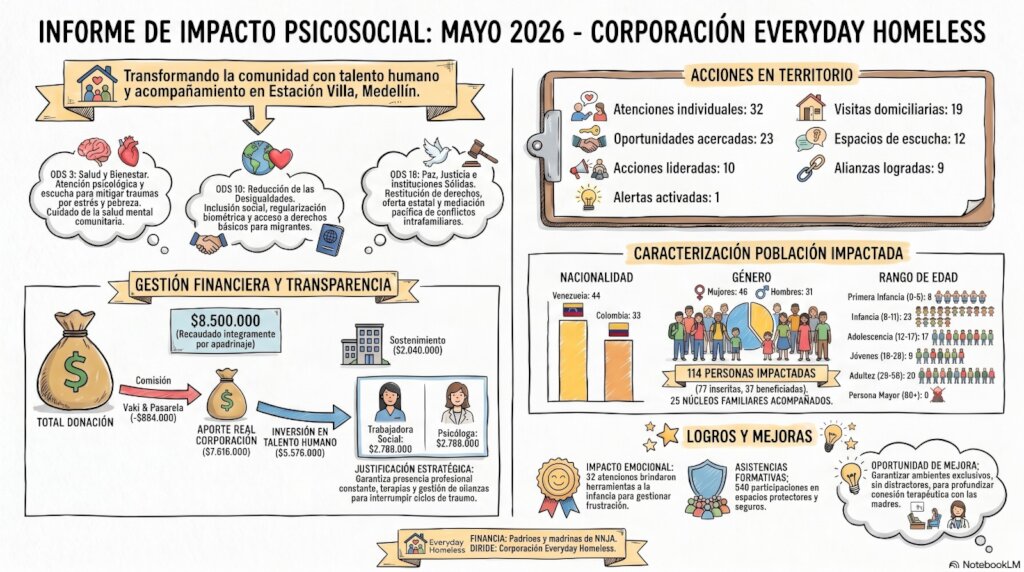
Between April and June, our psychologist and social worker carried out 323 documented interventions in Estación Villa, the neighborhood in Comuna 10 of Medellín where the families you sponsor rent rooms by the day. Here is what that means in practice.
WHAT YOUR SPONSORSHIP MADE POSSIBLE
Our characterized population held steady between 72 and 79 people across the quarter — roughly 60% of them Venezuelan migrant families, roughly 60% women and girls. In June, we estimate 190 additional people benefited indirectly through extended households.
THE MOMENT THAT DEFINED THE QUARTER
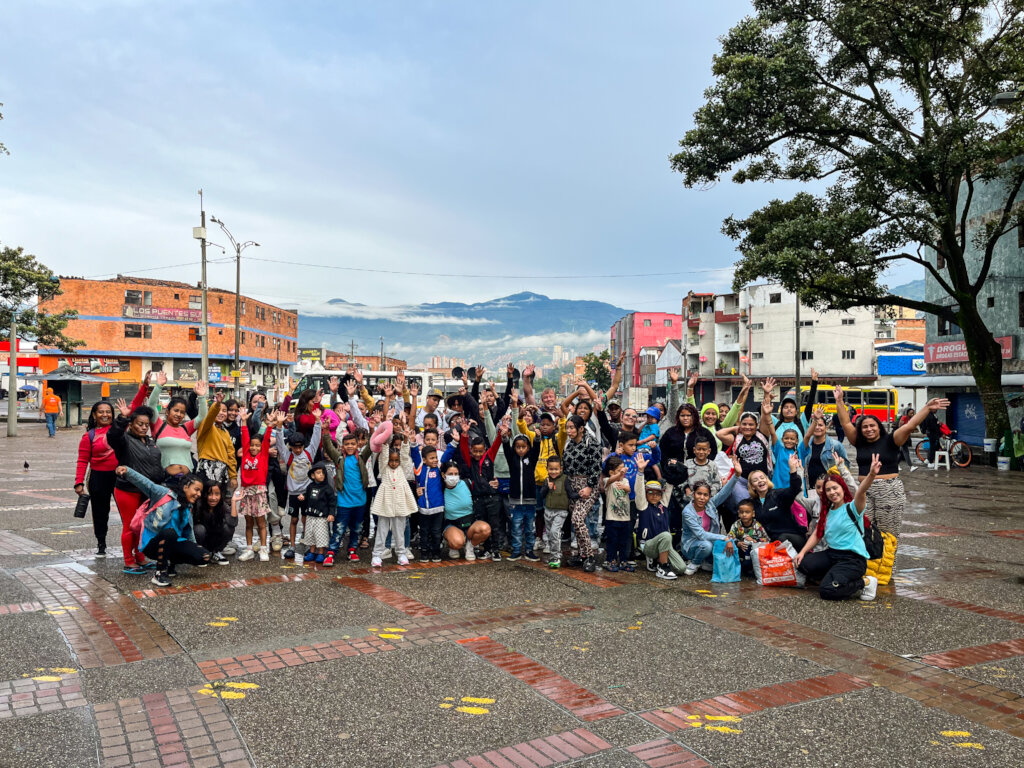
In May we did something we had never attempted at this scale: a Cultural and Assistance Takeover of the neighborhood. Instead of asking families to navigate a bureaucracy that has failed them for years, we brought the bureaucracy to them.
Over 105 people had rights restored in a single push — health system enrollments, biometric regularization for migrant families, school registrations, and enrollment in sports programs. All of it done in their own neighborhood, without the humiliation of being sent from office to office and retelling their trauma to a new stranger at each window. Thirty-seven additional community members who are not formally in our program were served that day too.
That is what it looks like when a state that does not arrive is replaced, temporarily, by two women with clipboards and a network of partners.
CHILDREN LEARNING TO HANDLE THEIR OWN ANGER
Our group sessions — the children call them "Parchémonos a Hablar," roughly "let's hang out and talk" — accumulated 97 attendances in June alone, part of 822 total attendances across all the spaces our psychologist accompanied that month.
In those sessions children built physical tools for self-regulation: calm bottles, stress objects, things they can hold when the anger arrives. The point is not the craft. The point is that a child in a hostile environment learns to redirect impulsivity instead of being redirected by it — because impulsivity in this neighborhood has consequences that follow you for life.
In the individual sessions, our psychologist documented real behavioral progress: children recognizing emotions in their own bodies, correctly identifying which adults in their life are safe, and showing more empathy toward siblings and parents. We also enrolled 11 mothers in a parenting skills course with our partner Bien Humano, and secured neuropsychology and speech therapy appointments for children who needed them.
In April our team detected and routed 10 alerts — vaping and drug use among adolescents, sexualized behavior, household conflict, children dropping out of our spaces. Every one of those is an early warning that, ignored, ends in street life.
WHAT WAS HARD
Young children cannot hold attention. Our clearest, most repeated finding this quarter: in early childhood sessions, children struggle to sustain focus and follow instructions. We are redesigning activities to run under four minutes at high intensity, with more regulated active breaks.
Anger and frustration dominate. Across children's activities, the prevailing emotions are anger and frustration. We are adapting our play-therapy activities specifically to channel those, rather than treating them as misbehavior.
We cannot get a private room. During listening spaces with mothers, phones ring and neighbors interrupt. Real therapeutic honesty requires a space these families do not have. Securing one is now a priority.
Parenting guidelines don't survive the work week. Mothers absorb what our psychologist teaches, then chronic work stress erodes it at home. Consistency requires more presence, not more instruction.
Teenagers arrive flat. Some youth workshops start with low energy and dispersion. We are rotating locations between the Emocionateca and the library to renew engagement.
WHERE YOUR MONEY WENT
April: 5,200,000 COP invested in professional fees — 2,600,000 COP for the psychologist, 2,600,000 COP for the social worker.
May: 8,500,000 COP raised from 34 active sponsors. Of that, 510,000 COP went to the Vaki platform commission and 374,000 COP to payment processing fees, leaving 7,616,000 COP received by the Corporation. We invested 5,576,000 COP in the psychosocial team and 2,040,000 COP in organizational sustainability.
June: 2,788,000 COP, of which 100% went to the psychologist's fees.
(Approximate USD equivalents at roughly 3,800 COP to the dollar: about USD 1,370 in April, USD 2,235 raised in May, and USD 735 in June.)
We want to be direct with you about that June figure. It reflects a smaller month, and it shows in the reporting: June's activity was carried by our psychologist. Sustaining both professionals consistently — the psychologist and the social worker together — is what makes this strategy work, because clinical care without home follow-up is care that ends at the door.
WHAT WE HAVE LEARNED
Working inside the tenements is not one method among several. It is the only method that works. You cannot understand or interrupt cycles of exclusion and violence from an office.
A mother's mental health determines a child's future. When we reduce hostility inside the household, every other intervention — school, therapy, job training — suddenly becomes viable. When we don't, none of them stick.
Legal invisibility is the shortest road to the street. A person who has not processed their trauma and does not legally exist for the system of guarantees is pushed directly into absolute marginality. Papers and psychological care are not two separate programs. They are the same defense.
Thank you for sustaining this. Every sponsorship is one month of a professional actually walking into these buildings.
With gratitude,
Nataly Cartagena Gómez General Director Corporación Everyday Homeless Medellín, Colombia
Links:
Project reports on GlobalGiving are posted directly to globalgiving.org by Project Leaders as they are completed, generally every 3-4 months. To protect the integrity of these documents, GlobalGiving does not alter them; therefore you may find some language or formatting issues.
If you donate to this project or have donated to this project, you can receive an email when this project posts a report. You can also subscribe for reports without donating.



Support this important cause by creating a personalized fundraising page.
Start a Fundraiser