By Nataly Cartagena Gomez | General Director Corporacion Everyday Homeless
Dear sponsors,
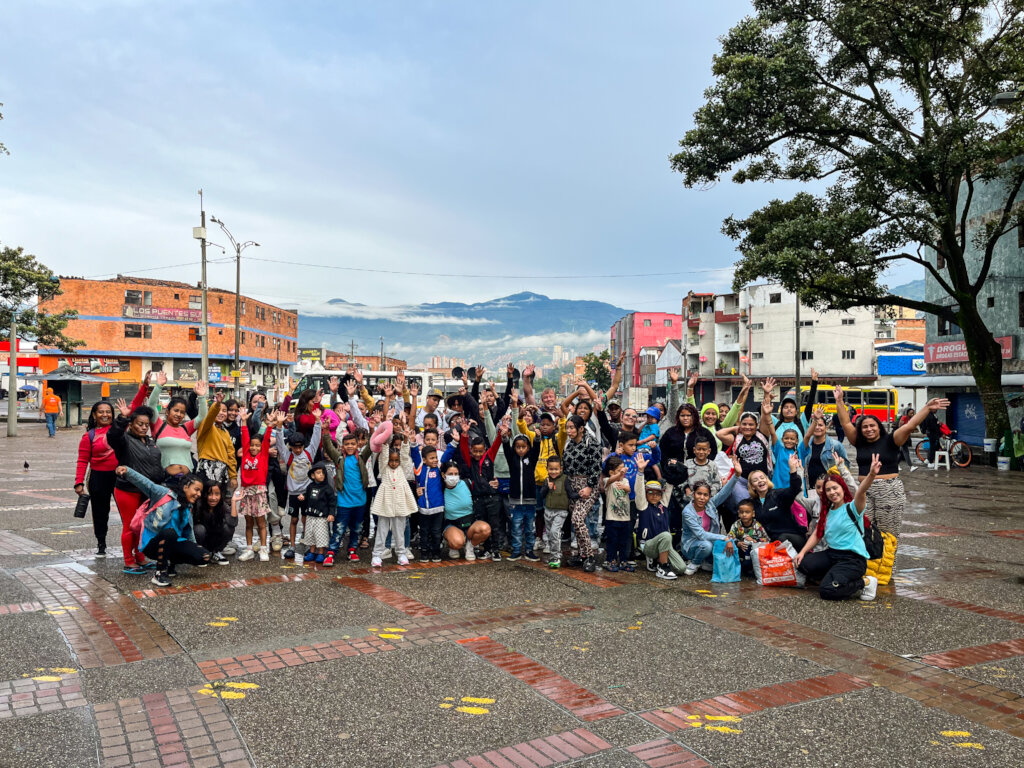
Every month, two professionals — a psychologist and a social worker — walk into the tenement houses of Estación Villa, a neighborhood in Comuna 10 of Medellín that most of the city knows only by a nickname it does not deserve. They knock on doors in buildings where families rent a single room by the day, where five or six people sleep in a space smaller than an American bedroom, and where a job lost on Tuesday can mean a family on the street by Friday.
Your sponsorship pays for those two professionals. This report tells you exactly what they did with your money between January and March, and what it changed.
WHAT YOUR SPONSORSHIP MADE POSSIBLE
Across January - February and March, our psychosocial team carried out 224 documented interventions with families in Estación Villa:
In January and February we reached 65 unique beneficiaries: 43 children and adolescents, and 22 mothers or guardians. By March our characterized population had grown to 74 people — 46 minors and 28 adult caregivers — with an estimated 290 more people benefiting indirectly through neighbors and extended family whose daily life improves when household conflict goes down.
THREE THINGS THAT ACTUALLY CHANGED
A child got her legal identity back. Our team accompanied a migrant family in person to Migración Colombia to obtain a safe-conduct document. Without papers, a child in Colombia does not legally exist: no school enrollment, no health coverage, no protection. That document is the difference between a future and a dead end.
Children who were out of school went back. Working with Corporación Educativa Combos and the CDI Reina Ester, we secured places and personally accompanied mothers through enrollment for several children who had dropped out. We also opened referral routes for mental health care through the San Buenaventura Integral Mental Health Center and neuropsychology appointments.
We were the first line of defense in three emergencies. Our team detected and activated three institutional protection routes in February, including a report to ICBF (Colombia's child protection authority) for suspected abuse, and mediation in a case involving serious threats of violence. These are situations the state does not detect on its own, because the state does not go into these rooms. We do.
In our individual sessions, our psychologist works on sustained attention, working memory and instruction-following with the youngest children, using play-based tools the children know by name — "The Color Detective," "Simon Says." With adolescents the work shifts to recognizing automatic thoughts and making assertive decisions. In the home visits and listening spaces, the work is with the mothers: validating exhaustion, lowering stress, and building peaceful household agreements that hold after we leave.
WHAT WAS HARD
We report our difficulties as openly as our successes, because you deserve an accurate picture.
Mothers cancel. The women we work with have long, rotating, informal work shifts. Home visits get rescheduled constantly, and school enrollment paperwork gets delayed. We are redesigning the schedule around their reality instead of ours, and building stricter shared-responsibility agreements with caregivers.
Privacy is nearly impossible. Conducting a confidential conversation inside a single overcrowded rented room limits how deep we can go with a mother. We are testing neutral spaces outside the tenement for the hardest conversations.
Some children can't hold focus. In individual stimulation work, several children get distracted quickly. Our psychologist is diversifying and shortening the play-based methods to extend attention span rather than fighting it.
And we have to be honest about money: sponsorship income did not fully cover professional fees this quarter. In February we received 4,800,000 COP from 24 active sponsors and invested 5,000,000 COP — a 200,000 COP gap the Corporation absorbed. Every new sponsor closes that gap.
WHERE YOUR MONEY WENT
Our model is simple and we keep it transparent. Each sponsorship is 250,000 COP, of which 50,000 COP goes to taxes, leaving 200,000 COP net for the project.
January and February: 4,800,000 COP received (24 sponsors). Invested: 2,500,000 COP for the social worker's fees and 2,500,000 COP for the psychologist's fees. March: 4,600,000 COP received (23 sponsorships paid during the month).
(Approximate USD equivalents at roughly 3,800 COP to the dollar: about USD 1,265 in January - February and USD 1,210 in March.)
That money is not administrative overhead. It is the entire strategy. Two qualified professionals with the ethical, clinical and legal training to carry out 224 interventions, handle family crises in real time, and face what these territories actually look like. Without them, there is no rights restoration, no diagnosis, no follow-up, and no one standing between a child and the street.
OUR CONCLUSION AFTER THIS QUARTER
You cannot change a child by treating only the child. Intervening with a boy in our community house is useless if no one is teaching and supporting his mother at home. The combination — clinical work with the child, social work with the family, presence in the neighborhood — is the only thing that moves the needle.
We are also more convinced than ever that the interdisciplinary pairing matters. Alerts raised in the field by our social worker get addressed in depth in the psychologist's clinical space. Neither professional alone would produce these results.
Thank you for making this possible. If you would like to strengthen this work, one additional sponsor covers a full month of a child's access to this team.
With gratitude,
Nataly Cartagena Gómez General Director Corporación Everyday Homeless Medellín, Colombia
Project reports on GlobalGiving are posted directly to globalgiving.org by Project Leaders as they are completed, generally every 3-4 months. To protect the integrity of these documents, GlobalGiving does not alter them; therefore you may find some language or formatting issues.
If you donate to this project or have donated to this project, you can receive an email when this project posts a report. You can also subscribe for reports without donating.



Support this important cause by creating a personalized fundraising page.
Start a Fundraiser