By Manizha Naderi | Executive Director
Overall Objective – To improve prospects for women, girls and children by using the period they spend in the shelter (from a few weeks to 2 years) productively. This entails offering educational opportunities, life skills training, instruction on their human rights, vocational training and other services that provide physical, intellectual and mental stimulation and advancement.
Progress towards achieving the overall objective .
Overview of Case Figures:
From June 1, 2011 through November 30, 2011, the Kabul FGC and shelter registered 229 new cases, of which 165 were adult females, 63 were underage females, and 1 was an adult male.
WAW’s caseworkers solved 255 cases, of which 65 were solved through legal means in three courts. Sixty-nine cases are currently in follow up; 53 cases remain open.
Objective 1: Enhanced access for women/girls-at-risk to safe living quarters, protective services such as professional legal assistance and social inclusion (re-integration into family and/or society) when feasible.
Progress towards achieving our Objective
Objective 2: Life enhancement of shelter residents—adults and children—through special services such as literacy classes, life skills classes, vocational training, and kindergarten for young children.
Progress towards achieving Objective 2 .
Women for Afghan Women provides educational opportunities to shelter residents. The majority of our clients have never been to school and are illiterate. During the reporting period, 39% of the clients were illiterate; 12 % could write only their names.
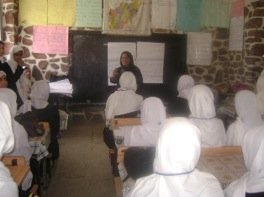
Life Skills Classes: Life skills classes focus on health and hygiene, family relationships, civic education, conflict resolution, and childcare. While living at the shelter, the women also participate in group therapy, role-playing, and therapeudic picture methods. These strategies give women knowledge and skills to assist their reintegration into family and community.
Objective 3: Strengthening the capacity of public, private and civil society bodies to exercise social protection for Afghan women/girls at risk by advocating for shelters before international donors, the GoA, local communities, schools/universities.
As a women’s NGO in a deeply patriarchal culture, we have had, and still have, many attitudinal barriers to overcome. From the outset, we have taken steps to change those attitudes.
WAW has worked to strengthen public, private, and civil society bodies through awareness- raising programs, media coverage, meetings with mullahs and perpetrators as part of the resolution process, and collaborative endeavors with other NGOs, ministries, and international donors.
These endeavors have taught us that awareness-raising accompanied by solutions works to inform and empower women to refuse further abuse. We discovered that both men and women are eager to learn about human rights and take action to protect them. We also concluded that advising women in a community about our services has a major impact on the number of women and girls who come to our facilities for help.
As a result we are committed to expanding our awareness-raising activities,. Reaching out to ordinary citizens and leaders helps establish respect for our work. We anticipate that many of them will become solid partners and will refer women to our facilities. Some may get involved in our counseling services. These projects provide much needed information on women’s rights and may even motivate communities to take steps toward protecting women’s rights by supporting our shelters in the face of government opposition.
We also endeavor to improve our already cooperative relations and partnerships with local police, ministries, law enforcement officials including local Attorney General’s staff, prosecutors, religious leaders, shura leaders and members, and other NGOs with related mandates and activities.
Objective 4: Support Afghanistan’s reporting to national and international bodies as to progress on related MDG targets and the situation of women/girls at risk.
Upon request, WAW’s database will provide the GoA, media, human rights organizations, schools, etc. documented and costed strategies for family/social reintegration for women and children. Data for all cases are compiled according to province, specific services, case numbers and types, client age, geographical distribution, issues, and outcomes, etc.
Challenges and suggested solutions
Although we have not completely solved this problem, we have we hired a male case worker who can accompany female caseworkers during some follow up visits.
Monitoring during reporting period.
The tools consist of 4 questionnaires that cover performance of caseworkers, lawyers, database operators and the facility itself.
caseworker’s treatment of client.
Coordination and cooperation with other organizations; is there any other organization that works in the same sector/areas you are implementing the project in?
What steps have you taken this quarter to consult community members (community shuras, elders, religious leaders etc.) for getting support for the project and how were their reactions?
Special issues to be tackled in the future and why are they important? It is important that we develop a strategy for dealing with media attacks. We are working on this problem with other equally vulnerable women’s rights NGOs. It is necessary to convey to the public what a shelter is, what it can contribute to a community, and why it is important.
Share a success story with evidence (photo, letter, etc) (e.g. a beneficiary sharing with you how the project has changed her life, or a community development council/committee presenting you appreciation letter, or how you were able to attract a community contribution in the implementation of the project, etc)
Nahida: 15 years old.
When Nadia was 12 years old, her father developed mental problems, and he and her mother began fighting. Finally, during one battle her father murdered her mother. He then sent Nadia and her sister to their uncle’s house. After a few days she learned that her father had taken her two brothers and run away.
Nahida and her sister lived with her uncle, who forced her into a marriage when she was 13 despite her strong objections. But she obeyed him when he told her that if she did not obey, she would have to leave his house. After the marriage her husband and mother-in-law beat her constantly. Unable to endure the oppression, she went to Family Court, which sent her to the WAW FGC.
Noria: 26 yrs old.
Noria is uneducated. Six years ago, with her agreement, her uncle engaged her to Ayatulah, whom she married three months later. Six months after her marriage, she found out that her husband was already married and had two children with his first wife. She did not take any action over this but continued her happy married life. She has two children, a son and a daughter. After four years, her husband married another woman with the agreement of both Noria and his first wife. He treated both wives equally, giving them the same financial support. But the third wife ruined her life. She didn’t let her husband talk to Noria or love her. Her husband made excuses, even attacked Nadia physically. Finally his violence drove to the police, who brought her to WAW. After a few counseling sessions, the client insisted that she would reconcile with her husband only if he gave her independence from his other wives. Her husband agreed, and his third wife regretted her behavior. They are now happy and grateful to WAW. The case is in follow-up.
Maryam: 17 years old
When Maryam was 7 years old, her father married her off. After a while, her in-laws and husband physically and mentally tortured her. Over time their violence increased. Her husband beat her, starved her, wouldn’t give her clothes to wear, and didn’t let her visit her relatives,


Project reports on GlobalGiving are posted directly to globalgiving.org by Project Leaders as they are completed, generally every 3-4 months. To protect the integrity of these documents, GlobalGiving does not alter them; therefore you may find some language or formatting issues.
If you donate to this project or have donated to this project, you can receive an email when this project posts a report. You can also subscribe for reports without donating.