By Joseph Cross | Fundraising and Communications Officer
RIDERS FOR HEALTH
Feedback report
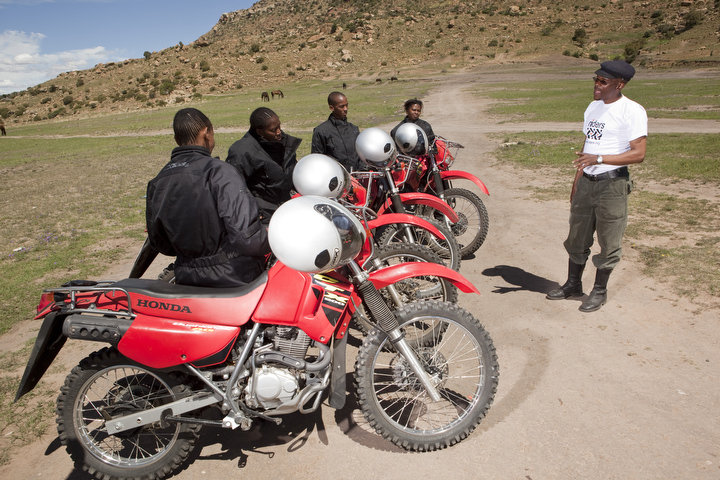
In June 2015, Riders for Health added a project to Global Giving in an attempt to fundraise for vital motorcycle training. Three months on and Riders are doing some fantastic work across Africa. Much of the work Riders do would not be possible if we failed to train motorcycle riders effectively and professionally. Your kind donations will mean we are able to continue delivering our life-saving service across our programmes, reaching 21.5 million people a year.Thank you.
Helping to control the spread of HIV/AIDS and tuberculosis (TB) in Malawi
The Ebola outbreak has provided a highly visible illustration that the health of remote villages in West Africa is directly connected to the rest of the world. The world has a responsibility to improve the health systems in all countries – and especially the provision of public health, and Riders is proud to be part of this process. Over the past 20 years we have shown that reliable motorcycles can provide a critical tool in preventing and halting the outbreak of disease. A prime example of this is the development of a unique motorcycle courier service to tackle one of the unseen challenges in health care delivery: the transportation of patient samples from health centres to laboratories, and the timely return of results.
It might sound obvious, but without this link patients cannot get the diagnosis they need to start life-saving treatment. But Riders’ Sample Transport service is turning this situation around. Building on the success of programmes in Lesotho, Zambia and Zimbabwe, in 2012 we expanded this system into seven districts of rural Malawi. Today we now operate across nine districts, with plans for moving into another two by the end of 2014, and a further three in the first half of 2015. Thanks to Riders’ Sample Transport service, for 4.2 million women, men and children in rural Malawi, actually getting that diagnosis is now much easier. And the results are impressive. In 2013, Riders’ team of motorcycle couriers transported a total of 38,779 samples and results, and this means that:
- Patient waiting times for CD4 count test (cell count treatment that identifies presence of HIV) results have reduced from an average of 10 days to three, with some health centres previously reporting delays of up to 60 days. This means that our Sample Transport service is now delivering test results in advance of the national seven day target.
- The turnaround time for a TB diagnosis has been cut in half (10 days to five). This means that if a patient tests positive they can start treatment immediately, which will prevent spread of infection.
- An infant in need of a diagnosis for HIV/AIDS will get one in 30 days, which is nine days faster than averages before Riders’ Sample Transport service began (NB: EID (Early Infant Diagnosis) samples are referred on to a higher level of testing laboratory, which is why turnaround times are longer).
And if people can trust in the health system to deliver, then they will be more likely to go for testing. It is perhaps no surprise then, that 83% of health centres reported a greater number of patients accepting the opportunity to get tested.
Managing 230 vehicles in The Gambia for years to come…
At Riders for Health our technicians are central to everything we do. It is their high level of ability and competency that enhances Riders for Health’s superb reputation across the countries we work in and across the world.
In order to maintain a workforce capable of providing this essential service, it is imperative to train technicians for the future and not just today. These technicians of the future will be the legacy of the outstanding workers who currently uphold the 230 vehicles in operation in The Gambia.
This is why in the latter stages of 2014, Riders launched a scheme that sought to provide training for seven female apprentices for three years, with the eventual aim that all seven women will gain a professional qualification as a ‘class one’ mechanic.
We hope that all the women will join Riders’ national fleet management at the end of their three years of training, serving rural communities and ensuring that health care continues to be mobilised effectively. This project is also aiding the national initiative to enhance the status of women in The Gambia. Through our work, Riders is able to provide women with an opportunity to succeed and embark on a career without the restriction of gender.
Riders moving in to Liberia
Liberia is home to over 4 million people, of which roughly 85% live below the international poverty line. Diseases such as tuberculosis and malaria are widespread, and since March 2014, around 4,800 people have died in Liberia from the Ebola virus.
The Ebola outbreak highlighted how a lack of reliable transport makes health systems weak, with devastating consequence. During the outbreak, there was a vital need of reliable transport for delivering blood samples for diagnosing patients, referring patients to health centres and the monitoring and education of communities. For 25 years, Riders for Health has shown that reliable transport is vital in strengthening public health systems.
After discussions with the Liberian Ministry of Health and Social Welfare, Riders for Health will now operate on a national scale in the country. We have already trained 329 and 70 motorcycle riders as well as training 10 technicians. The next step: Although the ST system has been a great success in Liberia, there are four counties where the implementation of this programme is yet to be completed. After completion the transport of samples will be entirely handed over to Riders by our partners Global Communities and the system will continue to be monitored.
Set up of the fleet management programme continues and will require us to train more drivers. We are also planning to conduct further motorcycle rider training in September once the motorcycles are refurbished. Finally, we are in the process of procuring protective clothing for our riders and further replacement parts for vehicle repair and maintenance.
Another reminder of the importance of our work
It is always encouraging when the effectiveness of Riders for Health’s work is recognised. A new study by Stanford University has found that health workers who have well managed and maintained motorcycles can travel further, visiting more people, more frequently, delivering lifesaving health care.
The two and a half year randomised control trial, which focused on the work of Riders in Zambia’s Southern province, found that health workers can travel an average of 10km further on every trip and can make longer trips more frequently. It is also discovered that the motorcycles managed by Riders were available 50% more often than ones run by the ministry of health.
This study really reaffirms the importance of the work of Riders and the recent outbreak of Ebola has explicitly demonstrated the devastating effect that a lack of transport can have on weak health systems in Africa.
Riders for Health co-founder and CEO, Andrea Coleman has said: ‘This is a landmark study. The Ebola outbreak has made the world aware of the disastrous effects on people when weak health systems in Africa have a lack of transport. This study shows that when health workers have access to properly managed motorcycles, they are able to deliver more health care, and visit communities that would otherwise be out of reach.’
On behalf of everyone at Riders for Health, I would like to take this opportunity to once again say ‘Thank you’ for your support of Riders for Health. Your generous support is vital to us, and greatly appreciated. We look forward to keeping you updated on our work as we continue into 2015.
Project reports on GlobalGiving are posted directly to globalgiving.org by Project Leaders as they are completed, generally every 3-4 months. To protect the integrity of these documents, GlobalGiving does not alter them; therefore you may find some language or formatting issues.
If you donate to this project or have donated to this project, you can receive an email when this project posts a report. You can also subscribe for reports without donating.