By Sierra James | Program Manager
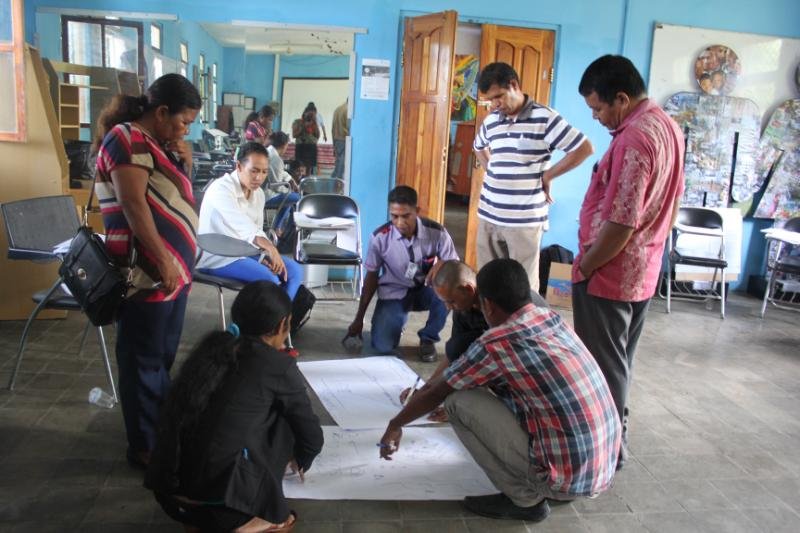
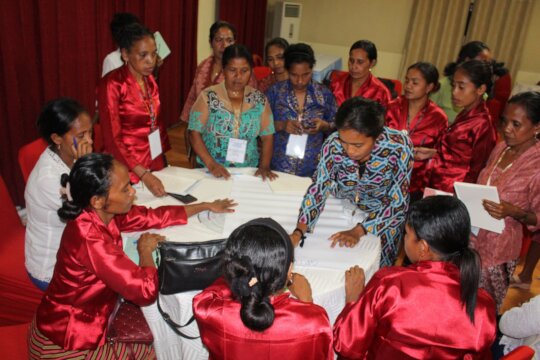
Over the last three years Ba Futuru’s Consolidating Peace and Democracy Initiative (CPDI) has provided 30 community trainings for 759 participants and intensive capacity development for a team of facilitators from the Government of Timor-Leste’s National Directorate for the Prevention of Community Conflict. Out of the 759 community training participants, 229 (58 women and 171 men) were traditional leaders involved in local village councils. Other participants included the police, community-based group representatives, youth, government mediators and other local government officials.
Both qualitative and quantitative project evaluation results showed a marked increase in understanding about the law against domestic violence and a reduction in the choice to use of violence as a way to resolve problems. All of the participants (424) that were interviewed in the follow-up evaluations reported that they felt that the training brought about a positive change in their lives and that they used the information from the training either in their homes, with their friends or in their community, and 98% reported the training information helped them to resolve conflict.
Encouragingly, the vast majority of the community leaders involved in the project reported to have improved their knowledge and skills in order that they are now able to better perform their role in their community. This will make an enormous difference to the lives of Timorese people and the peaceful development of this emerging nation.
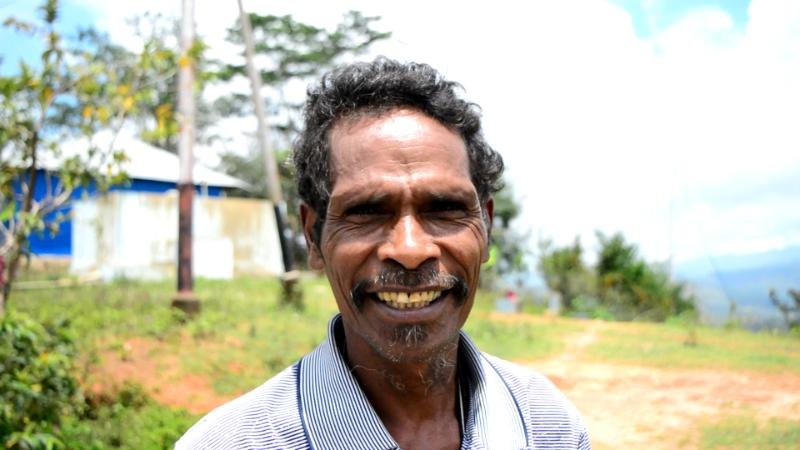
One 52-year-old male head of village and NDPCC mediatorstated: “I am very happy with this training because I have participated in a lot of trainings, but I have never receiveda training manual that could help me to work in my community.In addition, we sometimes just discussed conflict without theories in those trainings. However, in this training we were able toreceivea quality training manual and increase our capacities on how to solve problems by analyzing and identifying the root causes of them.This can help me to improve my mediation skills to find good solutionsfor the problems that my community has faced. I also learnedabout gender-based violence and domestic violence in this training. So now, if there is violence that happens in my community, I can quickly refer the case to the Vulnerable Police Unit. Finally, I will implement these lessons in my family and community, and I will share them with the villagecouncil.”
A female community leader also shared her experience on how the training had helped her to become more confident in performing her duty as the chief of the hamlet. She confessed that before attending the training, she was not confident enough to perform mediation and to resolve problems involving community-level conflict. However, after learning about, and practicing mediation, in the training, and learning the steps of conflict resolution, she became confident to facilitate the mediation processes. She also learnt that as a community leader, she is responsible for solving some cases, while others are left up to the courts, for instance, cases of domestic violence.
An external evaluation of the project has been completed by Joaquim Viana, a Timorese student from Victoria University in Australia. He researched the longitudinal results of a selection of the 2015/2016 CPDI trainings. In one section of his extensive report, he looked at the transformation of the sub-district of Zumalai from a community rife with conflict to a community with substantially less conflict. Mr. Viana interviewed two police officers who were assigned to work with two villages within the sub-district, Taz Hilin and Zulo, which were well-known as the most conflict afflicted places in Zumalai. The two police officers were recipients of the CPDI training in 2016.
From the interview, they confirmed that the training had led to reduced conflict in their community. In the Taz Hilin village case, it seems that the new approach and guidance used by the police officer was a key to conflict reduction in the village. The police officer said that after the training he organised a program in his community to share what he had learnt with other community members. He also identified and worked with a group of young people, who were always drunk and involved in the conflict, so that they could learn to avoid conflict and helped to motivate them to rebuild the image of their village as a less conflict area.
Although this successful project is coming to a close, Ba Futuru’s life transforming peace building work will continue as a component of our other much needed behavioral change projects. Please take this opportunity to continue supporting positive change in one of the poorest and violence afflicted countries in Asia.
Project reports on GlobalGiving are posted directly to globalgiving.org by Project Leaders as they are completed, generally every 3-4 months. To protect the integrity of these documents, GlobalGiving does not alter them; therefore you may find some language or formatting issues.
If you donate to this project or have donated to this project, you can receive an email when this project posts a report. You can also subscribe for reports without donating.